Focus on Impeachment Resolution on the 14th
Investigation Expected to Intensify in January Next Year
On the afternoon of the 12th, as the passage of a special prosecutor law to investigate President Yoon Seok-yeol's alleged charge of rebellion was announced at the National Assembly plenary session, the investigation into the 'December 3 Emergency Martial Law Incident' is expected to enter a new phase. If the special prosecutor is properly launched, it is also expected to resolve the controversy over overlapping investigations that have arisen due to the division between the prosecution and the joint investigation headquarters (police, Corruption Investigation Office for High-ranking Officials, and Ministry of National Defense investigation headquarters).
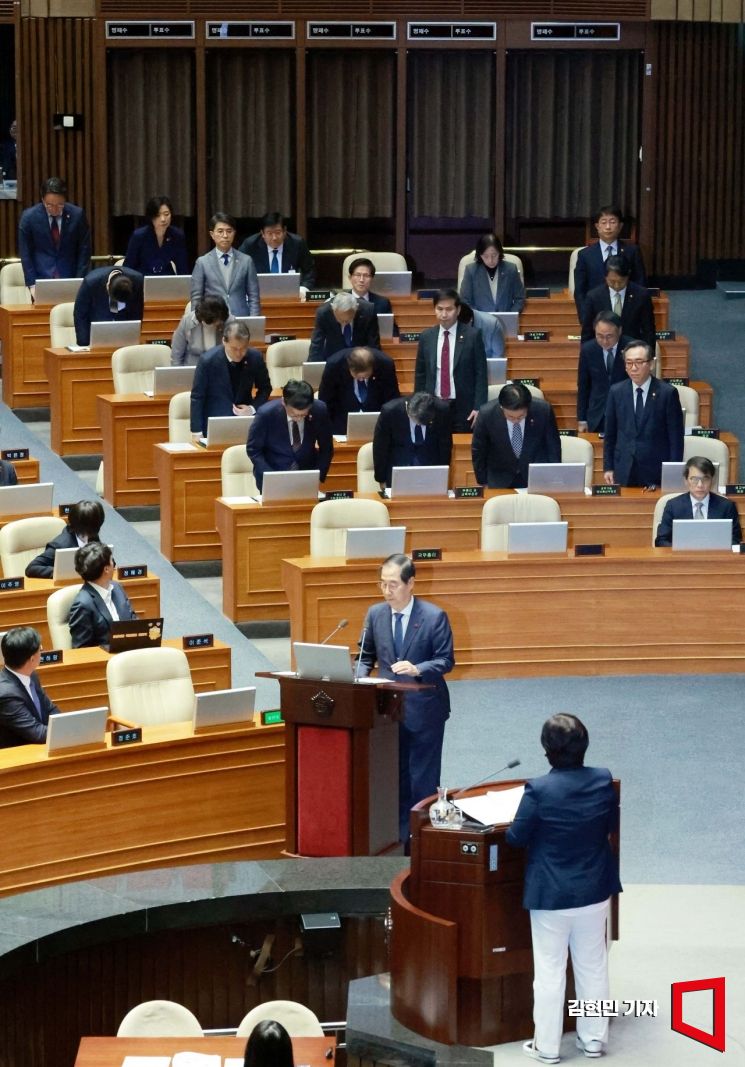 Prime Minister Han Duck-soo and other Cabinet members are bowing deeply to apologize to the public following the demand by Seo Young-kyo, a member of the Democratic Party of Korea, during the 'Emergency Questioning on President Yoon Seok-yeol's Unconstitutional Declaration of Martial Law and Treasonous Acts' held at the National Assembly plenary session on the 11th. Photo by Kim Hyun-min
At the plenary session of the National Assembly on that day, the bill titled “Special Prosecutor Appointment Act for the Investigation of Rebellion Acts through the Unconstitutional Declaration of Emergency Martial Law by the Yoon Seok-yeol Government” (Rebellion Special Prosecutor Act) was submitted. Earlier, on the 10th, a proposal to establish a permanent special prosecutor related to the martial law declaration passed the National Assembly plenary session, but for a more rapid investigation, launching a special prosecutor through an individual special prosecutor law is advantageous. The permanent special prosecutor uses already enacted laws, so the president cannot exercise a veto (reconsideration request right), but even if the president refuses to appoint the special prosecutor, there is no provision to enforce the appointment. Also, the number of special investigators that can be appointed is limited to within 30.
Conversely, the newly proposed Rebellion Special Prosecutor Act allows the appointment of up to 80 special investigators. In particular, if the president does not appoint the special prosecutor within a certain period, the law includes a provision that the eldest candidate among the recommended nominees is considered appointed, blocking any delay tactics. This differs from previously proposed special prosecutor laws in that the recommendation of special prosecutor candidates excludes ruling and opposition parties, instead requiring the Chief of the Court Administration, the President of the Korean Bar Association, and the President of the Korean Association of Law Professors to each recommend one candidate.
However, the individual special prosecutor law allows the president to exercise a veto, which is a variable factor. Therefore, the fate of the special prosecutor law will depend on whether the impeachment motion against President Yoon, expected on the 14th, is passed. If the impeachment motion passes the National Assembly, President Yoon’s duties will be immediately suspended, making it difficult to exercise a veto.
After the impeachment motion is passed, the appointment of the special prosecutor is likely to proceed smoothly. The Rebellion Special Prosecutor Act is designed so that the special prosecutor appointment is completed within a week at the latest. Once the law is enforced, the Speaker of the National Assembly must request the president to appoint the special prosecutor within one day, and the president must request candidate recommendations from three institutions/organizations in writing within two days. If the president fails to make the request within the deadline, the Speaker of the National Assembly will make the request, and the Chief of the Court Administration, the President of the Korean Bar Association, and the President of the Korean Association of Law Professors will recommend candidates within three days. The president must appoint one of the three candidates as the special prosecutor within two days.
The appointed special prosecutor can prepare for the investigation by securing necessary facilities and requesting the appointment of special assistant prosecutors for 20 days. Considering these points, the substantive special prosecutor investigation is expected to begin in earnest in January next year.
© The Asia Business Daily(www.asiae.co.kr). All rights reserved.
![Clutching a Stolen Dior Bag, Saying "I Hate Being Poor but Real"... The Grotesque Con of a "Human Knockoff" [Slate]](https://cwcontent.asiae.co.kr/asiaresize/183/2026021902243444107_1771435474.jpg)
















