Recent analysis shows that if the Asia-Pacific region, which is facing the triple challenges of climate change, environmental pollution, and biodiversity loss, adopts a circular economy, its gross domestic product (GDP) growth rate could increase by 5%, creating an economic value of $339.8 billion (approximately 485.37 trillion KRW).
On the 11th, Samil PwC stated in its "Asia-Pacific Circular Economy Trends Report" that "the adoption of a circular economy in the Asia-Pacific region will create 15,000 new jobs and reduce carbon dioxide emissions by about 7.2%."
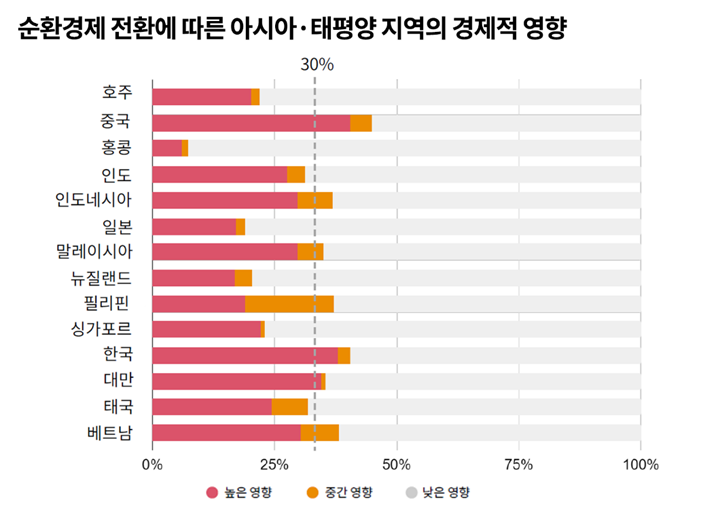
According to PwC's research, the sectors with the highest potential for circular economy adoption are Maintenance, Repair, and Operations (MRO), recycling, and construction, in that order. Conversely, the mining and quarrying, petrochemical and non-metallic minerals, and metal and equipment manufacturing sectors are expected to face challenges. While these sectors will gain environmental benefits such as reduced carbon emissions due to changes in production methods from adopting a circular economy, their GDP and employment levels are expected to decline.
The economic impact of transitioning to a circular economy varies depending on each country's economic structure and industry maturity. In particular, South Korea, like China and Taiwan, has developed manufacturing and recycling industries and is expected to undergo significant changes with the circular economy, with over 30% of its GDP projected to be affected by its adoption. The report emphasized that "countries with significant circular economy impacts need to transform their existing business models to provide circular products and services" and that "it is important to establish circular economy strategies tailored to each country's characteristics and circumstances."
The report presented five circular business models considering industry suitability, potential impact, and the ability to introduce and implement new business models. These include 'Circular Supply,' which uses renewable materials to reduce resource consumption and minimize waste; 'Resource Recovery,' which collects and reuses waste; 'Product Life Extension,' which designs sustainable products; 'Sharing Economy Model,' where multiple users share products or services; and 'Product as a Service,' where customers pay for usage without owning the product.
The report outlined activities and goals according to the level of circular economy adoption in stages. In the initial stage, it introduced five approaches focusing on business model analysis and review from compliance and cost-efficiency perspectives, and establishing feasible strategies and plans. In the maturity stage, it advised continuous monitoring of newly introduced regulations to understand the competitive advantages of a company's circular economy model in the market and to focus on creating new value, including circular economy initiatives, when formulating business strategies.
Steven Kang, Sustainability Platform Leader at Samil PwC, said, "Adopting a circular economy is not a choice but a necessity, and it is a time when consensus and efforts from the government, companies, and all members of society are required to create new value through circular economy adoption." He added, "If countries and companies in the Asia-Pacific region focus on building a sustainable economy and industry, they will become leaders driving new changes." Detailed information on the report is available on the Samil PwC website.
© The Asia Business Daily(www.asiae.co.kr). All rights reserved.

















