Reduction of Top Inheritance Tax Rate and Separate Taxation on Dividend Income
Government-Led Economic Policy Bills Rejected in National Assembly
Semiconductor and Power Grid Special Laws Not Even Submitted
National Assembly Faces Difficulty Processing Bills Amid Impeachment Crisis
"Discussions Must Continue... Closely Monitoring National Assembly Situation"
As major economic policy bills promoted by the government, such as the reduction of inheritance tax rates and separate taxation on dividend income, were rejected at the National Assembly plenary session led by the opposition party on the 10th, companies expressed their regret but stated that they will continue to closely monitor the situation in the National Assembly going forward.
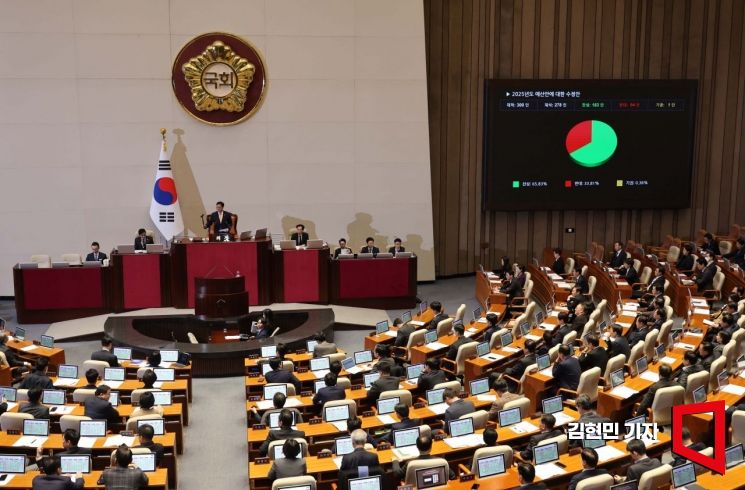 A revision to the 2025 budget was approved at the plenary session held at the National Assembly on the 10th. Photo by Kim Hyun-min
According to the business community and political circles on the 11th, the National Assembly held a plenary session the previous day and processed the next year's budget along with 35 subsidiary budget bills. During this process, the amendment to the Inheritance and Gift Tax Act, which aimed to lower the top inheritance tax rate that reaches as high as 60%, and the amendment to the Income Tax Act, which would have imposed separate taxation at a lower rate on increased dividend income when investing in value-up companies actively returning profits to shareholders, were rejected.
Regarding this, a company official said, "It is very regrettable that the reduction of inheritance tax, one of the causes for our companies being undervalued amid all-out efforts to overcome the 'Korea Discount,' has been scrapped," adding, "I believe the discussions must continue." Another official stated, "Not only this plenary session but also various procedures such as bill reviews are stalled, so it is necessary to continuously monitor the progress going forward."
With the ruling and opposition parties showing a confrontational stance over the vote on the presidential impeachment motion and the possibility of early resignation, causing political turmoil, it seems difficult for the National Assembly to process important bills for the time being. Accordingly, there is an analysis that it is also hard to predict when the 'Semiconductor Special Act' and the 'Power Grid Expansion Special Act,' which companies have persistently demanded, will be processed. These bills have not even passed the bill subcommittee and were not submitted to the plenary session. Although the National Assembly is showing signs of keeping its doors open and closely identifying companies' demands, specific procedures such as bill reviews are not progressing, making the passage of these bills unlikely.
In the semiconductor industry, there is a particular demand to the government and the National Assembly to exclude semiconductor research and development (R&D) personnel from the 52-hour workweek regulation, thereby creating conditions to research and develop new technologies for extended hours, and to promptly establish a power grid capable of supplying high-capacity electricity alongside the creation of the Yongin Semiconductor Cluster. A semiconductor company official expressed, "Everyone is disappointed about the situation where the law is stalled with no clear timeline for passage," adding, "The semiconductor industry’s competitive landscape changes continuously within weeks or months, so we cannot remain adrift like this." Another official said, "There may not be an immediate problem, but the exemption from the 52-hour workweek for R&D and the power grid construction issue could become a greater crisis as market competition intensifies in the future."
© The Asia Business Daily(www.asiae.co.kr). All rights reserved.
![Clutching a Stolen Dior Bag, Saying "I Hate Being Poor but Real"... The Grotesque Con of a "Human Knockoff" [Slate]](https://cwcontent.asiae.co.kr/asiaresize/183/2026021902243444107_1771435474.jpg)
















