4-Minute Acceptance Speech at Stockholm Ceremony
"Language Connects Us" Emphasized Again
Swedish King Personally Presents Certificate and Medal
Novelist Ellen Matson's Literary Award Speech
"Characters of Hangang Are Fragile but Strong"
"Reading and writing literary works is inevitably an act of opposing all actions that destroy life."
Han Kang, the 2024 Nobel Prize in Literature laureate, expressed these remarks during the Nobel Prize award ceremony banquet held on the 10th (local time) at the Blue Hall of the Stockholm City Hall. Toward the end of the banquet, Han Kang moved to the center of the hall and spoke for about four minutes. She once again reminded everyone of the point she emphasized in her Nobel Prize commemorative lecture on the 7th?that we are all connected through language. "Even on the darkest nights, language asks what we are made of, language insists on imagining from the perspective of people living on this planet, and language connects us to each other."
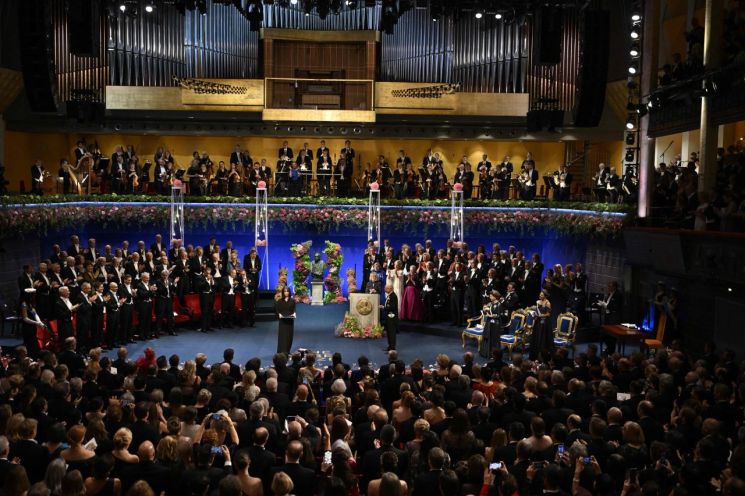 Novelist Han Kang is greeting the audience after receiving a medal and certificate from King Carl Gustaf XVI of Sweden at the 2024 Nobel Prize ceremony held on the 10th (local time) at the Stockholm Concert Hall in Sweden.
 Photo by AFP Yonhap News
Han Kang shared an experience from her childhood when she empathized with others while taking shelter from the rain, likening it to the act of writing. "I remember when I was eight years old, coming back from an afternoon math class, suddenly a heavy rain poured down, and I took shelter under the eaves of a building with other children. Across the street, I saw people taking shelter under the eaves of a similar building, and it felt like looking into a mirror. The people sheltering from the rain beside me and all those across the street were each living as ‘I’. It was a wondrous moment, and I experienced countless first-person perspectives,"
"Reading and writing literary works is inevitably an act of opposing all actions that destroy life." Han Kang’s acceptance speech
The banquet began at 7 p.m., and prior to that, Han Kang attended the award ceremony held at the Stockholm Concert Hall from 4 p.m. Han Kang wore a black dress and became the first Korean and the first Asian woman to receive the Nobel Prize in Literature on the symbolic ‘Blue Carpet’ of the Nobel Prize award ceremony. The dress code for the Nobel Prize ceremony is tuxedos for men and dresses for women, with traditional national costumes also permitted.
The ceremony began with the entrance of King Carl XVI Gustaf of Sweden and other members of the Swedish royal family. King Carl XVI Gustaf and others took their seats on the right side of the concert hall. Then, as the Royal Stockholm Philharmonic Orchestra conducted by Johannes Gustavsson played music, 11 laureates from five Nobel Prize categories (excluding the Peace Prize), including Han Kang, entered and took their seats on the left side. When the laureates entered, everyone present, including King Carl XVI Gustaf, stood and applauded.
Han Kang sat in the eighth seat from the left among the 11 laureates. The seating was arranged according to the order of awards: Physics, Chemistry, Physiology or Medicine, Literature, and Economics. Before the awards for each category, one of the 18 lifetime members of the Swedish Academy gave an award speech from the podium for about 6 to 7 minutes. Each time a laureate received an award, all attendees stood and applauded.
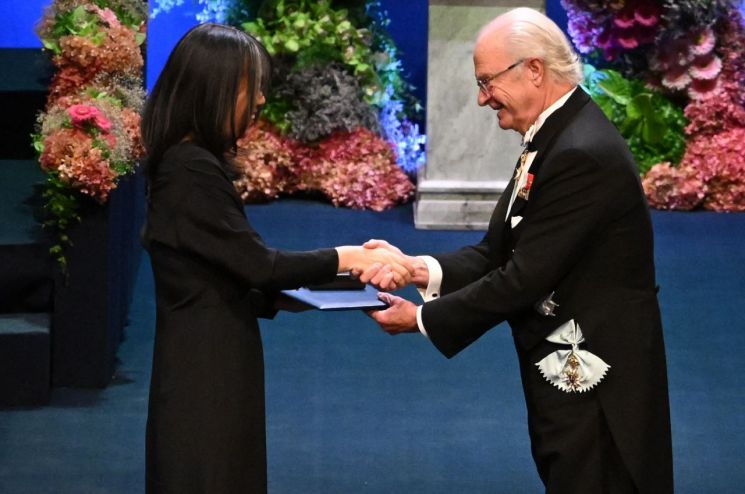 Novelist Han Kang is shaking hands with King Carl Gustaf XVI of Sweden after receiving the medal and certificate at the 2024 Nobel Prize Award Ceremony held at the Stockholm Concert Hall in Sweden on the 10th (local time).
 Photo by AFP Yonhap News
About 50 minutes after the ceremony began, Han Kang received the Nobel diploma and medal from King Carl XVI Gustaf. The award speech for the Literature Prize was delivered by Ellen Mattson, a Swedish novelist and one of the lifetime members of the Academy.
Mattson did not mention it explicitly but filled her speech with evaluations of Han Kang’s works “The White Book” and “The Boy Who Escaped”. She began by saying that Han Kang’s works bring together two colors: white and red. She explained that white is a protective barrier between the speaker and the world but also the color of sorrow and death, while red represents life but also pain, blood, and deep wounds cut by a knife. She further explained that Han Kang’s voice can be remarkably gentle but tells of unspeakable cruelty and irreversible loss.
"Her voice can be remarkably gentle but tells of unspeakable cruelty and irreversible loss." Ellen Mattson’s award speech
Mattson also said that the soul of the murdered boy asks, ‘Who killed me?’ This is interpreted as referring to Dong-ho, a middle school student murdered in The Boy Who Escaped. Mattson emphasized the need to remember that the purpose is not oblivion and that forgetting is not possible. She added, "The characters in Han Kang’s novels are wounded, vulnerable, and fragile, but at the same time, they possess just enough strength." She said, "Therefore, they take one step further to ask another question, demand records, or engage in conversations with other living witnesses."
© The Asia Business Daily(www.asiae.co.kr). All rights reserved.
![Clutching a Stolen Dior Bag, Saying "I Hate Being Poor but Real"... The Grotesque Con of a "Human Knockoff" [Slate]](https://cwcontent.asiae.co.kr/asiaresize/183/2026021902243444107_1771435474.jpg)
















