[K-Construction, A New Leap] Hyundai Engineering
Research on Design System Application Since 2019
Smart Technology Center Established in 2021
Automation Introduced Throughout Construction Processes
Reducing Design Errors and Enhancing Work Accuracy
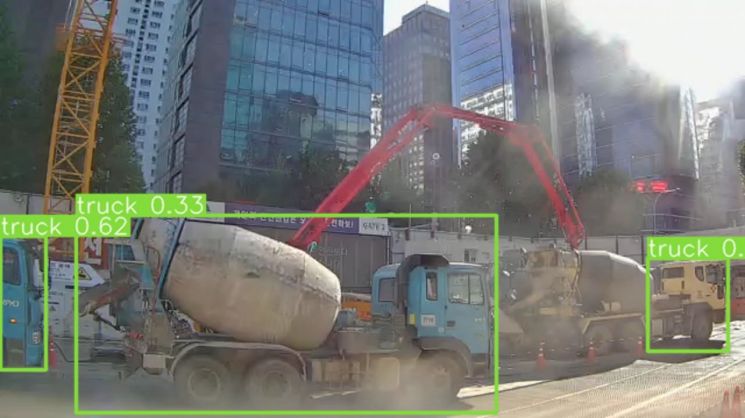 Artificial intelligence (AI) CCTV is operating at the Hyundai Engineering construction site. (Photo by Hyundai Engineering)
Hyundai Engineering is emerging as a leading AI powerhouse in the domestic construction industry by presenting ways to apply artificial intelligence (AI) to various construction processes. While various industries such as IT, manufacturing, distribution, and services are striving to integrate AI, Hyundai Engineering’s early efforts to apply AI to its operations in the construction sector are now bearing fruit. In particular, Hyundai Engineering has enhanced productivity and significantly improved work accuracy by integrating AI into design, construction, and safety management.
Enhancing Design Capabilities with AI
Since 2019, Hyundai Engineering has been conducting research and development (R&D) to introduce AI-based automation systems in the plant and housing sectors. This research aims to expand the areas where AI can be applied, such as design. In 2021, the company established the Smart Technology Center by expanding and reorganizing its existing Technology Research Institute. Recently, through this R&D, Hyundai Engineering has been able to integrate automation systems throughout the entire construction process, from design drawing recognition to design and verification. This has increased productivity and improved work accuracy.
Hyundai Engineering has particularly focused its AI capabilities on the design field. The AI automation system reduces the possibility of errors caused by frequent revisions during design work. It also allows for a reduction in the personnel involved in design review. This leads to increased work efficiency and cost savings.
In the drawing recognition stage of the design process, Hyundai Engineering developed and introduced an in-house ‘Process Piping and Instrumentation Diagram (P&ID) Automatic Recognition System’ based on AI deep learning and computer vision. P&ID refers to design drawings containing key process information received from the client at the early stage of a project. Using this system, digital process diagrams such as piping and instrumentation lists and CAD (computer-aided design) drawings can be automatically generated.
In the design stage, Hyundai Engineering developed and applied Korea’s first AI-based ‘Plant Steel Structure Design Automation Program.’ This program interprets design information and various variables of steel structures and reflects them in the design. It also automatically selects appropriate members by calculating loads acting on steel members. Engineers can thus move away from simple repetitive design tasks and focus on designs that consider economic efficiency and constructability.
This program won first place in the structural engineering category at the ‘Going Digital Infrastructure Awards,’ a global infrastructure industry awards ceremony hosted by Bentley Systems, an infrastructure engineering software company. Hyundai Engineering reported that testing this program on sample projects reduced the time required for steel structure design by 70% and cut design errors by 50%. Hyundai Engineering emphasized, "This helps prevent construction schedule delays and non-compliance caused by design delays and errors in advance, contributes to reducing steel quantities and carbon emissions," and added, "Winning at a global infrastructure industry awards ceremony externally recognized our design automation technology."
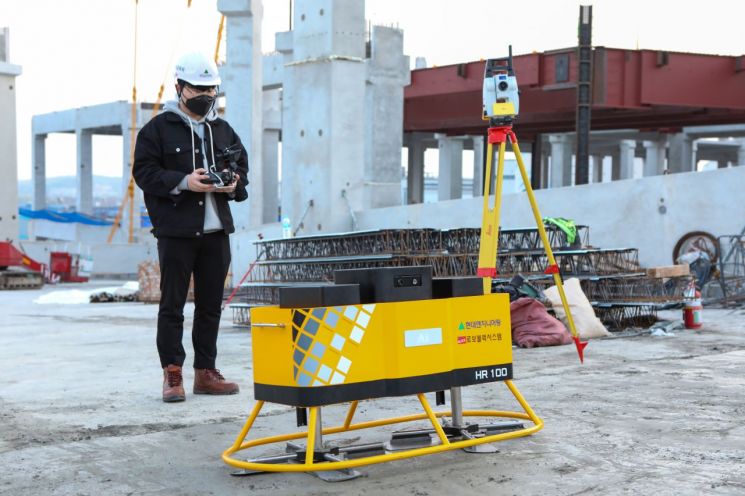 A Hyundai Engineering employee is operating an AI plastering robot at a construction site. (Photo by Hyundai Engineering)
Additionally, Hyundai Engineering developed a ‘Civil Engineering Automation Design Program’ that automates Piperack and Shelter design to shorten construction periods and reduce man-hours by more than 30%. Man-hour refers to the unit of labor or productivity produced by one person in one hour. Piperack is a structure that supports piping serving as a passage for plant raw materials and products, while Shelter refers to steel structures where various machines are temporarily or permanently located in plant projects.
In the stage of verifying designs and selecting actual quantities, Hyundai Engineering established an automation system using 3D-based technology. This technology automatically reviews designs and detects design errors that may occur before construction. Through this process, drawings are automatically generated, preventing unnecessary rework or material waste, making quantity management easier.
Hyundai Engineering is also conducting R&D on more than ten design automation technologies in areas such as ‘2D Drawing-Based Quantity Calculation Automation,’ ‘3D Piping Design Automation,’ and ‘Steel Fabrication Drawing Automation.’
Safety Management at Construction Sites Also OK
Hyundai Engineering actively utilizes AI during construction as well. A representative example is the ‘AI Finishing Robot,’ a smart construction device developed for unmanned floor finishing work. It precisely measures the poured concrete floor surface with a 3D scanner and smooths areas where flatness (surface smoothness) deviates from the standard by rotating two motors equipped with four finishing blades. By utilizing the AI Finishing Robot’s autonomous driving function, finishing work in repetitive areas is automated, which is expected to improve construction quality uniformity and productivity by reducing labor costs. It is deployed at sites where floor flatness quality is critical, such as smart factories, large logistics warehouses, and factory-type buildings, preventing accidents caused by poor floor finishing. Recently, it has also been used at apartment construction sites where sensitivity to inter-floor noise and defects has increased. Operators can control the robot remotely from a location away from the work site, enhancing safety.
In the safety field, Hyundai Engineering uses ‘AI CCTV.’ AI CCTV recognizes workers and construction equipment through real-time video analysis and informs whether workers are wearing safety gear. It also monitors 11 environmental factors in real time, including equipment temperature, flames, altitude, and carbon dioxide concentration.
A Hyundai Engineering official stated, "By actively adopting external innovative technologies and co-developing through open innovation, we have succeeded in developing innovative smart construction technologies such as the AI Finishing Robot, leading the introduction of robot technology in the construction industry." He added, "Hyundai Engineering will continue to do its best to secure smart construction technologies to improve efficiency and safety at construction sites."
© The Asia Business Daily(www.asiae.co.kr). All rights reserved.
![Clutching a Stolen Dior Bag, Saying "I Hate Being Poor but Real"... The Grotesque Con of a "Human Knockoff" [Slate]](https://cwcontent.asiae.co.kr/asiaresize/183/2026021902243444107_1771435474.jpg)
















