5th Korea-US Business Council General Meeting in Washington After 5 Years
Hankyung Business Association Dispatches Large-Scale High-Level Private Delegation
Attendees Include Cho Won-tae, Lee Jang-han, Cho Hyun-sang, Shin Hak-cheol
Chairman Ryu Jin: "Cooperation in Semiconductors, Batteries, SMR, Shipbuilding"
Working Group Established for Economic Cooperation Based on Korea-US FTA
Policies for Continuous Cooperation and Investment in Advanced Industries
Korean Delegation's Active Engagement with Key US Figures
Amid growing uncertainties in our economy due to the 'impeachment political situation' and the launch of the 'Trump 2nd term' administration, our business community has agreed to further strengthen the 'technology alliance' by meeting with the U.S. business community in Washington D.C. Economic leaders from both countries voiced a unified stance on navigating the era of economic security through a strong technology alliance and solidifying supply chain cooperation in key industrial sectors, especially in advanced industries such as batteries and semiconductors.
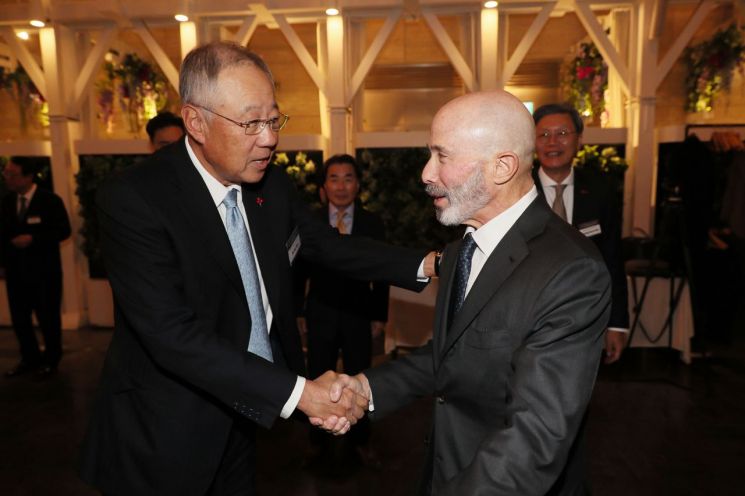 Ryu Jin, Chairman of the Korea Economic Association, and Evan Greenberg, Chairman of the US-Korea Business Council, are shaking hands at the 'Networking Reception hosted by the US-Korea Business Council' held on the 20th of last month at the FKI Tower in Yeouido, Seoul. Photo by Yonhap News Agency
They also decided to establish various working groups and hold public-private joint dialogues to create a foundation for smoother trade and communication between the two countries in the future. They urged the enhancement of policy stability for continuous cooperation in advanced industries and adopted a joint declaration specifying new areas of cooperation such as Small Modular Reactors (SMR) and shipbuilding.
The Korea Economic Association (HanKyungHyup) held the '35th Korea-U.S. Business Council General Assembly' on the 10th (local time) at the U.S. Chamber of Commerce in Washington D.C. The general assembly was held for the first time in five years due to the impact of the COVID-19 pandemic. It was about a month after the U.S. presidential election held on the 5th of last month.
About 60 key businesspeople and experts from both Korea and the U.S. attended the general assembly. From Korea, attendees included Ryu Jin, Chairman of HanKyungHyup; Cho Won-tae, Chairman of Hanjin Group; Lee Jang-han, Chairman of Chong Kun Dang; Sung Rae-eun, Vice Chairman of Youngone Trading; Cho Hyun-sang, Vice Chairman of HS Hyosung; Shin Hak-cheol, Vice Chairman of LG Chem; Yoon Young-jo, Vice President of Samsung Electronics; Kim Dong-wook, Vice President of Hyundai Motor Company; Son Sang-soo, Vice President of SK America; and Michael Smith, President of Hanwha Aerospace U.S. branch. From the U.S., many chairmen and CEOs of leading American companies attended, including Evan Greenberg, Chairman of the Korea-U.S. Business Council (Chubb Group Chairman).
In his opening remarks, Chairman Ryu Jin emphasized, "The pledges of President-elect Donald Trump have forecast various changes in the business environment," and added, "We must overcome this wave of change and prepare for a new era through closer cooperation between the business communities of both countries." He stressed the need to strengthen unwavering supply chain cooperation between Korea and the U.S. in advanced industries such as semiconductors and batteries, which determine global technological supremacy. He actively explained that Korean companies have contributed to creating high-quality jobs and technological innovation in the U.S. through massive investments totaling $143 billion over seven years since the launch of the first Trump administration. He also pointed out that Korean companies possess world-class technological capabilities in areas emphasized by President-elect Trump, such as SMR and shipbuilding defense industries, and called for exploring active industrial cooperation between the two countries.
Chairman Greenberg welcomed the Korean delegation, saying, "I welcome the Korean delegation participating in the Korea-U.S. Business Council General Assembly held in the U.S. for the first time since 2019," and added, "Korea is an important ally and partner of the U.S., and at the heart of a strong and future-oriented Korea-U.S. relationship are the business communities of both countries."
The meeting discussed topics such as promoting innovation and strengthening cooperation in key emerging technologies, Korea's strategy to become a biotech hub, and the perspective of the U.S. Congress on Korea-U.S. relations.
A notable highlight was a dialogue involving a current U.S. Senator. Chairman Greenberg (Chubb Group Chairman) engaged in a discussion with Senator Dan Sullivan on the topic of 'Korea-U.S. Relations as Seen by the U.S. Congress,' exchanging views on economic cooperation and future-oriented relations between the two countries. Senator Sullivan was a founding member of the 'Korea Caucus,' established for the first time in the U.S. Senate last year. He leads various activities to strengthen economic and security cooperation between Korea and the U.S. and has expressed a friendly stance toward Korea in previous administrations, emphasizing the importance of the Korea-U.S. alliance.
At the closing ceremony of the general assembly, business leaders from both countries conveyed their positions through the approval of a joint statement. They confirmed that the Korea-U.S. Free Trade Agreement (FTA) has been the backbone of exponential growth in trade and investment and mutual benefit enhancement between the two countries, emphasizing the need to establish a trade and commercial system and a pro-market business environment based on the Korea-U.S. FTA. They also agreed on the necessity to guarantee the stability of Korean companies' production, employment, and technological innovation in the U.S. and to maintain policy consistency to ensure that corporate investments in both countries occur in a mutually beneficial and predictable environment. Furthermore, they requested the promotion of investment and supply chain cooperation in promising bilateral cooperation sectors such as the nuclear industry including SMR and shipbuilding, and the activation of workforce exchanges between the two countries through institutional improvements such as professional visas. They also called for cooperation to strengthen supply chain resilience in strategic industries including semiconductors, batteries, critical minerals, pharmaceuticals/biotech, medical technology, defense, and aerospace.
Meanwhile, the HanKyungHyup delegation plans to conduct 'outreach' activities targeting key U.S. figures from the 9th to the 11th during their visit to the U.S. in connection with the Korea-U.S. Business Council. They will hold consecutive meetings with members of the Korea Caucus, including Senator Todd Young, Representative Ami Bera, and Representative Mike Kelly. They will also meet with opinion leaders from various sectors in the U.S., such as think tanks like the Center for Strategic and International Studies (CSIS) and the Peterson Institute for International Economics (PIIE), as well as former White House Chief of Staff Reince Priebus and former senior advisor Kellyanne Conway from the first Trump administration, to convey the views of the Korean business community.
Kim Bong-man, Director of the International Headquarters of HanKyungHyup, said, "It is significant that the business communities of both countries agreed that the Korea-U.S. FTA should continue to serve as the policy standard for economic and trade cooperation between the two countries and that policy consistency must be maintained to continuously expand trade and investment." He added, "It is necessary to widely inform and help the U.S. Congress and government understand the importance of Korea-U.S. economic cooperation in preparation for the launch of the Trump 2nd term and the contributions of Korean companies to the U.S. economy, and communication with U.S. opinion leaders is essential for this purpose."
© The Asia Business Daily(www.asiae.co.kr). All rights reserved.
![Clutching a Stolen Dior Bag, Saying "I Hate Being Poor but Real"... The Grotesque Con of a "Human Knockoff" [Slate]](https://cwcontent.asiae.co.kr/asiaresize/183/2026021902243444107_1771435474.jpg)
















