Looking at the 673 Trillion Won Budget for Next Year
4.1 Trillion Won Cut from Government Proposal
Half of the Contingency Fund Reduced
Next year's national budget has been finalized at 673.3 trillion won, a reduction of 4.1 trillion won from the government's original proposal. This marks the first time in constitutional history that the opposition party has passed a budget bill with unilateral cuts. The ruling and opposition parties' negotiations, which had escalated into a chicken game where whoever blinked first would lose, accelerated at the last minute to avoid the worst amid political turmoil involving martial law and impeachment. Although the ruling and opposition parties and the government engaged in final negotiations right before the plenary session's budget approval, they failed to reach a final agreement due to issues such as the budget size for the regional love gift certificates (local currency), a budget item championed by Lee Jae-myung. With a budget bill passed reflecting only cuts without any increases, it seems inevitable that an additional supplementary budget bill will be drafted next year.
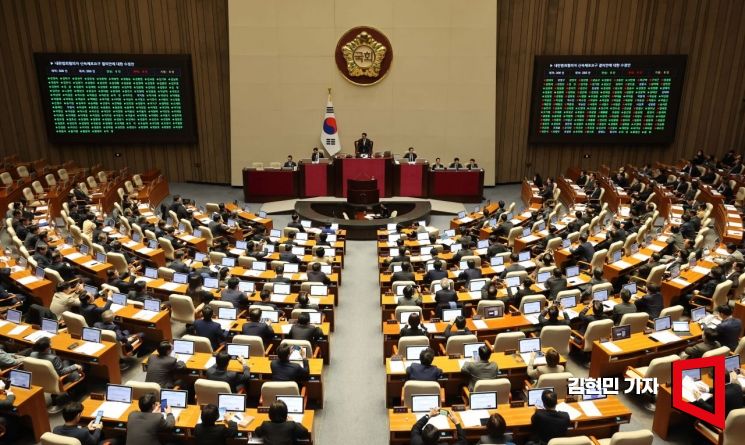 On the 10th, the resolution demanding the swift arrest of suspects accused of internal rebellion crimes was passed at the National Assembly plenary session. Photo by Kim Hyun-min
Only Cuts Without Increases...Government's Key Project Budgets Slashed One After Another
According to the Ministry of Economy and Finance on the 10th, the National Assembly held a plenary session and finalized next year's budget at 673.3 trillion won, cutting 4.1 trillion won from the government's submitted budget of 677.4 trillion won. This reflects only cuts without any increases, marking the first time in constitutional history that the opposition party has passed a budget bill with unilateral cuts.
Significant cuts were made to the contingency fund. The contingency fund, which was a subject of contention between the ruling and opposition parties, was halved by 240 billion won. The contingency fund is a budget allocated for use in emergencies such as disasters. The government expressed concerns that the cut to the contingency fund would hinder timely responses to disaster situations, but this was rejected on the grounds that 1.5 trillion won from disaster recovery burden acts could be utilized, ensuring sufficient capacity to respond to disasters.
The budgets for investigative agencies, including special activity expenses and special investigation expenses, which were major points of contention, were also drastically cut. The entire 58.7 billion won allocated for special investigation expenses (특경비) and special activity expenses (특활비) for the prosecution, police, and Board of Audit and Inspection were eliminated. The 8.2 billion won special activity expenses for the Presidential Office were also fully cut. Special activity expenses have been criticized as typical opaque costs of power institutions because they are used for activities where it is difficult to provide receipts or other evidence to maintain confidentiality. Special investigation expenses cover actual costs incurred during investigations and inquiries.
The budget for government bond interest repayments was cut by 50 billion won. Additionally, budgets for key government projects were slashed one after another, including 93.1 billion won for resident doctor support projects, 81.5 billion won for research and development (R&D) in future growth engines such as semiconductors, 64.5 billion won for military personnel wages, 38.4 billion won for childcare support allowances, and 22.9 billion won for the Yongsan Park development project. The budget for the East Sea deep-sea gas field project, known as the "Great Whale," was cut by 49.7 billion won out of 50.5 billion won.
Abolition of Financial Investment Income Tax and Two-Year Postponement of Virtual Asset Taxation...Income Tax Act Passed
On the same day, the amendment to the Income Tax Act, which includes the abolition of the financial investment income tax, was also passed. The financial investment income tax, scheduled to be implemented next year, was abolished, and the taxation of virtual assets was postponed by two years to January 1, 2025. The taxation of virtual assets was confirmed with the passage of the Income Tax Act amendment in December 2022. Initially scheduled to be implemented in January 2022, virtual asset taxation was postponed twice?to 2023 and then to 2025?due to incomplete tax systems and infrastructure.
The amendment also passed a provision exempting corporate childbirth support payments from full taxation on wages paid to employees or their spouses within two years after the birth of a child, up to twice. The child tax credit amount was also expanded. To alleviate childcare costs, the annual tax credit amount for children and grandchildren aged eight and above will be increased by 100,000 won per child.
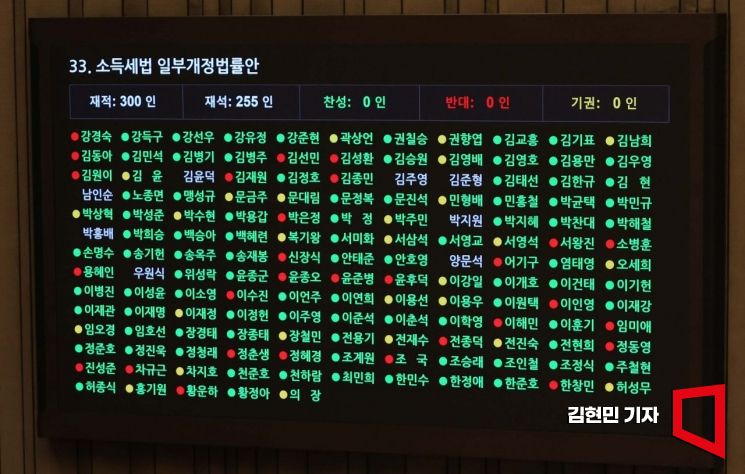 On the 10th, the amendment to the Income Tax Act, which focuses on the abolition of the financial investment tax and the postponement of virtual asset taxation, is being passed in the plenary session of the National Assembly. Photo by Kim Hyun-min
Reduction of Highest Inheritance Tax Rate Rejected
The contentious issue of lowering the highest inheritance tax rate was rejected. The government had proposed reducing the world's highest inheritance tax rate from 50% to 40% and expanding the lowest taxable bracket, which is taxed at 10%, from 100 million won to 200 million won to ease the tax burden. The inheritance tax system has been maintained since the 1999 tax law revision, which lowered the highest taxable bracket from "over 5 billion won" to "over 3 billion won" and raised the top rate from 45% to 50%.
If the tax law amendment had passed, the top rate would have been lowered to 40%, and the 20% surcharge applied to major shareholders of large corporations would have been abolished, significantly easing the inheritance tax burden. Although there have been calls to efficiently improve the inheritance tax system, which has been unchanged for 24 years since 2000, amid aging business owners and their preparations for inheritance tax, the major opposition party opposed the proposal, calling it a tax cut for the wealthy.
The amendment to the Restriction of Special Taxation Act passed with an opposition party revision that did not include the government's proposed "shareholder return promotion tax system." The government had planned to introduce provisions to reduce dividend income tax through separate taxation for shareholders of companies with excellent dividend records and to provide corporate tax reductions for companies increasing shareholder returns, but these were not introduced due to opposition from the opposition party. The amendment also excluded provisions to raise the tax-exempt limit for Individual Savings Accounts (ISA) from 2 million won to 5 million won and to increase the total contribution limit from 100 million won to 200 million won. The domestic-type ISA was also not introduced.
Other approved amendments include the Liquor Tax Act amendment to expand the tax reduction limit for traditional liquors, the Customs Act amendment requiring e-commerce product sellers to register with the Korea Customs Service, and the amendment to the Act on the Promotion of Films and Videos to abolish the admission fee levy for movie theaters starting next year.
The opposition party plans to draft a supplementary budget next year. Park Chan-dae, the floor leader of the Democratic Party, stated, "If there are parts that require increases for people's livelihood and economic recovery, they can be addressed later through supplementary budgets or other means." This means that the budget will be prepared based on the budget bill reflecting only cuts, and additional budgets can be drafted around early to mid-next year if more funds are needed.
The Ministry of Economy and Finance announced that it will make thorough preparations for budget execution to stabilize people's livelihoods and respond to external uncertainties and will execute the budget promptly once the fiscal year begins. Choi Sang-mok, Deputy Prime Minister and Minister of Economy and Finance, said immediately after the plenary session, "It is regrettable, but we will prepare to execute the budget based on the passed budget to stabilize people's livelihoods and respond to external uncertainties."
© The Asia Business Daily(www.asiae.co.kr). All rights reserved.


















