4.1 Trillion Won Cut in National Assembly Review
Ruling and Opposition Parties Failed to Reach Agreement Ahead of Plenary Session
Unprecedented Opposition-Only Budget Passed
On the 10th, the National Assembly approved a budget worth 673.3 trillion won. After review by the National Assembly, 4.1 trillion won was cut from the government’s budget proposal. This marked an unprecedented opposition party’s unilateral budget reduction being passed.
On the same day, the National Assembly held a plenary session and passed the budget for the next year. Among the 278 members present, 183 voted in favor, 94 against, and 1 abstained.
Prior to this, the government and the ruling and opposition parties negotiated ahead of the budget approval but failed to reach an agreement. The opposition party, which had been negotiating over an increase related to local currency, ultimately rejected the government’s proposal and passed a budget that only reflected cuts from the original government proposal. Although the budget was passed after the legal deadline, it was handled within the regular session of the National Assembly. However, this was an unprecedented budget passed without political coordination between the ruling and opposition parties.
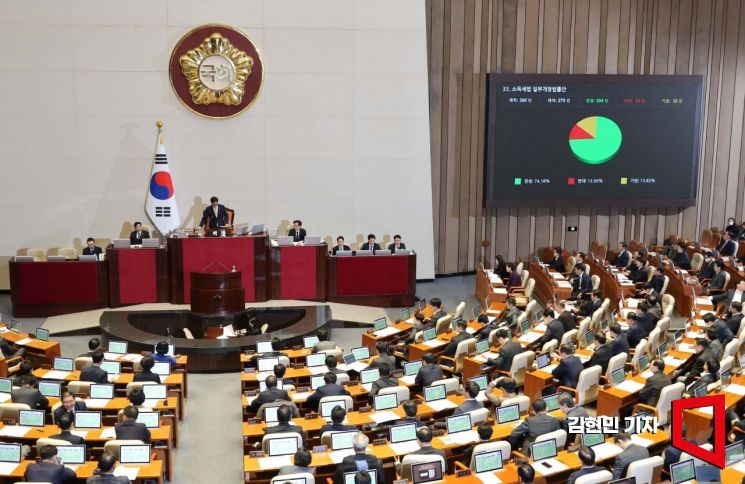 On the 10th, the amendment to the Income Tax Act, which focuses on the abolition of the financial investment tax and the postponement of virtual asset taxation, is being passed in the National Assembly plenary session. Photo by Kim Hyun-min
Initially, the opposition party’s Budget and Accounts Committee approved a budget that fully cut special activity expenses of the Presidential Secretariat and National Security Office (8.251 billion won), prosecution’s specific task expenses (50.691 billion won) and special activity expenses (8.09 billion won), Board of Audit and Inspection’s special task expenses (4.5 billion won) and special activity expenses (1.5 billion won), and police special activity expenses (3.16 billion won) from the government’s budget proposal. Additionally, the government’s contingency fund of 4.8 trillion won was cut by 2.4 trillion won, and the budget for national treasury bond interest repayment was reduced by 500 billion won. The contingency fund refers to an amount pre-allocated within a certain limit to cover unpredictable expenditures outside the budget.
The budget for the “Great Whale Project,” which was 50.5 billion won in the government proposal, was cut to 49.7 billion won; the budget for the Yongsan Park development project, originally 41.6 billion won, was reduced to 22.9 billion won; and the budget for the public-private partnership advanced nuclear reactor export infrastructure (R&D), initially 7 billion won, was cut to 6.3 billion won. The opposition party also cut 7.4 billion won from the “Jeon Gukmin Ma-eum Investment Support” budget, which the opposition labeled as the “Kim Geon-hee budget,” reducing it from 50.8 billion won in the government proposal.
Park Jeong, Chair of the Special Committee on Budget and Accounts (Democratic Party), explained, "Rather than bypassing the Budget and Accounts Committee review through automatic submission of the government proposal, we judged that processing the budget within the committee by adhering to the legal deadline as promised to the public was the right path." However, the ruling party strongly opposed the budget review without consensus.
According to the Constitution, the National Assembly must obtain government consent to increase the budget or create new budget items, but cuts can be made without government approval.
The opposition party plans to prepare a supplementary budget next year. Park Chan-dae, floor leader of the Democratic Party, said, "If there are parts that need increases for people’s livelihood and economic recovery, they can be addressed later through supplementary budgets or other means." This means that the budget will be planned based on the budget reflecting only cuts for now, and additional necessary funds can be allocated in early to mid-next year.
The ruling and opposition parties and the government held final negotiations ahead of the budget approval on the day but failed to reach an agreement. The government proposed restoring some of the opposition’s unilateral cuts to the contingency fund and national treasury bond interest in exchange for the local currency budget, but the talks broke down over the scale of the local currency budget.
Kim Sang-hoon, Policy Committee Chair of the People Power Party, said, "Today, the People Power Party proposed a total budget increase of 3.4 trillion won, including a 300 billion won increase for the issuance of local love gift certificates and restoring 1.6 trillion won for the contingency fund, etc." He added, "The Democratic Party submitted a revised bill with cuts to the plenary session and, in the meantime, tried only to satisfy their own greed, effectively breaking off negotiations." He continued, "The Democratic Party demanded 1 trillion won for the issuance of local love gift certificates until the end. The revised bill reflecting only the 4.1 trillion won cut unilaterally processed by the Democratic Party was passed, which will result in unforeseen losses in the country’s future crisis response capabilities and inadequate investigation of crimes harming people’s livelihood. The Democratic Party must take full responsibility for the problems arising from the unilateral passage of the cut budget."
Jin Sung-jun, Policy Committee Chair of the Democratic Party, introduced the negotiation progress, saying, "The government only demanded restoration of the cuts but did not utter a word about increasing the livelihood budget, so the final breakdown was declared at 11 p.m. last night. However, today, Deputy Prime Minister and Minister of Economy and Finance Choi Sang-mok said he prepared a response to the Democratic Party’s demands, and they met again under the mediation of the Speaker of the National Assembly." Jin explained the reason for the breakdown of budget negotiations, saying, "The Democratic Party maintained the position that if the cut budget is restored, the livelihood budget must also be increased accordingly. The Ministry of Economy and Finance did not accept this position."
The budget was passed in the form of the original Budget and Accounts Committee proposal with additional conditions from the Democratic Party. The Democratic Party amended the general provisions of the budget to prioritize support of 268 billion won from the 1.6 trillion won purpose contingency fund for free high school education and free education for 5-year-olds. In addition, the opposition party prohibited the reallocation of previously cut budgets such as special activity expenses. The revised budget passed in the plenary session included a supplementary opinion stating, "While clearly reflecting the intent of some expenditure cuts in the revised bill, the government shall not secure additional project budgets through reallocation or contingency fund allocation for the cut projects, excluding legally mandated expenditures. If additional funding is inevitably required, it shall be reflected in supplementary budgets and secured through National Assembly approval."
Speaker Woo Won-shik pointed out immediately after the budget was passed, "The current problem fundamentally results from the government’s failure to sufficiently consult with the National Assembly during the preparation of next year’s government budget proposal," and said, "It can only be seen as disregarding the National Assembly’s budget review authority by relying on the advantage of the budget review and approval process under the National Assembly Act favoring the government." He added, "Parts that need increases should be expanded through supplementary budgets for people’s livelihood."
© The Asia Business Daily(www.asiae.co.kr). All rights reserved.

















