On the 10th, the 43rd Korean Medical Association President Election Candidates' Policy Presentation
"If the Medical Community Does Not Lead Medical Policy, Conflicts Will Repeat"
Candidates for the next president of the Korea Medical Association (KMA) have united in their commitment to block the government's healthcare reform. While plans mainly focus on changing public opinion through both struggle and public persuasion, there are also calls for continued resistance until perceptions of the medical community improve.
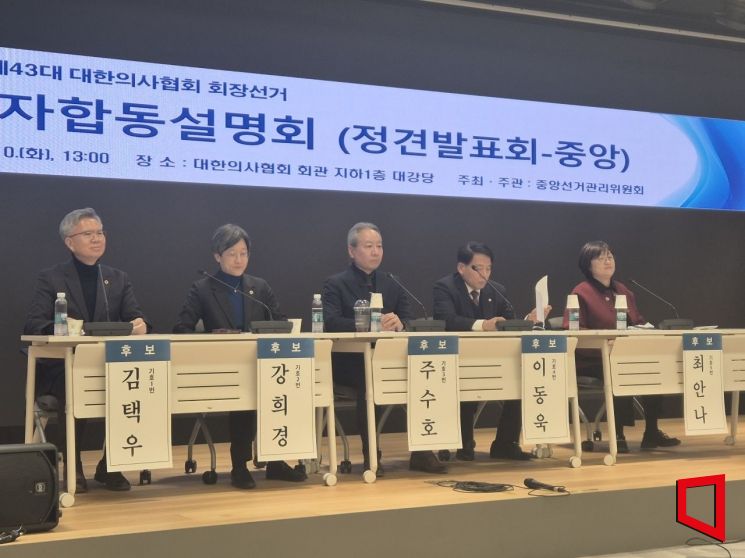 Candidates are preparing to speak at the joint briefing session for the 43rd president election held by the Korean Medical Association Central Election Commission on the 10th at the KMA Hall in Yongsan-gu, Seoul. Photo by Choi Taewon
The KMA Central Election Commission held a policy presentation session for candidates of the 43rd presidential election on the 10th at the KMA headquarters in Yongsan-gu, Seoul. All registered candidates?Kim Taek-woo, Kang Hee-kyung, Joo Soo-ho, Lee Dong-wook, and Choi Anna (in order of ballot number)?participated and presented their platforms.
The candidates unanimously blamed the medical service disruption on the government’s reckless and unilateral enforcement of healthcare policies. They expressed concern that if the medical community does not lead healthcare policy, conflicts between the medical sector and the government will continue to recur. Their principles and plans for government confrontation included “strong resistance,” “evidence-based policy discussions,” and “demanding apologies for healthcare policies.”
Kim Taek-woo (Chairman of the National Association of Metropolitan and Provincial Medical Associations) stated, “When the government announces healthcare policies, doctors are often labeled selfish for opposing them. This is because the government’s policies have always been unilateral and dismissive of the medical community’s interests. The government creates situations where it has no choice but to act this way.”
He added, “Healthcare policies must be properly discussed with the medical community. Otherwise, conflicts will repeat. If I become president, I will first present reasonable opinions that encompass all medical professions to the government,” he emphasized.
Kang Hee-kyung (Professor at Seoul National University College of Medicine) said, “I will meet with the actual decision-makers of healthcare policy to first halt the current government’s so-called healthcare reform and propose policies based on evidence and consensus. The structural transformation should focus on primary care, not tertiary hospitals. We should aim for a system where evidence-based care is sufficiently compensated.”
Lee Dong-wook (Chairman of the Gyeonggi-do Medical Association) stated, “Essential and regional healthcare cannot be improved by appealing only to individual dedication and public interest. If I become president, I will improve working conditions to support essential healthcare, such as completely changing the regional fee system, similar to the U.S.”
He also appealed, “Regarding the medical school quota issue, after a year of fierce protests including presidential commute demonstrations, the government has significantly softened its stance. Please choose the strongest candidate.”
Choi Anna (KMA Planning Director and Spokesperson) said, “The principle is that an increase of 2,000 medical students, acknowledgment and apology for the martial law proclamation, and accountability are necessary.”
She also addressed Han Dong-hoon, leader of the People Power Party, saying, “Leader Han once suggested making next year’s quota flexible. However, the presidential office rejected it. Now that the presidential office that rejected it has fallen, that proposal must be realized.”
Joo Soo-ho (Representative of the Future Medical Forum) spoke with a particularly strong voice. He said, “To those who ask, ‘Doctors are right, but must it be to this extent?’ I answered that our message does not reach them. For 20 to 30 years, we have argued that as long as the health insurance system is maintained based on compulsory designation, Korean healthcare will inevitably collapse someday, but no one has listened to us.”
He continued, “The reason the public is paying attention to this KMA presidential election is probably because we have risen up. Our goal is for the claims made by doctors to be trusted and recognized as necessary to listen to. Until that situation is achieved, we have no choice but to fight,” he emphasized.
© The Asia Business Daily(www.asiae.co.kr). All rights reserved.
![Clutching a Stolen Dior Bag, Saying "I Hate Being Poor but Real"... The Grotesque Con of a "Human Knockoff" [Slate]](https://cwcontent.asiae.co.kr/asiaresize/183/2026021902243444107_1771435474.jpg)















