Introduction of Gyeonggi Carbon Neutral Education at the '2024 UNESCO Future of Education International Forum'
Development of Modular Environmental Class Materials Using the 2022 Revised Curriculum 'School Autonomy Time'
The Gyeonggi Provincial Office of Education (Superintendent Lim Tae-hee) announced on the 10th that it declared participation in climate action through environmental education for a sustainable future at the ‘2024 UNESCO International Forum on the Future of Education’ and will solidify the foundation of school environmental education as the first step.
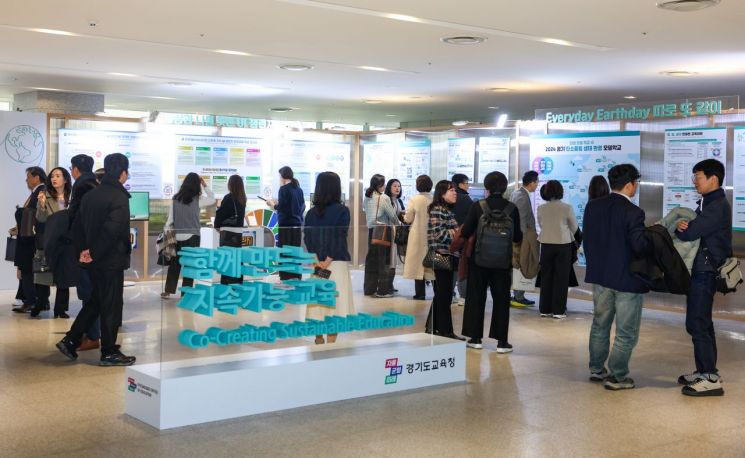 Gyeonggi Provincial Office of Education declares participation in climate action through environmental education for a sustainable future at the '2024 UNESCO International Forum on the Future of Education' and aims to strengthen the foundation of school environmental education as the first step. Provided by Gyeonggi Provincial Office of Education
The ‘2024 UNESCO International Forum on the Future of Education’ was held from the 2nd to the 4th at the Suwon Convention Center, co-hosted by the Provincial Office of Education, UNESCO, the Ministry of Education, and the Korean National Commission for UNESCO.
At the special session of the international forum, the Provincial Office of Education declared joint action for everyday climate action practice and operated an exhibition and experience booth on Gyeonggi carbon-neutral education for sustainable education.
Furthermore, it plans to develop and distribute environmental lesson materials on-site and strengthen practice-centered, region-based carbon-neutral education to respond to the climate crisis.
According to the 2023 revision of the Environmental Education Act, environmental education is mandatory in elementary and middle schools, and the Provincial Office of Education recommends organizing and operating at least two sessions annually.
The existing school environmental education policy faces challenges such as ▲difficulty in restructuring the curriculum in elementary schools ▲lack of teaching expertise in ‘environmental subjects’ not included in the general education subject group in middle schools ▲and a shortage of environmental teaching materials in the field.
To address these issues, the Provincial Office of Education developed modular environmental lesson materials that can be used during the ‘school autonomous time’ in the 2022 revised curriculum. These materials allow lessons to be conducted in desired topics, sessions, and formats based on two-session units according to school circumstances.
This material is composed of two types tailored to student developmental stages for student-led, region-based experiential environmental lessons: one for early childhood and elementary levels, and one for middle school levels.
The early childhood and elementary materials are titled ‘Environmental Lessons Made Separately and Together ? From Occasion Education to Projects’ and are divided into materials for young children and elementary students.
The young children’s materials cover three themes (12 sessions): ▲“Earth’s Table, Strong Table Operation” ▲“Be Friends with Trees (GO)! Be Friends with Nature (GO)!” ▲“Plastic Treasure Expedition,” fostering love for the Earth and ecological sensitivity.
The elementary materials include 14 themes (85 sessions): ▲Lower grades (1st?2nd grade) Environmental Stories in Our School ▲Middle grades (3rd?4th grade) Carbon-Neutral Village for Our Tomorrow ▲Upper grades (5th?6th grade) ‘A Sustainable Global Community Starts with Me!’ addressing the expansion of environmental education according to student developmental stages.
The middle school materials are themed ‘Carbon-Neutral Ecological Environmental Lessons with the Community ? Focused on Modular Materials’ and consist of 11 units across 4 areas. Each unit is designed for 3?4 sessions, totaling 35 sessions.
The four areas are ▲Carbon Civilization and Ecological Transition ▲Biodiversity and Resource Circulation ▲Exploration of Regional Environmental Issues ▲Participation and Practice for Ecological Transition, broadening the horizon of environmental education and supporting education tailored to student developmental stages.
Notably, this material set provides webzines, worksheets, and PPTs to support teachers’ environmental education lessons. Teachers can modify worksheets and PPTs to suit school and classroom situations and conduct customized environmental education for students.
The materials can be downloaded from the Convergence Education Policy Division in the integrated resource room of the Office of Education.
Hyun Gye-myeong, head of the Convergence Education Policy Division at the Provincial Office of Education, said, “At the UNESCO International Forum on the Future of Education, we felt the importance of environmental education even more for a sustainable future for children,” adding, “We will develop materials necessary for curricula and lessons on-site to help internalize the practice of environmental education.”
© The Asia Business Daily(www.asiae.co.kr). All rights reserved.
![Clutching a Stolen Dior Bag, Saying "I Hate Being Poor but Real"... The Grotesque Con of a "Human Knockoff" [Slate]](https://cwcontent.asiae.co.kr/asiaresize/183/2026021902243444107_1771435474.jpg)















