OpenAI, the developer of ChatGPT, officially launched its video generation artificial intelligence (AI) model 'Sora' on the 9th (local time). It has been 10 months since its first unveiling in February.
Sora is an AI model that generates high-quality videos based on scenes input by users in text, images, or videos. It can create videos inspired by images, extend existing videos, or fill in missing frames. Sam Altman, CEO of OpenAI, attracted attention during an online demonstration of Sora by showcasing the 'Blend' feature, which generates videos by combining two images.
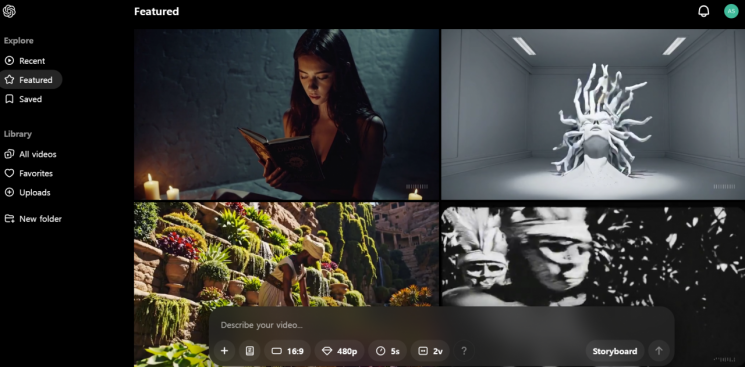 OpenAI, the developer of ChatGPT, officially launched the video-generating AI model 'Sora' on the 9th (local time). Sora homepage
OpenAI has been testing Sora's safety with a limited group of users. At its February unveiling, Sora was described as being able to "quickly produce videos up to one minute long featuring multiple characters, specific types of actions, and complex scenes." OpenAI emphasized again that "Sora can realize your imagination through text, images, or videos."
Sora is available from today in most countries, including the United States. However, the release schedule for Europe and the United Kingdom has not been determined. This is believed to be influenced by the tightening regulations on IT companies in these regions. Sora is included in the 'ChatGPT Plus' and 'ChatGPT Pro' subscriptions, allowing existing paid ChatGPT users to access it without additional fees.
With Sora entering the market, competition among big tech companies over video AI models is expected to intensify. Google previously launched 'Veo,' a video generation AI model for enterprises, and Meta Platforms, Facebook's parent company, introduced 'Movie Gen' last October. AI startup Runway unveiled its AI model 'Gen-3 Alpha' in July.

Rohan Sahai, OpenAI's head of the Sora product, said, "We are definitely setting big goals," adding, "Our aim is to prevent legal issues related to Sora while maximizing users' creative expression." CNBC cited data showing that the number of AI-generated deepfakes increased by 900% compared to the previous year during this election year, suggesting that the video generation AI market could become a new legal and ethical battleground for companies.
Backed by Microsoft (MS), OpenAI raised $6.6 billion (approximately 9 trillion KRW) from big tech and investment firms last October, recently valuing the company at $157 billion (approximately 225 trillion KRW). Bloomberg stated, "Generative AI is driving an average annual growth of about 43% in hardware, software, advertising, and gaming revenues in the tech industry," forecasting that the generative AI market size will reach $1.3 trillion (approximately 1,862 trillion KRW) by 2032.
© The Asia Business Daily(www.asiae.co.kr). All rights reserved.
![Clutching a Stolen Dior Bag, Saying "I Hate Being Poor but Real"... The Grotesque Con of a "Human Knockoff" [Slate]](https://cwcontent.asiae.co.kr/asiaresize/183/2026021902243444107_1771435474.jpg)
















