Higher Proportion Increases Currency Loss Burden
Risk Reduced by Net Foreign Currency Debt
Refining Margin Breakeven Point Signals Warning
Declining International Oil Prices Also Increase Pressure
The won-dollar exchange rate surpassing 1,430 won has put oil refiners, who rely on crude oil imports, on high alert. In particular, some refiners with a higher domestic sales ratio than exports are expected to suffer greater foreign exchange losses. Companies pursuing overseas investments are also facing increased burdens due to rising raw material prices.
Among oil refiners, SK Energy and S-OIL are identified as the companies most burdened by exchange rate fluctuations. According to the Financial Supervisory Service's electronic disclosure system on the 10th, SK Energy had the highest domestic sales ratio at 48%, accounting for half of its total sales among the four domestic refiners in the first to third quarters of this year. S-OIL followed with 45%. The domestic sales ratios of GS Caltex and HD Hyundai Oilbank were only 26% and 23%, respectively.
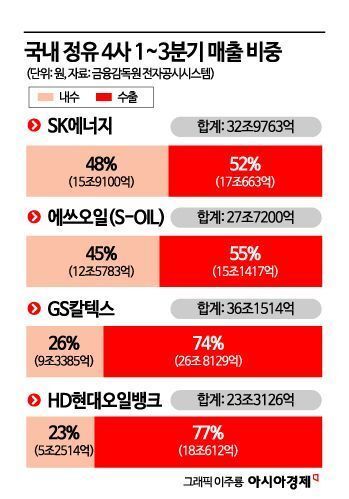
The higher the domestic sales ratio, the greater the burden of foreign exchange losses caused by won depreciation. This is because it is difficult to offset losses caused by exchange rate increases with export profits. According to the Seoul Foreign Exchange Market, the won-dollar exchange rate was around 1,427 won as of 10 a.m. that day. Although it fell slightly from the previous day's closing price of 1,437 won, the situation remains concerning. Some speculate that if political turmoil prolongs and foreign capital outflows continue, the exchange rate could rise to 1,500 won.
The refining industry, which purchases all crude oil from overseas, is particularly hard hit. Domestic refiners buy over 1 billion barrels of crude oil annually in dollars from abroad. A representative from the Korea Petroleum Association explained, "If the exchange rate rises, larger foreign exchange losses will occur, negatively impacting business performance."
The industry currently manages foreign exchange risk by maintaining an appropriate level of net foreign currency debt. This means they have established a system to manage foreign currency debt and exchange rate fluctuation risks to minimize the impact of exchange rate changes on their financial status.
However, concerns grow as the refining margin, a profitability indicator, barely exceeds the breakeven point. Currently, the refining margin is about $6 per barrel, slightly above the breakeven range of $4 to $5, but no visible profitability improvement has appeared even in the seasonal peak fourth quarter. Earlier, the four refiners recorded a total loss of 1.4592 trillion won in the third quarter due to weak demand and declining refining margins.
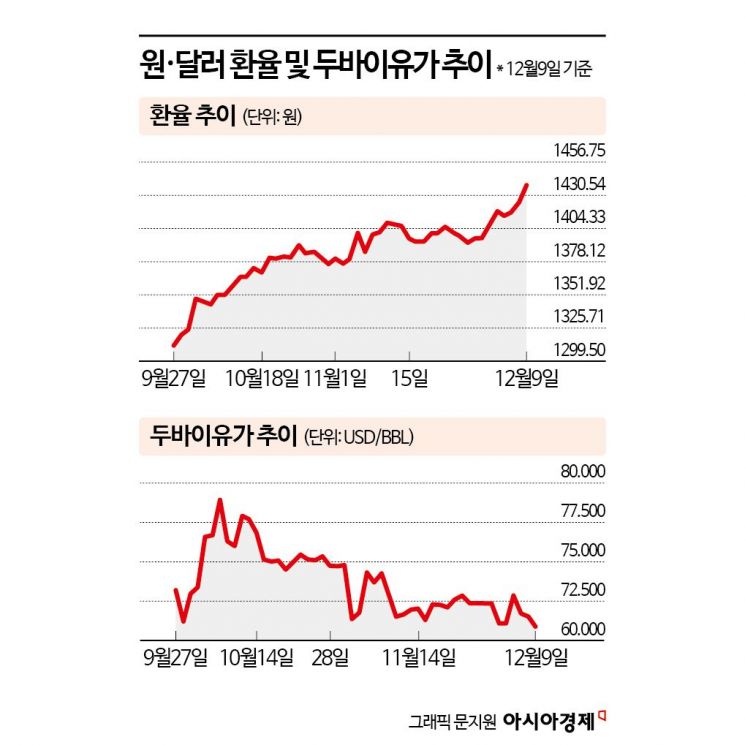
The downward trend in crude oil prices also burdens refiners. Dubai crude oil, the benchmark for Korea's crude oil import prices, closed at $71.96 per barrel on the New York Mercantile Exchange on the 9th. Dubai crude oil has been on a downward trend since surging to $86 in April. The global economic recession reducing oil demand, along with U.S. President Donald Trump's announcement to ease domestic oil production regulations, also influenced the price decline.
An industry insider said, "The current combination of high exchange rates and low oil prices makes performance improvement difficult," adding, "We are closely monitoring the trends of oil prices and exchange rates after December."
The exchange rate impact also burdens companies pursuing overseas investments, such as Samsung Electronics and SK Hynix. The semiconductor industry is focusing more on the ‘short-term sharp rise’ phenomenon rather than the exchange rate increase itself. Since most equipment and materials (raw materials) are purchased in dollars, the rise in the dollar's value can lead to increased production costs.
In the short term, the industry is concentrating on reducing business volatility by minimizing logistics costs, but in the mid to long term, it is also considering adjusting investment costs. Currently, Samsung Electronics and SK Hynix are undertaking projects worth $17 billion (approximately 24.3 trillion won) and $3.9 billion (approximately 5.6 trillion won) respectively in the U.S. These figures reflect overall cost increases, including equipment and material import costs, construction costs, and labor costs.
© The Asia Business Daily(www.asiae.co.kr). All rights reserved.
![Clutching a Stolen Dior Bag, Saying "I Hate Being Poor but Real"... The Grotesque Con of a "Human Knockoff" [Slate]](https://cwcontent.asiae.co.kr/asiaresize/183/2026021902243444107_1771435474.jpg)
















