Few Applicants for Resident Recruitment Closing on 9th
"Anger at 'Execution' Expression for Residents... Employed as General Practitioners"
As the recruitment of first-year residents set to begin training in March next year sees only a small number of applicants even at the Big 5 hospitals (Seoul St. Mary's, Samsung Seoul, Seoul Asan, Severance, Seoul National University Hospital), the nearly year-long medical service gap is expected to be prolonged further. Residents who have resigned are deeply angered by the government's aggressive expressions such as the martial law command's 'punishment' and, having already found employment as general practitioners, are refusing to return to training hospitals.
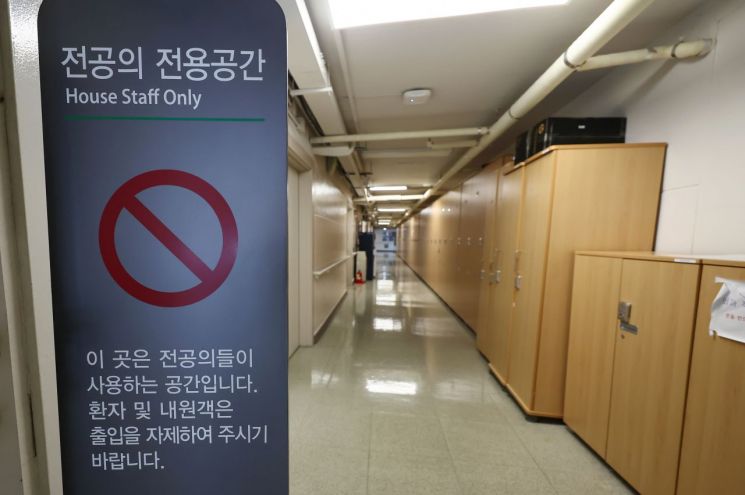
According to the Ministry of Health and Welfare's Training Evaluation Committee and the medical community, out of 176 training hospitals nationwide that recruited a total of 3,594 residents for the first half of next year from the 4th to 9th at 5 p.m., most hospitals reportedly received only about 10 applicants each.
The Big 5 hospitals, which are major tertiary general hospitals and representative training hospitals in the Seoul area, also reportedly had single-digit applicants or barely exceeded 10 applicants per hospital.
In the previous recruitment for the second half of this year, the total number of recruits was 7,645, but the total number of applicants was only 125.
Residents resigned in February this year in opposition to the government's policy to increase medical school quotas by 2,000 and are currently mostly employed as general practitioners in hospitals and clinics, showing skepticism about returning to training hospitals. In particular, they strongly oppose the martial law command's proclamation on the 3rd, which specified 'punishment of residents' during President Yoon Seok-yeol's emergency martial law declaration.
A, who resigned from a training hospital in Seoul, said, "I am currently working as a general practitioner at a clinic-level hospital, so realistically, returning to a training hospital is difficult," adding, "I never really considered returning, but after seeing the martial law command's proclamation, I am even more determined never to go back." A emphasized, "The proclamation specifically singled out residents for punishment out of the blue. It shows how the government views the resigned residents."
B, who resigned from a regional training hospital, also said, "The proclamation revealed that the current government perceives residents as the main enemy," adding, "Now is the time to convey our demands for Korean healthcare, not to return to training hospitals." B, currently working at a general hospital, added, "Residents resigned; they did not strike, and many are still treating patients in medical settings."
These residents also argued that the government's resident training innovation plan, presented as one of the first medical reform implementation measures, lacks persuasive power to consider returning. The resident training innovation plan includes reducing residents' weekly working hours from 80 to 72, shortening continuous working hours from 36 to 24?30 hours, and expanding training allowance support.
Another resigned resident, C, said, "Although the government's proposed measures are positive in intent, they lack practicality and sustainability and may even be distorted," adding, "For example, if working hours are shortened without solving the problem of unpopular specialties, the same medical staff will have to work 'illegal hours' more to handle the same workload, and paradoxically, recognized working hours will decrease, leading to lower salaries."
© The Asia Business Daily(www.asiae.co.kr). All rights reserved.
![Clutching a Stolen Dior Bag, Saying "I Hate Being Poor but Real"... The Grotesque Con of a "Human Knockoff" [Slate]](https://cwcontent.asiae.co.kr/asiaresize/183/2026021902243444107_1771435474.jpg)















