Survey on 'Deepfake Fake News' in October-November
597 Respondents... 94.5% Say "Serious Impact"
Top Concern: "Personality Damage Such as Sexual Crimes"
According to a government-conducted public survey, 41.9% of the 597 respondents stated that they cannot distinguish deepfake fake news.
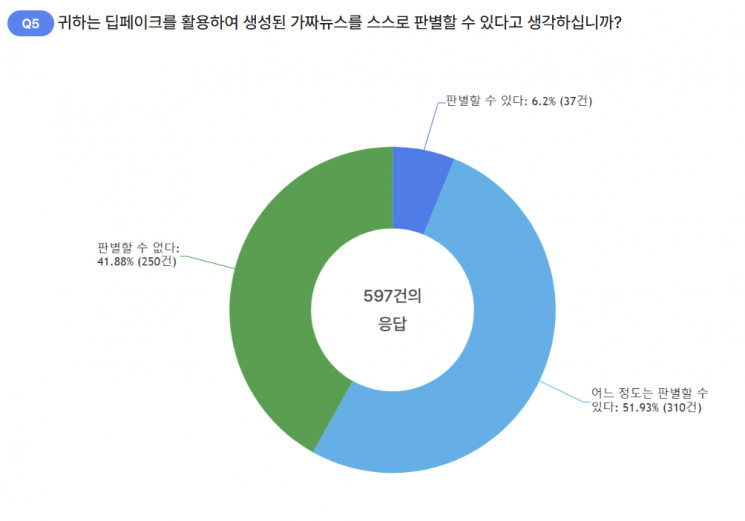
On the 9th, the Ministry of Science and ICT announced the results of a public survey conducted through a digital forum from October 10 to November 8 on the theme of 'Responding to Deepfake Fake News.' When asked, "Can you distinguish deepfake fake news on your own?" respondents answered as mentioned above. Among the same question, 51.93% answered that they can distinguish it to some extent, while only 6.2% responded that they can fully distinguish it.
Regarding the impact of fake news on individuals and society, 55.95% responded that it is "very serious," and 38.53% said it is "serious." In particular, when asked whether they think fake news using deepfakes has a more negative impact than general fake news, 61.31% answered "more serious," and 23.62% answered "somewhat more serious." 39% of respondents had encountered deepfake fake news.
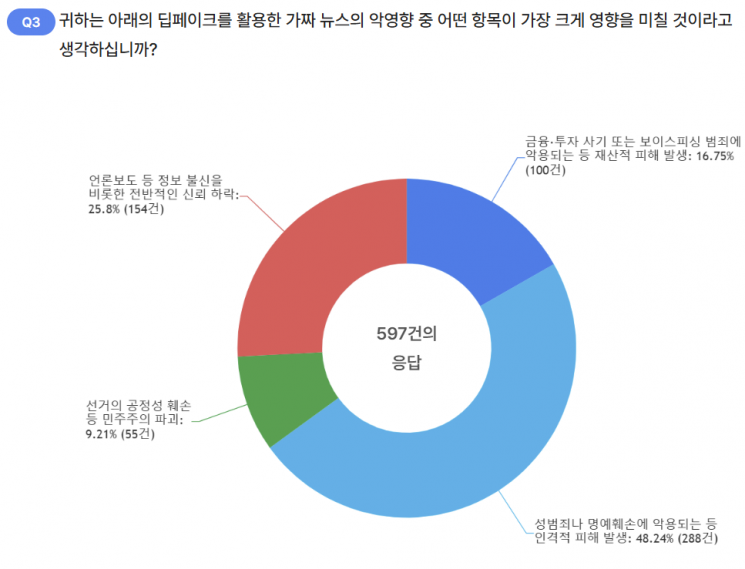
The biggest concern about the harmful effects of deepfake fake news was personal damage such as misuse in sexual crimes or defamation, accounting for 42.24%. Next were a general decline in trust including distrust in media reports (25.8%), property damage such as misuse in fraud and voice phishing crimes (16.75%), and destruction of democracy such as undermining election fairness (9.21%), in that order.
The Ministry of Science and ICT also held a policy idea contest during the same period. Jiwoo Park and Seongmo Yoo, who proposed "Tracking and detecting deepfakes through watermarks," received the grand prize, while policy proposals such as "Fake news detection using PGD-based watermarking" and "Establishment and support for AI-generated content watermarking standards" received excellence awards.
On October 19, a university student debate on responses to deepfake fake news and sexual crimes was held through a digital in-depth issue debate competition. At the 3rd Digital In-depth Issue Colloquium, Director Changwon Pyo of the Crime Science Research Institute and science critic Dokshil Lee were invited to create a public forum related to deepfakes.
Song Sanghoon, Director of the Information and Communication Policy Office at the Ministry of Science and ICT, stated, "The public agrees that deepfake fake news has a significant negative ripple effect on individuals and society and that it is becoming increasingly difficult to distinguish from reality due to technological advancements," adding, "We will actively cooperate with the Korea Communications Commission to promptly revise laws and regulations."
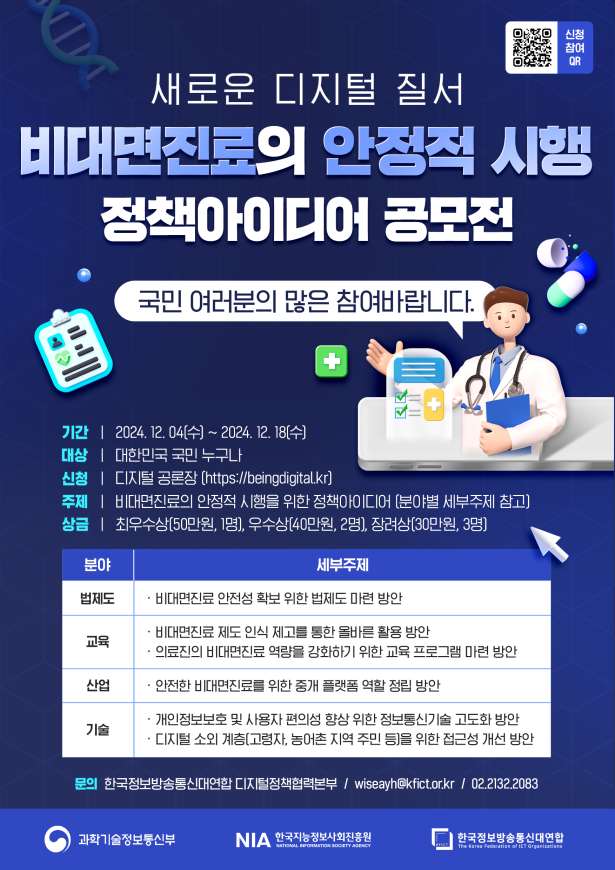
Meanwhile, the Ministry of Science and ICT will conduct a public survey and policy idea contest this month on the theme of "Stable Implementation of Non-face-to-face Medical Services." The survey plans to gather opinions on the experience of using non-face-to-face medical services, awareness, laws and regulations, and directions for policy improvement. On the 11th at 2 p.m., the 4th Digital In-depth Issue Colloquium will be held under the theme "Where Are We in the Medical Changes Caused by Digital Technology?"
© The Asia Business Daily(www.asiae.co.kr). All rights reserved.
![Clutching a Stolen Dior Bag, Saying "I Hate Being Poor but Real"... The Grotesque Con of a "Human Knockoff" [Slate]](https://cwcontent.asiae.co.kr/asiaresize/183/2026021902243444107_1771435474.jpg)

















