Donald Trump, the President-elect of the United States, stated in his first broadcast interview after winning the November 5 presidential election that he has no plans to fire Jerome Powell, the chairman of the Federal Reserve (Fed). He also announced that starting from his first day in office in January next year, he will implement key pledges such as high tariffs, large-scale deportation of illegal immigrants, and tax cuts. Additionally, he promised to pardon supporters who caused the January 6 Capitol riot after refusing to accept the 2020 election results.
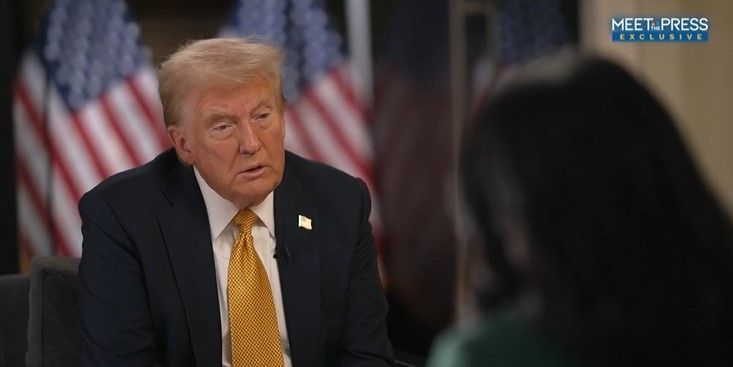
In an interview with NBC News' "Meet the Press" released on the 8th (local time), when asked if he planned to shorten Chairman Powell's term, Trump replied, "No. I have no such intention." He added, "If I told him to do so, he would, but if I asked, he probably wouldn't (resign)." Powell's term runs until May 2026.
Following Trump’s victory in the November election, speculation about Powell’s dismissal arose both inside and outside the market. During the election campaign, Trump expressed dissatisfaction with the Fed’s monetary policy decisions and hinted that he might fire Powell if he returned to the White House. In response, Powell clearly stated that "it is not legally permissible" and that he would remain in his position even if Trump demanded his resignation.
This interview was Trump’s first media interview after his election victory. It was pre-recorded in New York on the 6th. By directly stating that he has no plans to fire Powell before his term ends, concerns about the Fed’s independence are expected to ease somewhat.
"Tariffs, the most beautiful word in the world" Reaffirms pledge to implement key promises on first day in office
Trump reaffirmed his previous stance that he will implement his major pledges, including high tariffs and large-scale deportation of illegal immigrants, starting from his first day in office. When asked if he could promise that high tariffs would not increase the burden on American citizens, he said, "Nothing can be guaranteed," but claimed there was no inflation during his first administration. He reiterated, "Tariffs are the most beautiful word in the world," emphasizing that "they will make us rich." Notably, Trump also claimed that "when used properly, tariffs can serve many purposes," and asserted that he prevented wars and other problems through tariffs, drawing attention.
When asked if he would deport all illegal immigrants during his second term, he replied, "I think it should be done," adding, "There is no choice." He said, "We will start with criminals (among illegal immigrants) and then deport others," and "We will see how it proceeds." Regarding cases where parents are illegal immigrants but their children legally reside, he mentioned, "The only way to keep families together is to send them all back."
Trump also explained that he would abolish birthright citizenship on his first day in office. Under the current U.S. Constitution, citizenship is granted to anyone born on U.S. soil regardless of their parents’ immigration status. When asked if an executive order could override the Constitution, he said, "That will have to be changed." However, regarding the so-called 'Dreamers,' beneficiaries of the Deferred Action for Childhood Arrivals (DACA) program implemented during the Barack Obama administration, he expressed a willingness to cooperate with the Democrats to create a plan allowing them to remain in the U.S., stating, "They have gotten good jobs, started businesses, and become successful citizens."
"If they pay the bills, NATO will stay" Repeats claim of free-riding on security
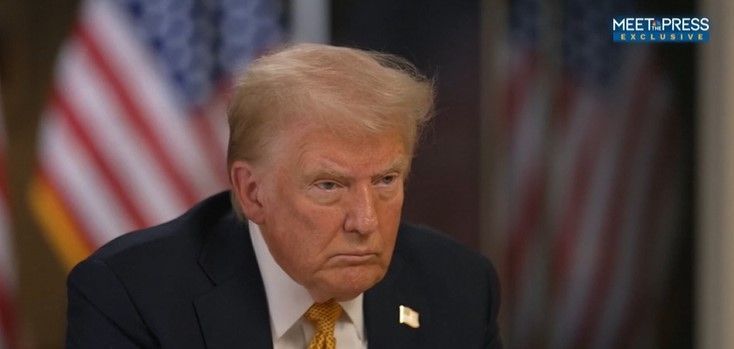
Regarding the North Atlantic Treaty Organization (NATO), Trump said, "If they (NATO member countries) treat us fairly, of course we will remain in NATO." He claimed, "European countries are exploiting us terribly in trade," and added, "On top of that, we are defending them." This aligns with his previous statements criticizing allies for free-riding on security. In October, Trump also referred to South Korea as a "money machine," demanding $10 billion (about 14 trillion won) annually for defense costs.
Regarding support for Ukraine, he reaffirmed that U.S. aid would decrease after the start of his second administration next year. Mentioning casualties from the Russia-Ukraine war, he said, "It should never have happened," adding, "I am trying to end (the Russia-Ukraine war) if possible (even before taking office)." When asked if he had spoken with Russian President Vladimir Putin since his election, he avoided a direct answer, saying, "Not recently."
On the same day, Trump said he would not order an investigation into current President Joe Biden. He explained, "I have no plans to do that (order an investigation into Biden) unless I find something I consider reasonable," adding, "I don’t want to go back. I want to make our country successful. Retribution will come through success."
However, he also added, "It will be up to Pam Bondi (nominee for Attorney General), and in another area, (FBI Director nominee) Kathy Patel’s decision," suggesting that investigations could proceed based on their own judgment rather than his direct orders. Previously, Trump had pledged to appoint a special prosecutor to investigate President Biden. While he said he would not order an investigation into Special Prosecutor Jack Smith, who indicted him, he left room by saying, "I hope Bondi does what she wants." Furthermore, regarding supporters who caused the January 6, 2021 Capitol riot, he announced a pardon plan, saying, "I will act very quickly. On the first day of my inauguration."
© The Asia Business Daily(www.asiae.co.kr). All rights reserved.
![Clutching a Stolen Dior Bag, Saying "I Hate Being Poor but Real"... The Grotesque Con of a "Human Knockoff" [Slate]](https://cwcontent.asiae.co.kr/asiaresize/183/2026021902243444107_1771435474.jpg)
















