"Loyal ruling party (People Power Party) lawmakers boycotted the vote, and the crowd called for the president's impeachment." (BBC)
"The Speaker of the National Assembly condemned the ruling party lawmakers for boycotting the vote, saying it would be a disgrace in Korean history." (Bloomberg)
Major foreign media outlets are closely monitoring South Korea's political situation by providing real-time coverage of the impeachment vote against President Yoon Suk-yeol on the afternoon of the 7th.
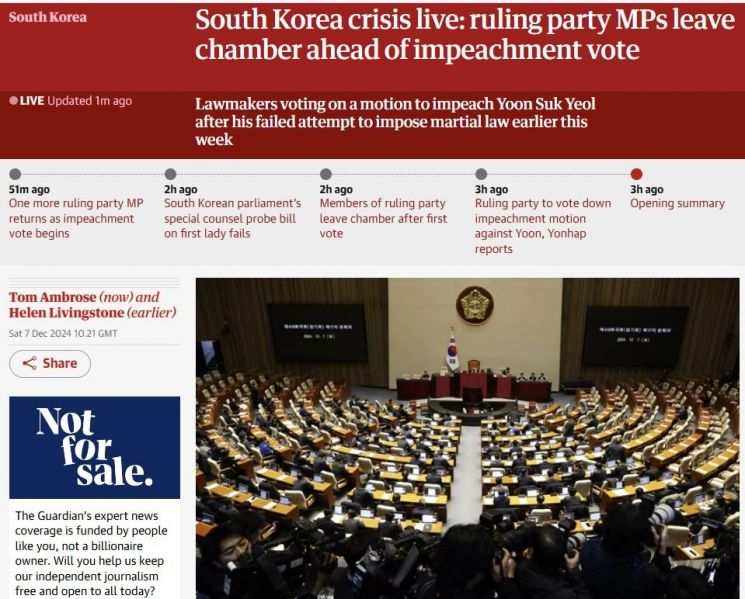
Bloomberg, Reuters, The New York Times (NYT), BBC, and others are running live streaming on their homepage main pages, delivering breaking news from President Yoon’s national address in the morning to the vote in the afternoon. The British daily The Guardian is also live streaming with a cut title on the left side of its homepage reading "South Korea Crisis." Foreign media typically operate such live sections for highly important issues.
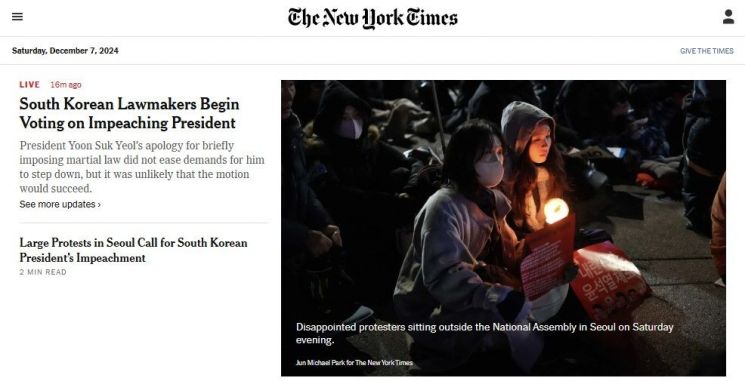
NYT reported in real time that the special law on Kim Geon-hee, which was voted on before the impeachment motion, was rejected, and "People Power Party lawmakers who finished voting left their seats." It also reported that Park Chan-dae, the floor leader of the Democratic Party of Korea, was reading the names of ruling party lawmakers one by one, appealing for them to return to their seats to vote. Additionally, NYT focused on protesters outside the National Assembly shouting "Impeach Yoon Suk-yeol." The outlet included photos of protesters gathered in the cold, noting, "President Yoon apologized earlier this week for the political crisis he created (the declaration of martial law), but it did little to ease calls for his resignation. Many protesters gathered outside the National Assembly even before the vote."
BBC reported, "The impeachment vote failed to reach the required quorum," attributing this to "loyal lawmakers boycotting." The Guardian also reported through a live stream titled "South Korea Crisis: Ruling party lawmakers left the parliament ahead of the impeachment vote," stating, "With only one ruling party lawmaker remaining in the parliament, the Speaker raised his voice in criticism." This one lawmaker referred to Ahn Cheol-soo, and this live report was made before the voting of Kim Ye-ji and Kim Sang-wook was confirmed. Later, The Guardian introduced the Speaker Woo Won-shik’s appeal to the ruling party lawmakers who had left, quoting him saying, "How do you think the people and the world will see this? Aren’t you afraid of history’s judgment?"
U.S. CNN reported, "After ruling party lawmakers boycotted the National Assembly, President Yoon survived the impeachment vote," noting that "at least 200 lawmakers are needed for the vote." It added that if the vote fails as expected, the next impeachment vote will be held on the 11th. The outlet also highlighted, "Although the martial law was brief, it caused nationwide shock and anger," and noted, "South Korea suffered deep wounds under decades of military dictatorship, experiencing the brutality of martial law until it won a long and bloody fight for democracy in the 1980s."
Bloomberg expressed concerns that the impeachment process could be prolonged. The outlet said, "What the market hates most is uncertainty," calling it "a bad signal for the market." It also noted the rising voices outside the National Assembly calling for impeachment and conveyed a citizen’s voice saying, "I was so angry to see ruling party lawmakers leaving in groups. They are not qualified to represent the people."
Japanese and Chinese media also paid close attention to the situation in South Korea. Japan’s public broadcaster NHK interrupted regular programming at 6 p.m. to live broadcast President Yoon’s impeachment vote after his national address on the martial law situation earlier that morning. Victor Cha, Korea Chair at the U.S. think tank Center for Strategic and International Studies (CSIS), told NHK in an interview that President Yoon’s national address seemed to express regret for the reckless decision to declare martial law and was an attempt to atone for the mistake and maintain political influence in South Korea to remain in the presidential position. Kyodo News and Jiji Press also reported that People Power Party lawmakers left en masse and predicted the motion would be rejected.
China Central Television (CCTV) covered the rejection of the special investigation law on Mrs. Kim Geon-hee and the ruling party lawmakers’ exit as the lead story in its news program. CCTV reported, "Ruling party lawmakers left collectively," and "Opposition lawmakers stood up in unison, urging the ruling party lawmakers to return."
© The Asia Business Daily(www.asiae.co.kr). All rights reserved.
![Clutching a Stolen Dior Bag, Saying "I Hate Being Poor but Real"... The Grotesque Con of a "Human Knockoff" [Slate]](https://cwcontent.asiae.co.kr/asiaresize/183/2026021902243444107_1771435474.jpg)
















