Overseas Offices and Dispatched Agencies Strengthen Situation Sharing and Reporting Systems
FSS Overseas Offices Report Directly to the Governor in Real Time
FSC Enhances 'Shift Work System' for Domestic and International Market Monitoring Teams
Financial Authorities' Heads Urge Active Communication with Overseas Investors in the Private Sector
Direct Communication Initiated with Overseas Media
Following the emergency martial law situation under President Yoon Suk-yeol and the National Assembly's failure to impeach the president, volatility in financial markets such as exchange rates and stock markets has increased, raising uncertainty about the future of the Korean market. In response, financial authorities have been continuously strengthening their situation-sharing and reporting systems through overseas offices and global institutions. The Financial Supervisory Service (FSS) has arranged for local information delivered by overseas offices to bypass the usual reporting sequence and be received directly by the Commissioner. Meanwhile, the Financial Services Commission (FSC) has reportedly reinforced shift work systems to monitor domestic and international overnight market trends. The financial authorities plan to swiftly implement additional system enhancements if necessary to prevent a decline in external credibility.
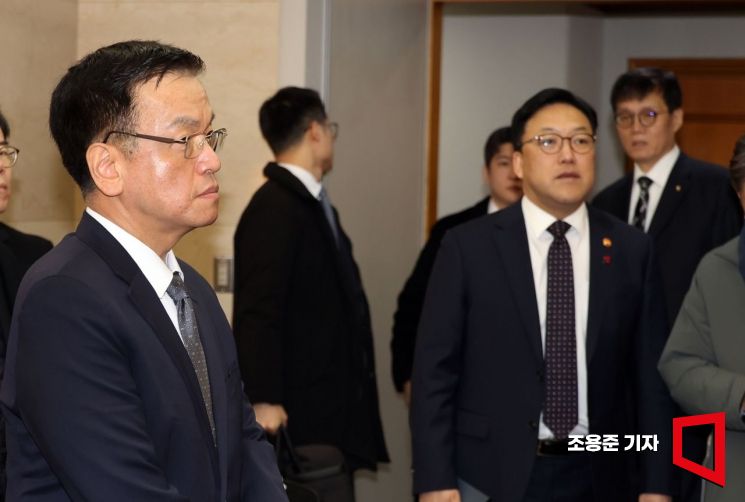 Choi Sang-mok, Deputy Prime Minister and Minister of Economy and Finance (left), Lee Chang-yong, Governor of the Bank of Korea (right), and Kim Byung-hwan, Chairman of the Financial Services Commission (center), are leaving the meeting room with serious expressions after a closed-door emergency macroeconomic and financial issues meeting held on the 4th at the Korea Federation of Banks in Jung-gu, Seoul. Photo by Jo Yong-jun
According to a comprehensive report by Asia Economy on the 9th, the FSS has confirmed that it began operating a strengthened hotline allowing overseas offices to report to the Commissioner in real time following the martial law situation. According to the FSS organizational management regulations, overseas offices are organizations that cooperate with foreign financial supervisory authorities and institutions, collect data related to financial supervision systems, and are established in six countries: New York (USA), London (UK), Tokyo (Japan), Beijing (China), Frankfurt (Germany), and Hanoi (Vietnam).
In addition, the role of overseas offices has been significantly expanded, including enhanced monitoring functions. They conduct 24-hour checks on local procurement and capital market conditions and relay global evaluations of the Korean market back to Korea. A key official in charge of overseas offices at the financial authorities stated, “Previously, we mainly focused on local institutional and market changes, but now we review all situations related to Korea, including political circumstances. If any unusual matters are discovered during this process, they are reported to the Commissioner in real time.”
Kim Byung-chil, Deputy Commissioner of the FSS, also explained in a phone interview with Asia Economy, “We have strengthened the reporting system of overseas offices. In particular, we are making efforts to accurately inform local institutions about the situation in Korea.”
The FSC has reinforced the shift work system of the organization responsible for monitoring financial markets. After the martial law situation, the Financial Market Analysis Division, which has been collaborating with other institutions such as the FSS and the International Financial Center to monitor overnight global trends, operated a three-shift system to monitor domestic and international market conditions. This division was especially responsible for checking overseas markets overnight and immediately reporting any unusual occurrences to higher authorities. An FSC official said, “The Financial Market Analysis Division has only 5 to 6 personnel, so it operated on a shift basis when necessary.”
The financial authorities are closely monitoring foreign investors because political uncertainties, such as the aftermath of martial law and the impeachment crisis, have accelerated global capital outflows and caused negative trends in Korean won assets. During the three days following the martial law, foreign selling pressure caused the KOSPI index to briefly fall below the 2400 level on the 6th. The KOSDAQ index also dropped more than 3% intraday, falling below the 650 level. On that day, the won-dollar exchange rate opened at 1416 won and surged to around 1429 won by 11 a.m., reflecting increased volatility due to uncertainty.
Since the onset of the situation, financial authorities have urged private financial firms to actively communicate with foreign investors. On the morning of the 4th at 8:30 a.m., FSC Chairman Kim Byung-hwan held a “Financial Situation Review Meeting” with private financial firms, just three and a half hours after President Yoon Suk-yeol declared the lifting of martial law at around 4:30 a.m. An attendee of the meeting said, “There was a request for financial firms to actively convey the message to foreign shareholders and investors that they need not worry about Korea’s foreign exchange and stock markets.”
On the same day, FSS Commissioner Lee Bok-hyun also held a meeting with overseas investors, including branches of foreign banks, during an “Expanded Financial Situation Review Meeting.” At a meeting on the 6th, Commissioner Lee emphasized, “We will strengthen on-site communication with the financial sector to prevent unnecessary misunderstandings about Korea’s economy and financial markets and reflect this in ongoing tasks.”
These heads of economic and financial authorities are personally managing communication with overseas media. Bank of Korea Governor Lee Chang-yong mentioned in an interview with the Financial Times (FT) that despite the political crisis in Korea, the economic impact is limited. He also pointed out that high tariffs imposed by the U.S. under the second Trump administration pose a greater burden on the Korean economy. This emphasized that external factors create more uncertainty for the Korean economy than internal ones. Furthermore, FSS Commissioner Lee Bok-hyun explained in an interview with Bloomberg TV, “Regardless of political instability, programs such as the ‘Value-Up Program’ will continue,” adding, “We are preparing various measures to respond to additional market turmoil.”
© The Asia Business Daily(www.asiae.co.kr). All rights reserved.
![Clutching a Stolen Dior Bag, Saying "I Hate Being Poor but Real"... The Grotesque Con of a "Human Knockoff" [Slate]](https://cwcontent.asiae.co.kr/asiaresize/183/2026021902243444107_1771435474.jpg)















