Paju City Council Cuts 13.7 Billion Won from Living Waste Collection and Transportation Budget in Preliminary Review
City States No Issues with Cost Estimation... Budget Cut Could Cause Major Confusion
At the preliminary review of the budget by the Urban Industry Committee of Paju City Council in Gyeonggi Province, when the budget of 13.7 billion KRW for outsourcing the collection and transportation of municipal solid waste in Paju was cut, Paju City expressed concerns that the cleaning system could be paralyzed and that significant disruption to citizens' daily lives could occur.
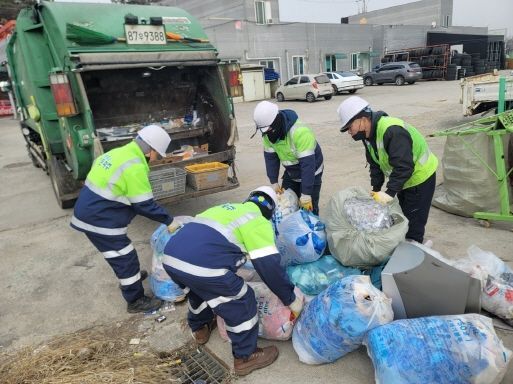 Paju City expressed concerns that cutting 13.7 billion KRW from the budget for outsourced collection and transportation of municipal solid waste during the preliminary review by the Urban Industry Committee of the Paju City Council could paralyze the cleaning system and cause significant disruption to citizens' daily lives. Photo by Paju City
On the 5th, the Urban Industry Committee of Paju City Council cut 13.7 billion KRW from the total 43.7 billion KRW budget for outsourcing the collection and transportation of municipal solid waste in Paju. In response, Paju City explained that due to the budget cut, the outsourcing companies would have no choice but to lay off more than 30% of the sanitation workers currently performing cleaning duties, and that the shortage of sanitation workers would inevitably paralyze cleaning operations, causing unavoidable inconvenience to citizens.
Regarding the reason for the budget cut cited by Assemblyman Son Seong-ik, who led the budget reduction, claiming there was a problem with the cost calculation for municipal solid waste collection and transportation, Paju City stated that the cost calculation was conducted by a specialized cost calculation service agency in accordance with Article 14 of the Waste Management Act and related regulations, and that there was no problem.
Furthermore, concerning Assemblyman Son Seong-ik's claim during a 5-minute free speech at the Paju City Council plenary session on the 6th that the cost calculation should have analyzed one year of GPS data but only two weeks of GPS data were used, thus not following the patent application of the cost calculation company, Paju City argued that he selectively quoted parts of the patent application to distort the facts as if there were errors.
The full patent application refers not to analyzing GPS data for one year, but to deriving optimal numbers of collection vehicles and workers over one year by using GPS and basic data corrected and calculated based on waste generation volume and characteristics. In reality, collection work shows the same pattern weekly, so it is unnecessary to analyze all collection and transportation vehicles for a full year. Almost all local governments nationwide calculate costs based on two weeks of GPS data.
Additionally, the city claimed that Assemblyman Son Seong-ik ignored the legal basis that cost calculation must be conducted by a specialized service agency according to Article 14 of the Waste Management Act, and made ultra vires remarks suggesting the establishment of an independent verification system and development of a public in-house system.
Paju City commissioned the relevant research to a specialized cost calculation service agency, which is a certified institution qualified to perform cost calculation and review under Article 6, Paragraph 2 of the Enforcement Decree of the Local Contract Act and Article 9, Paragraph 2 of the Enforcement Rules. As of the end of last year, this agency has performed cost calculation services for municipal solid waste and street cleaning for 57 local governments including Gangnam-gu, Seoul, demonstrating extensive experience as a professional cost calculation institution.
The cost calculation process was conducted fairly according to the Ministry of Environment Notification (2022-170) titled “Regulations on Cost Calculation Methods for Municipal Solid Waste Collection and Transportation Outsourcing Contracts,” and the final results were derived based on data such as number of workers, working hours, and collection and transportation volumes.
However, the Urban Industry Committee of Paju City Council cut the budget citing opinions that there were errors in the GPS analysis method used in the cost calculation and ordered a review of improvement measures for data collection. Paju City explained that cost calculation is mainly designed based on waste generation volume and characteristics, and GPS data is only one of the objective approaches.
The city stated that during the ongoing administrative investigation, a practitioner from the specialized cost calculation agency appeared as a witness on November 7 to provide detailed explanations, and the responsible department has explained multiple times to Assemblyman Son Seong-ik, but he continues to claim there are problems in the calculation process.
A Paju City official said, “Garbage cleaning work is a livelihood service directly connected to citizens' lives, an essential role in maintaining the urban environment and guaranteeing citizens' basic rights. With Paju City's population continuously increasing, the cleaning budget inevitably must increase as well. We hope it is remembered that cutting the budget ultimately harms the citizens of Paju.”
© The Asia Business Daily(www.asiae.co.kr). All rights reserved.
![Clutching a Stolen Dior Bag, Saying "I Hate Being Poor but Real"... The Grotesque Con of a "Human Knockoff" [Slate]](https://cwcontent.asiae.co.kr/asiaresize/183/2026021902243444107_1771435474.jpg)















