20,000 Jobs (0.8%) Increased Last Year
40,000 Jobs Decreased in Large Companies, 150,000 Increased in SMEs
Jobs for 20s Decreased for the First Time... Reduced by 80,000
Last year, the increase in the number of jobs and the growth rate recorded the lowest figures ever. By generation, it was found that jobs for people in their 20s decreased for the first time last year. Unlike the increase in jobs at small and medium-sized enterprises, the decrease in jobs at large corporations is also a notable factor.
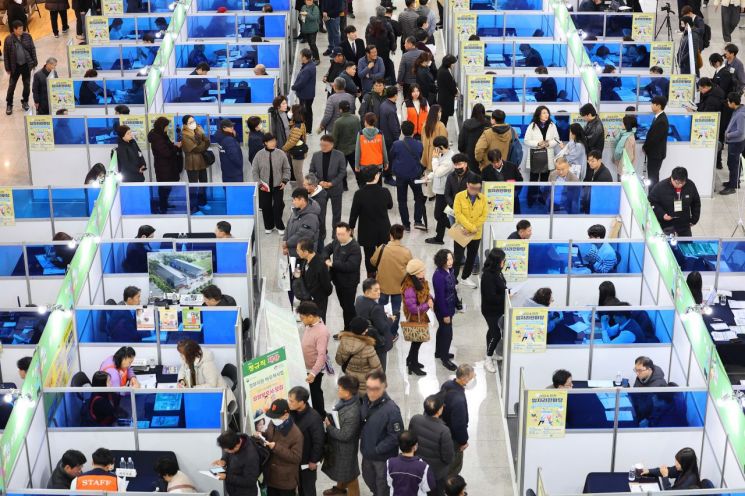 The scene from the '2024 Incheon Job Fair' held last month at Incheon City Hall in Namdong-gu, Incheon. This is unrelated to the article content. Photo by Yonhap News.
According to the '2023 Job Administration Statistics Results' announced by Statistics Korea on the 6th, the number of jobs last year was 26.66 million, an increase of 200,000 (0.8%) compared to the previous year. Both the increase in number and the growth rate last year recorded the lowest figures since related statistics began in 2016. Statistics Korea explained that the base effect and the reduction of jobs in some industries influenced this outcome.
Among all jobs, the number of continuous jobs held by the same worker as the previous year was 20.64 million (77.4%). Jobs where workers were replaced due to retirement or job change were 3.04 million (11.4%). New jobs created by company formation and business expansion were 2.98 million (11.2%), and jobs lost due to company closure or business reduction were 2.77 million.
By company size, jobs provided by for-profit companies were 20.95 million (78.6%), and jobs provided by non-profit companies were 5.7 million (21.4%). Among for-profit companies, jobs at large corporations were 4.41 million (16.5%), and jobs at small and medium-sized enterprises were 16.54 million (62.1%). Jobs at large corporations decreased by 40,000 compared to the previous year, while jobs at small and medium-sized enterprises increased by 150,000.
By industry, manufacturing had the most jobs with 5.13 million (19.2%). Following were wholesale and retail trade with 3.23 million (12.1%), health and social welfare with 2.64 million (9.9%), and construction with 2.21 million (8.3%). Among these, health·social welfare (100,000 jobs), manufacturing (60,000 jobs), accommodation·food service (60,000 jobs), and professional·scientific·technical services (40,000 jobs) saw job increases. In contrast, finance·insurance (-60,000 jobs), transportation·warehousing (-50,000 jobs), and wholesale and retail trade (-40,000 jobs) decreased.
By age group, jobs for people in their 50s were the most at 6.37 million (23.9%). Following were those in their 40s with 6.2 million (23.2%) and those in their 30s with 5.29 million (19.8%). Compared to the previous year, jobs increased for those aged 60 and over (380,000) and those in their 50s (20,000), but decreased for those in their 40s (-110,000) and 20s (-80,000). This is the first time jobs for people in their 20s have decreased.
Jobs refer to employment positions occupied by workers and have a different meaning from employed persons. For example, if a worker goes to a company during the week and works as an academy instructor on weekends, the employment statistics count this as one person, but jobs are calculated multiple times by applying weights based on the number of working days.
© The Asia Business Daily(www.asiae.co.kr). All rights reserved.
![Clutching a Stolen Dior Bag, Saying "I Hate Being Poor but Real"... The Grotesque Con of a "Human Knockoff" [Slate]](https://cwcontent.asiae.co.kr/asiaresize/183/2026021902243444107_1771435474.jpg)















