Evaluation Institute Analyzes 444,870 2024 CSAT Candidates
Korean and Math Standard Scores Also Higher Than Current Students
Last Year's Graduates Ratio Highest in 27 Years
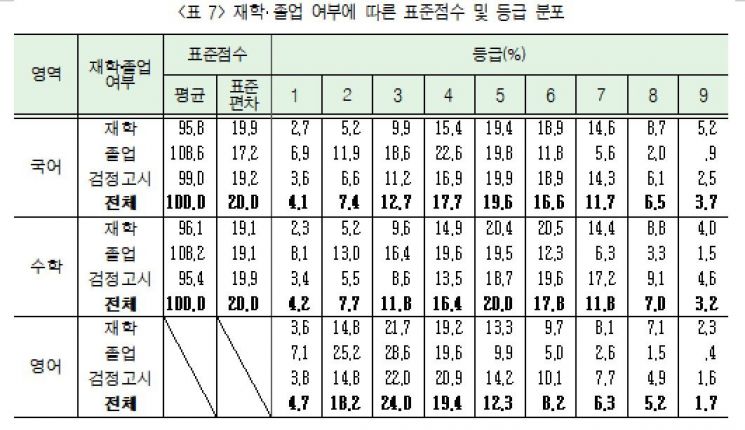
Analysis of last year's College Scholastic Ability Test (CSAT) candidates showed that the average standard scores in Korean and Mathematics, as well as the proportion of top 1st and 2nd grades across all subjects, were higher among graduates than current students. Additionally, scores were higher in metropolitan areas and private schools.
On the 8th, the Korea Institute for Curriculum and Evaluation announced these findings through the "2024 Academic Year CSAT Score Analysis Results."
Last year, the total number of CSAT candidates was 444,870. The total number of candidates had been steadily decreasing from the 2014 academic year to the 2021 academic year, then slightly increased in the 2022 academic year, and decreased again from the 2023 to the 2024 academic year.
Among last year's CSAT candidates, 287,502 were current students, 141,781 were graduates, and 15,587 took the qualification exam. Notably, the proportion of graduates was the highest in 27 years since the 1997 academic year (32.5%).
According to the score analysis, graduates had the highest average standard scores in Korean and Mathematics and the highest proportion of 1st and 2nd grades in all subjects. The proportion of 8th and 9th grades was lowest among graduates.
By gender, female students had higher standard scores in Korean, while male students scored higher in Mathematics. The proportion of 1st and 2nd grades in Mathematics was higher among male students, whereas in English it was higher among female students. The proportion of 8th and 9th grades was lower for females in Korean and English, and lower for males in Mathematics.
By school background, average standard scores in Korean and Mathematics were higher in private schools than in national and public schools. The proportion of 1st and 2nd grades was also higher in private schools across all subjects. The proportion of 8th and 9th grades was lower in private schools.
By region, the average standard scores in Korean and Mathematics were highest in metropolitan areas. The proportion of 1st and 2nd grades was also highest in metropolitan areas across all subjects. The proportion of 8th and 9th grades was lowest in metropolitan areas.
By city and province, Seoul had the highest average standard scores in Korean and Mathematics. The difference in average standard scores between schools within a city or province was smallest in Gwangju for Korean and Mathematics. Seoul had the highest proportion of 1st and 2nd grades across all subjects, while Daegu had the lowest proportion of 8th and 9th grades.
© The Asia Business Daily(www.asiae.co.kr). All rights reserved.
![Clutching a Stolen Dior Bag, Saying "I Hate Being Poor but Real"... The Grotesque Con of a "Human Knockoff" [Slate]](https://cwcontent.asiae.co.kr/asiaresize/183/2026021902243444107_1771435474.jpg)
















