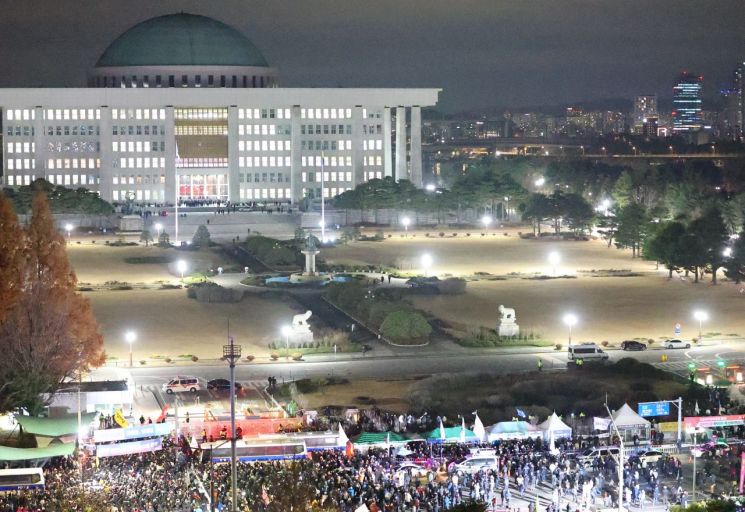
The Biden administration's stance on President Yoon Suk-yeol's declaration of martial law is becoming increasingly tense. While the U.S. side has conveyed messages that the South Korea-U.S. alliance remains strong even after the martial law situation, concerns are emerging that short-term negative impacts on Korea-U.S. cooperation may occur, given the postponement of U.S. Secretary of Defense Lloyd Austin's visit to South Korea.
On the day martial law was declared, the 3rd, U.S. Deputy Secretary of State Kurt Campbell stated that the U.S. is "watching recent developments in South Korea with grave concern," and on the 4th, he evaluated that President Yoon had "badly misjudged." This is considered a very unusual and strong diplomatic criticism from the second-highest official in the U.S. State Department responsible for Korea policy.
Additionally, Vedant Patel, Deputy Spokesperson of the State Department, the main diplomatic agency, pointed out during a briefing on the 5th, "There are many questions that need to be answered regarding the decisions surrounding this development (martial law)," and emphasized, "The activation of martial law and the potential impact of such measures on individual rights and freedoms is certainly a matter that must be taken very seriously."
The U.S. side also decided to postpone Secretary Austin's visit to South Korea and indefinitely delay the Korea-U.S. Nuclear Consultative Group (NCG) meeting and tabletop exercise originally scheduled for the 4th and 5th. For the Biden administration, which has about a month and a half left in office until the inauguration of the Trump administration on the 20th of next month, this schedule might have been important for managing achievements, but the fact that it was effectively canceled is seen by diplomatic circles as sending a certain message to South Korea.

The unusual stance of the U.S. appears to be primarily based on the judgment that the recent declaration of martial law, which has sparked constitutional controversy, contradicts the Biden administration's emphasis on human rights and democracy. There may also be dissatisfaction over the fact that the allied U.S. was not given prior notice before the announcement of martial law, which involves troop mobilization. It also seems that the sudden declaration of martial law was considered a dangerous matter from a security perspective.
In this regard, the Wall Street Journal (WSJ) editorial on the 4th speculated, "Signs of internal turmoil in South Korea, such as President Yoon's declaration of martial law, could provoke reckless military actions by North Korean dictator Kim Jong-un," and "The Biden administration may have given President Yoon some sharp advice regarding the risks of martial law, keeping in mind the U.S. troops stationed in South Korea."
However, the U.S. side has repeatedly emphasized that the Korea-U.S. alliance and defense commitments to South Korea remain ironclad even after the martial law situation. Deputy Spokesperson Patel stated at the briefing, "We will continue to support South Korea's rule of law and democracy, which we consider the fundamental pillars of the alliance," and "We continue to expect that South Korea's democratic system and democratic processes will prevail." He also stressed, "This relationship, this alliance, and the partnership we have with South Korea transcend any particular president or government on both sides of the Pacific (Korea-U.S.)."
This reflects concerns that Korea-U.S.-Japan cooperation aimed at North Korea and China should not be affected. However, there are also concerns that short-term negative impacts on Korea-U.S. cooperation may occur. There is also worry that this could become a variable in establishing a new relationship with the second Trump administration, which officially begins in January next year.
© The Asia Business Daily(www.asiae.co.kr). All rights reserved.
![Clutching a Stolen Dior Bag, Saying "I Hate Being Poor but Real"... The Grotesque Con of a "Human Knockoff" [Slate]](https://cwcontent.asiae.co.kr/asiaresize/183/2026021902243444107_1771435474.jpg)
















