CDMH, Preparation and Distribution for Winter Respiratory Disease Patients
Special Response Period Operated During Seol Holiday
The government has decided to reactivate fever clinics and COVID-19 cooperative hospitals to prepare for respiratory diseases that frequently occur during the winter season. During next year's Lunar New Year holiday, a 'Special Response Period for the Lunar New Year Holiday' will be operated, similar to the last Chuseok holiday.
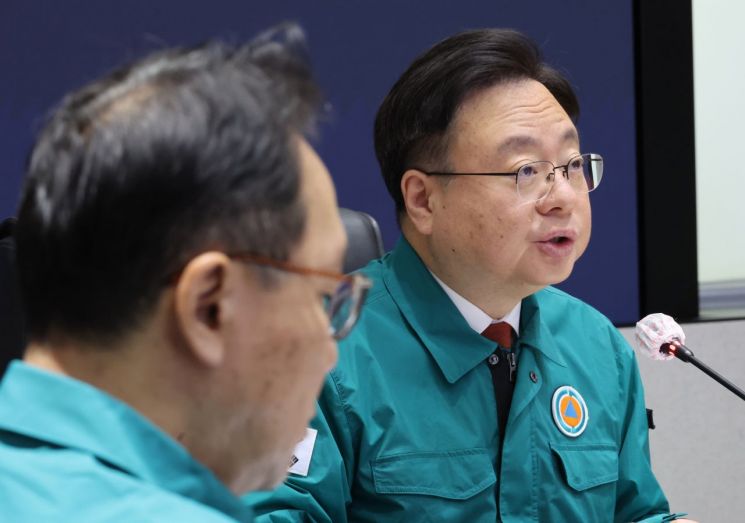 Minister of Health and Welfare Cho Kyoo-hong is speaking at the Central Disaster and Safety Countermeasures Headquarters meeting on doctors' collective action held on the 6th at the Situation Room of the Government Seoul Office in Jongno-gu, Seoul. Photo by Yonhap News
On the 6th, Cho Kyu-hong, Minister of Health and Welfare, held a meeting of the Central Disaster and Safety Countermeasures Headquarters for the doctors' collective action to check the implementation status of measures to increase vaccination rates in preparation for winter and discussed emergency medical measures for the winter season.
The government will first reactivate more than 100 fever clinics and about 200 COVID-19 cooperative hospitals to disperse mild patients to nearby hospitals and prevent overcrowding in emergency rooms in preparation for the surge in respiratory diseases this winter. In particular, the 'Inter-Ministerial Joint Response Team for Respiratory Infectious Diseases' will be operated to closely monitor domestic and international respiratory disease outbreaks and implement measures such as focused management of high-risk groups and encouragement of vaccinations.
The emergency medical system for winter will also be strengthened. In addition to the current 14 regional base centers, about 10 more will be designated to supplement the capacity to respond to severe emergency patients. Institutions will be evaluated on their contribution to emergency medical care, including acceptance of severe emergency patients and provision of follow-up treatment, and outstanding institutions will receive post-incentives.
For specific diseases such as cardiovascular and cerebrovascular diseases, pediatrics, and obstetrics, the medical cooperation network within regions will be strengthened to minimize treatment gaps through rapid transfer and referral. The upcoming Lunar New Year holiday, which is a bridge holiday, will be designated and operated as a 'Special Response Period for the Lunar New Year Holiday,' just like the last Chuseok holiday.
Along with this, the medical environment will be improved to prevent workforce attrition. To allow tertiary general hospitals to focus on severe and emergency care, fees for severe surgeries and anesthesia will be increased through a pilot project for structural transformation, and additional fees for emergency treatment and follow-up surgeries will be expanded. The intensive care unit admission fee will be increased by 50%, strengthening critical care functions. Starting next year, capable tertiary general hospitals will be able to serve as regional emergency centers through the reorganization of the 'emergency medical delivery system,' securing the final treatment capacity of follow-up departments and minimizing cases of emergency room refusal.
Minister Cho said, "We will work closely with medical institutions on the ground to ensure that the emergency medical system centered on severe and emergency patients operates smoothly even during the winter when patient numbers may increase," and urged, "We ask the public to use nearby hospitals for mild symptoms so that severe and emergency patients can receive treatment without missing the golden time."
He also urged everyone to get vaccinated as respiratory diseases such as COVID-19 and influenza are expected to increase this winter as well. As of the previous day, the vaccination rates for seniors aged 65 and older were 45.5% for COVID-19 and 78.2% for influenza.
Meanwhile, regarding the recent announcement by the Korean Hospital Association to withdraw from participation in the Medical Reform Special Committee, Minister Cho said, "I find it very regrettable." He added, "Saving regional and essential medical services and protecting the lives and health of the people is an unavoidable mission for both the government and medical professionals. To this end, the government will continue to communicate with the medical community in various ways and prepare reform measures."
He continued, "I deeply thank the committee members who are actively participating in the special committee discussions, including those related to medical care," and expressed, "I once again extend my deep gratitude to the medical staff who are doing their best in the medical field to protect the lives and safety of the people despite difficult circumstances."
© The Asia Business Daily(www.asiae.co.kr). All rights reserved.
![Clutching a Stolen Dior Bag, Saying "I Hate Being Poor but Real"... The Grotesque Con of a "Human Knockoff" [Slate]](https://cwcontent.asiae.co.kr/asiaresize/183/2026021902243444107_1771435474.jpg)















