Artemis Manned Moon Landing Plan Delayed Another Year
Spacecraft Defect Found and Alternatives Prepared
Trump May Further Change Plan by Appointing Musk Ally as NASA Director
Possible Impact on Korea-US Cooperative Artemis Research Plan
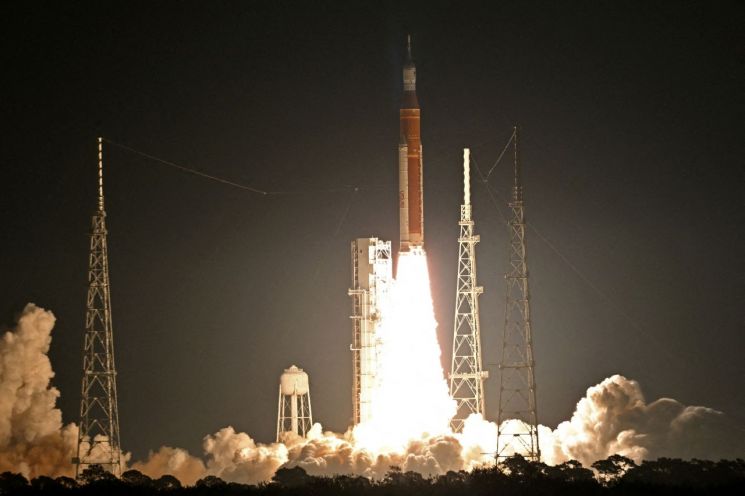 In November 2022, the SLS rocket carrying the Orion capsule soared toward the moon from Cape Canaveral Base in Florida, USA. This rocket is part of the Artemis 1 mission, which aims to land humans on the moon. Photo by Reuters Yonhap News
The United States has postponed its plan to send humans to the lunar surface for the first time in half a century by one year, moving the timeline to 2027. This decision is expected to inevitably impact the cooperation between South Korea and the United States on this project.
NASA announced on the 5th (local time) during a press conference that the Artemis program's second phase plan (Artemis II), which involves sending a crewed spacecraft to orbit the Moon, has been delayed until April 2026. This also means that the third phase plan, Artemis III, which aims to land astronauts on the Moon, will be postponed to 2027.
NASA has been continuously delaying the Artemis program. Initially, the plan was to launch Artemis II in November this year, sending four astronauts to lunar orbit and returning them to Earth, followed by Artemis III next year. However, in January, Artemis II was rescheduled to September next year, and Artemis III to September 2026. With the latest delay, the execution of Artemis II and III missions will be postponed by approximately 7 months to a year.
NASA Administrator Bill Nelson explained that they have identified the root cause of the heat shield issue on the Orion capsule, which will carry astronauts to the Moon. According to NASA's investigation, during the first Artemis test in 2022, the Orion capsule that returned to Earth had a heat shield that cracked and partially eroded while re-entering Earth's atmosphere, leading to a series of subsequent delays.
 Bill Nelson, NASA Administrator, is announcing the delay of the Artemis program at a press conference on the 5th. Photo by AFP Yonhap News
Administrator Nelson said, "We need time to ensure that the Orion capsule is ready to safely carry astronauts to deep space and bring them back to Earth."
Deputy Administrator Pam Melroy also explained, "This issue occurred due to the way Orion re-enters Earth's atmosphere," and added that a new method will be chosen for future missions. The Artemis program is the United States' plan to send humans back to lunar orbit for the first time in half a century since the Apollo program ended in 1972. The original goal was to land people on the Moon by 2028, but during Donald Trump's first term, then-Vice President Mike Pence directed that a crewed lunar landing be achieved by 2024, significantly accelerating the schedule.
This decision was intended to counter China's lunar landing plans and to ensure the U.S. would be the first to send humans to the Moon. China announced in April that its crewed lunar landing plan would be pursued by 2030. Consequently, the U.S. no longer felt pressured to rush the Artemis program due to concerns about being overtaken by China.
The Artemis plan could change again if Trump's second term begins. Earlier, President-elect Donald Trump nominated billionaire Jared Isaacman (41), an ally of Elon Musk, Tesla's CEO, as NASA administrator. Isaacman is known for collaborating with Musk's space company SpaceX and setting the record for the first private spacewalk last September.
If Isaacman assumes the role of NASA administrator, a major revision of the Artemis program cannot be ruled out. This is because the SLS rocket used in Artemis is costly and has faced reliability concerns, while SpaceX has succeeded in testing the Starship and Super Heavy rockets. NASA has already decided to use SpaceX's Starship for lunar landings.
Bloomberg News pointed out, "Isaacman's nomination is likely to raise concerns that he will favor Musk's SpaceX in NASA policies and contracts." Musk retweeted and shared both the statement released by Trump upon Isaacman's nomination and Isaacman's own posts, commenting, "Congratulations."
This change in plans is also expected to affect the Artemis cooperation between South Korea and the United States. The Korea Aerospace Agency signed a research agreement with NASA on Artemis last October and planned to jointly conduct feasibility studies in various fields including lunar lander development, space communication and navigation systems, astronaut support tools development, and space life sciences and medical operations. A Korea Aerospace Agency official stated, "We will confirm the impact on the Artemis research agreement."
© The Asia Business Daily(www.asiae.co.kr). All rights reserved.
![Clutching a Stolen Dior Bag, Saying "I Hate Being Poor but Real"... The Grotesque Con of a "Human Knockoff" [Slate]](https://cwcontent.asiae.co.kr/asiaresize/183/2026021902243444107_1771435474.jpg)

















