7 National Assembly Laws and 3 Martial Law Bills Proposed After Emergency Martial Law
The opposition parties, startled by the sudden declaration of martial law, have consecutively introduced related bills. These bills aim to fill the blind spots of martial law by granting the Speaker of the National Assembly command authority over the police blocking access to the National Assembly, or by rendering the martial law immediately invalid if the government declares it without notifying the National Assembly.
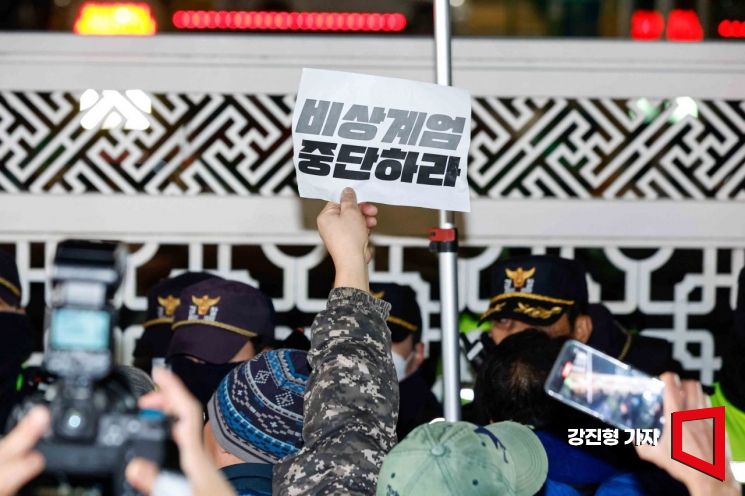 President Yoon Suk-yeol declared martial law, and on the 4th, citizens gathered in front of the National Assembly in Yeouido, Seoul, urging the lifting of martial law. Photo by Kang Jin-hyung
According to the Legislative Information System on the 6th, since the declaration of martial law on the 4th, seven amendments to the National Assembly Act and three amendments to the Martial Law Act have been proposed. Prior to the declaration of martial law, only three bills related to the Martial Law Act had been introduced since the 22nd National Assembly convened on May 30. Kim Min-seok, Senior Supreme Council Member of the Democratic Party, proposed an amendment to the Martial Law Act in September requiring the President, Yoon Seok-yeol, who nominated Defense Minister Kim Yong-hyun, to obtain the National Assembly’s consent before declaring martial law.
Lawmakers pointed out issues with the command chain of the police responsible for security outside the National Assembly building. When martial law was declared on the 4th, the National Assembly Security Unit under the Seoul Metropolitan Police Agency, following orders from the police command including the Seoul Police Chief, blocked members of the National Assembly and staff from entering the building. On the 5th, Kim Tae-seon of the Democratic Party proposed an amendment to the National Assembly Act to prioritize the National Assembly Security Unit’s obedience to the Speaker’s command during martial law. Kim Tae-seon explained, "The National Assembly must maintain the autonomy and independence of the legislative branch as the center of democratic governance," and added, "The security and protection system of the National Assembly should also be operated independently, reflecting the needs and special characteristics of the legislative branch."
A bill was also introduced to establish a security organization that only takes orders from the Speaker of the National Assembly. On the 5th, Kim Young-bae of the Democratic Party took the lead in proposing an amendment to the National Assembly Act to create a National Assembly Security Unit under the command and supervision of the Speaker. This bill allows the Speaker, with the consent of the National Assembly Steering Committee, to establish the Security Unit and provides a legal basis for the unit to be under the Speaker’s command and supervision. Han Jeong-ae of the Democratic Party proposed an amendment to the National Assembly Act assigning the 'National Assembly Police Officer,' a civil servant responsible for internal order management, to also handle external security of the National Assembly building.
A bill was introduced to prepare for cases where the main plenary hall is blocked. On the same day, Kim Tae-nyeon of the Democratic Party led the proposal of an amendment to the National Assembly Act allowing remote video meetings to be held in situations such as closure of the National Assembly or restrictions on members’ access to the plenary hall. The legal basis for holding plenary sessions remotely was created in 2020 due to the spread of COVID-19 but expired in June 2022 and has now been revived. So Byung-hoon of the Democratic Party proposed an amendment to the National Assembly Act specifying that remote video plenary sessions can be held only under conditions such as rebellion or declaration of martial law.
Bills addressing the loopholes in martial law were also introduced. Although the government declared martial law without immediately notifying the National Assembly, martial law was effectively implemented through the deployment of military or police forces. Furthermore, even though the National Assembly unanimously passed a resolution demanding the lifting of martial law in a plenary session, the government did not immediately lift it. On the 5th, Jin Sun-mi of the Democratic Party led the proposal of an amendment to the Martial Law Act that invalidates the effect of martial law if the procedures for notifying the National Assembly and requesting assembly are not followed. Yoon Ho-jung of the Democratic Party also introduced an amendment to the Martial Law Act. This bill requires prior approval from the National Assembly for martial law in non-war situations and stipulates that if the National Assembly demands lifting martial law with a majority of the total members’ approval, it is deemed to have passed the Cabinet meeting review process.
© The Asia Business Daily(www.asiae.co.kr). All rights reserved.
![Clutching a Stolen Dior Bag, Saying "I Hate Being Poor but Real"... The Grotesque Con of a "Human Knockoff" [Slate]](https://cwcontent.asiae.co.kr/asiaresize/183/2026021902243444107_1771435474.jpg)
















