'October International Balance of Payments (Preliminary)'
Current Account Surplus of 9.78 Billion USD... 3rd Highest on Record for October
Strong Export Performance in Semiconductors and Passenger Cars Continues
Exports of semiconductors and passenger cars continued to perform well, resulting in a current account surplus for six consecutive months. However, the surplus margin narrowed compared to the previous month due to an expanded decline in exports of petroleum products and others.
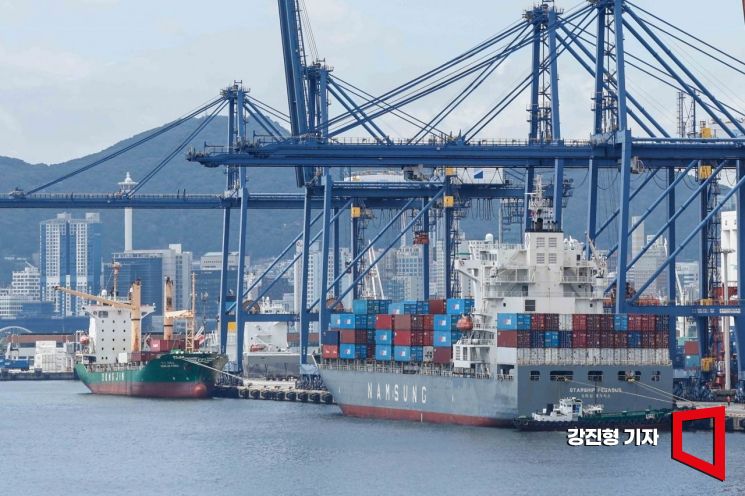
According to the 'October Balance of Payments (provisional)' released by the Bank of Korea on the 6th, South Korea's current account recorded a surplus of $9.78 billion in October. The current account had recorded a deficit for the first time in a year in April due to an increase in foreign dividend payments but has maintained a surplus for six consecutive months since May.
The surplus size ranked third highest ever for October. In October last year, the current account surplus was $7.44 billion.
The cumulative current account surplus from January to October was $74.24 billion, an increase of $50.06 billion compared to the same period last year ($24.18 billion).
The current account surplus continued as exports of semiconductors, passenger cars, and others expanded while imports decreased. The goods balance ($8.12 billion) saw a reduced surplus margin compared to the previous month. Exports amounted to $60.08 billion, up 4.0% year-on-year, while imports were $51.96 billion, down 0.7%. Based on customs clearance in October, semiconductor exports increased by 39.8%, steel products by 6.8%, passenger cars by 5.2%, information and communication devices by 5.2%, and chemical products by 1.6% compared to the same month last year. Conversely, machinery and precision instruments (-4.2%) and petroleum products (-34.5%) decreased.
By region, exports increased year-on-year to China (10.8%), Southeast Asia (7.7%), the EU (5.7%), and the United States (3.4%), while exports to Japan decreased (-2.9%).
Imports decreased by 0.7% year-on-year to $51.96 billion, mainly due to reduced imports of raw materials such as crude oil and petroleum products. Based on customs clearance in October, imports of raw materials decreased by 4.7% year-on-year, including crude oil (-17.9%), petroleum products (-13.3%), coal (-9.5%), and chemical products (-6.7%). On the other hand, imports of capital goods such as semiconductor manufacturing equipment (48.6%), semiconductors (18.2%), and precision instruments (3.3%) increased by 7.5%. Imports of consumer goods, including precious metals and jewelry (72.9%) and direct consumer goods (15.1%), also rose by 8.8%.
The services balance recorded a deficit of $1.73 billion, centered on processing services and other business services. The travel balance decreased by $480 million due to increased travel income influenced by China's National Day holiday, narrowing the deficit compared to the previous month (-$940 million). The transportation balance turned to a deficit of $230 million due to a decline in container ship freight rates.
The primary income balance showed a surplus of $3.45 billion, mainly from dividend income. The secondary income balance recorded a deficit of $50 million.
The financial account net assets, which indicate capital inflows and outflows, increased by $12.98 billion in October. Direct investment decreased by $1.96 billion due to factors such as overseas subsidiaries of domestic large corporations selling part of their shares.
Securities investment increased by $1.72 billion as stocks turned to net sales amid concerns over the performance slowdown of artificial intelligence (AI)-related stocks and caution ahead of the U.S. presidential election. This significantly narrowed the surplus margin compared to the previous month ($8.8 billion).
© The Asia Business Daily(www.asiae.co.kr). All rights reserved.
![Clutching a Stolen Dior Bag, Saying "I Hate Being Poor but Real"... The Grotesque Con of a "Human Knockoff" [Slate]](https://cwcontent.asiae.co.kr/asiaresize/183/2026021902243444107_1771435474.jpg)















