Professor Jeongmin Hanyang University Publishes 'Dasan's Diary'
Focus on Activities Before Exile to Gangjin
Four Volumes Including Geumjeong Ilrok and Jukran Diary
Simple Full Translation Would Be 300 Manuscript Pages
With Commentary, It Reaches 688 Pages
In 1800, King Jeongjo passed away, and the following year, amidst fierce factional strife, a massive persecution of Catholics took place. This was the Shin-yu Persecution. It was at this time that Dasan Jeong Yak-yong (1762?1836), a Catholic favored by Jeongjo, began his 18-year-long exile. Initially exiled to Janggi-hyeon in Gyeongsang Province, his place of exile was later moved to Gangjin in Jeolla Province in November 1801. Most people recall Dasan during his Gangjin exile period because he wrote major works such as Mokminsimseo and Gyeongseyu-pyo, which are considered his representative works, during this time.
Professor Jeong Min of Hanyang University, an authority on Dasan studies, recently published Dasan’s Diary, focusing on Dasan’s activities before his exile to Gangjin. He fully translated and annotated four diaries written by Dasan between 1795 and 1797: Geumjeong Ilrok (金井日錄), Jukran Ilgi (竹欄日記), Gyuyoung Ilgi (奎瀛日記), and Hamju Ilrok (含珠日錄). During this period, Dasan was demoted to a low-ranking local official, the Geumjeong Chalbang of Chungcheong Province, after being implicated in the failed arrest of Father Ju Mun-mo, and later pushed further to the position of Goksan Busa in Hwanghae Province, enduring hardships. Ju Mun-mo was a Catholic priest from China and the first foreign missionary to enter Joseon. He infiltrated Joseon in 1795 to conduct missionary work and was martyred during the Shin-yu Persecution. In his 2022 publication Seohak, Passing Through Joseon, Professor Jeong revealed that Dasan was the key figure who helped Father Ju Mun-mo avoid capture in 1795.
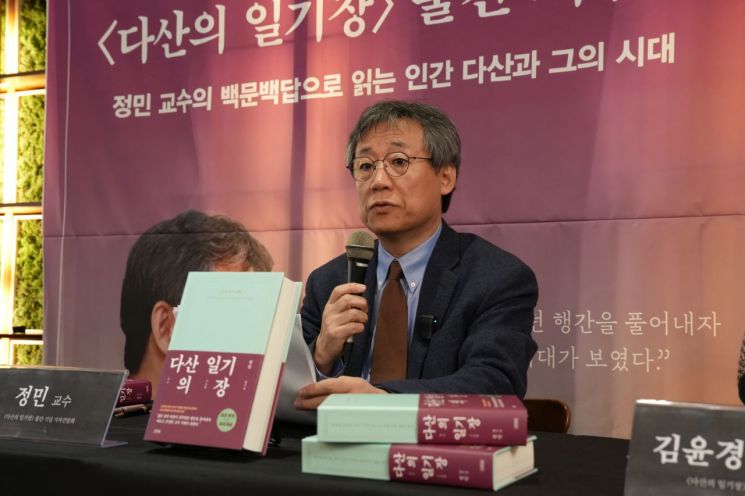 Professor Jeongmin from Hanyang University explained the new book "Dasan's Diary," which fully translates and annotates four diaries of Dasan Jeong Yak-yong, including Geumjeong Ilrok, at the Francisco Education Center in Jung-gu, Seoul, on the 3rd.
 [Photo by Kim Young-sa]
At a press conference held on the 3rd to mark the publication, Professor Jeong explained that through Geumjeong Ilrok and other diaries, one can see Dasan not as a lofty scholar but as a hot-tempered young politician.
"Dasan was truly remarkable at a young age. He was a vanguard leader and hot-headed. If things went wrong, he never let it slide. He confronted problems head-on and charged forward. This is quite different from the saintly image of Dasan that we know. This is natural because the fate of his family and political faction was at stake. These four volumes are diaries from that era."
Professor Jeong began serious research on Dasan after publishing Dasan Seonsaeng Jisik Gyeongyeongbeop in 2006. Initially, he focused on Dasan during his Gangjin exile. He also felt somewhat uncomfortable linking the scholar Dasan with Catholicism.
"At first, I avoided it, but when I looked into Dasan’s younger years, I realized it was not a simple matter. Some inexplicable parts made more sense when connected with Catholicism."
Dasan was very careful to conceal his true feelings in his diaries due to various political circumstances.
"The four diaries are merely a dry listing of facts?where he met whom, who sent letters, and what the contents were."
Thus, a straightforward translation of the four diaries amounted to only about 300 manuscript pages. However, with the added commentary, Dasan’s Diary spans a substantial 688 pages.
"Many figures appear in the diaries. Dasan wrote as if he just happened to stop by and meet them casually. But when you trace their genealogies, they are all connected to important events or figures. It felt like being repeatedly blindsided."
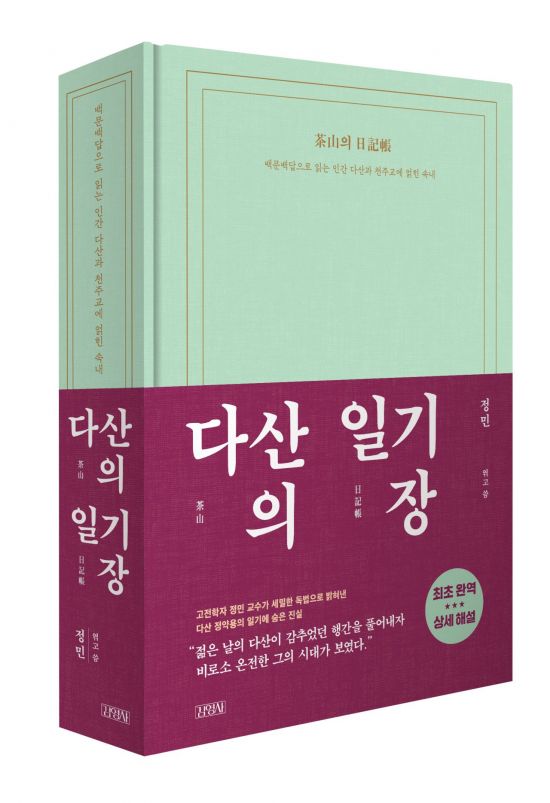
The most significant of the four diaries is Geumjeong Ilrok, which records five months during his time as Geumjeong Chalbang.
"The number of letters written during the five months as Geumjeong Chalbang exceeds those written during the entire 18 years of exile in Gangjin. This shows how intensely tense and critical that period was for Dasan."
Dasan’s third elder brother, Jeong Yak-jong, chose martyrdom in 1801, but Dasan, along with his second elder brother Jeong Yak-jeon, chose apostasy and thus avoided execution. Professor Jeong emphasized that approaching the sincerity of Dasan’s apostasy is less important than getting closer to the truth.
"I believe we should not approach this with a black-and-white logic of whether Dasan was an apostate or not. That era was a contradictory time created by the intersection of Confucianism and Western learning. Therefore, it requires a broader and deeper perspective. When you look closely at Dasan’s declaration of apostasy and his series of actions related to the Catholic persecution, it even feels like a prearranged game of Go-stop (a Korean card game). Only through meticulous reading between the lines of Dasan’s writings can we get closer to the truth of that era and to Dasan’s true intentions. That is what I wanted to focus on revealing in this book."
© The Asia Business Daily(www.asiae.co.kr). All rights reserved.
![Clutching a Stolen Dior Bag, Saying "I Hate Being Poor but Real"... The Grotesque Con of a "Human Knockoff" [Slate]](https://cwcontent.asiae.co.kr/asiaresize/183/2026021902243444107_1771435474.jpg)
















