Ban on Lawmaker Entry Is 'National Disorder'
Wide Recognition of Accomplices in Treason Charges
Following President Yoon Suk-yeol's declaration of martial law, controversy has arisen over the police's responsibility for the lockdown of the National Assembly. Barring lawmakers from entering the National Assembly, thereby rendering its authority impossible, is pointed out as a crime of rebellion under criminal law and an act of disrupting the national order. Experts believe that in cases of rebellion, accomplices are broadly recognized, meaning the police leadership cannot escape legal responsibility.
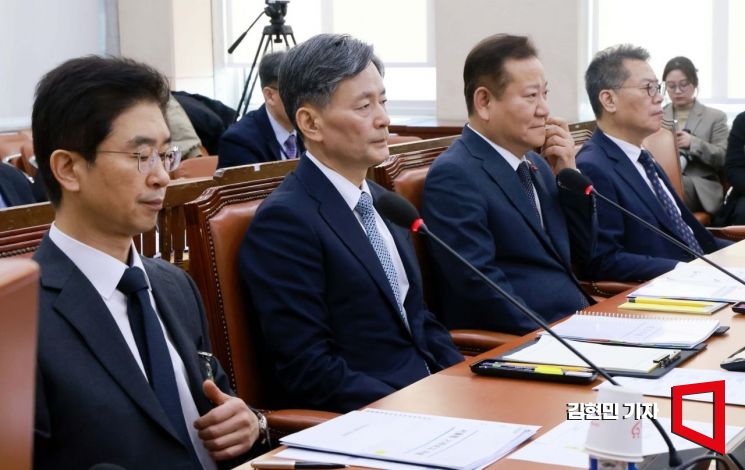 Minister of the Interior and Safety Lee Sang-min (from the right), National Police Agency Commissioner Cho Ji-ho, and Seoul Metropolitan Police Agency Commissioner Kim Bong-sik are attending an emergency hearing of the National Assembly's Public Administration and Security Committee on the 5th. Photo by Kim Hyun-min
On the 5th, at an emergency inquiry by the National Assembly's Public Administration and Security Committee, Police Chief Jo Ji-ho said, "Once the martial law commander's proclamation is issued, all administrative agencies are obliged to comply," adding, "I instructed to take necessary measures." The police deployed a stage for managing the assembly at the National Assembly around 10:35 p.m., immediately after the president's statement was announced, and access was controlled twice. The first control occurred around 10:46 p.m., citing concerns over unexpected incidents within the National Assembly, and 20 minutes later, lawmakers and related personnel were allowed entry after identity verification. Then, at around 11:37 p.m., a second full lockdown was implemented.
Chief Jo explained, "At around 11:30 p.m., then Martial Law Commander Park An-su called and requested control of the National Assembly. Initially, I refused, saying there was no legal basis. After confirming the proclamation's contents, I ordered the Seoul Metropolitan Police Agency to fully control access to the National Assembly." Proclamation No. 1 stated, "All political activities, including the activities of the National Assembly, local councils, political parties, political associations, assemblies, and demonstrations, are prohibited."
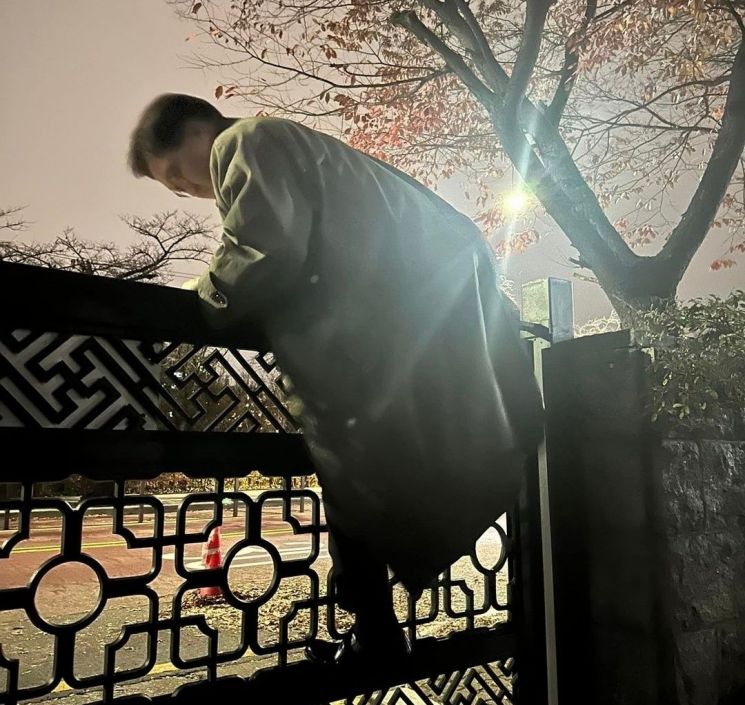 Speaker Woo Won-shik is climbing over the fence as the police block the entrance to the National Assembly. Photo by Woo Won-shik on Instagram
Seoul Police Chief Kim Bong-sik said, "At first, there was no time for legal judgment, so I thought control was appropriate," and 20 minutes after the first control, the National Assembly security chief conveyed a request for lawmakers to enter. Chief Kim added, "Upon further review, I thought there was insufficient legal basis. However, allowing all ordinary citizens to enter at once would be dangerous, so only lawmakers and those with National Assembly passes were permitted entry." National Assembly Security Chief Mok Hyun-tae stated, "As a police officer faithful to the chain of command, I followed the orders issued under the president's strict martial law and judged them to be legitimate instructions," and said he did not consider the orders illegal at the time.
Chief Jo said that around the time of leaving work, a presidential office official requested to wait near his office. After the declaration of martial law, he claimed to have received contact from the martial law command. Regarding the deployment of police personnel when martial law troops entered the Central Election Commission in Gwacheon, Gyeonggi Province, Chief Jo said, "I thought it was necessary to prepare for unforeseen incidents, so I called the Southern Gyeonggi Police Agency and gave instructions."
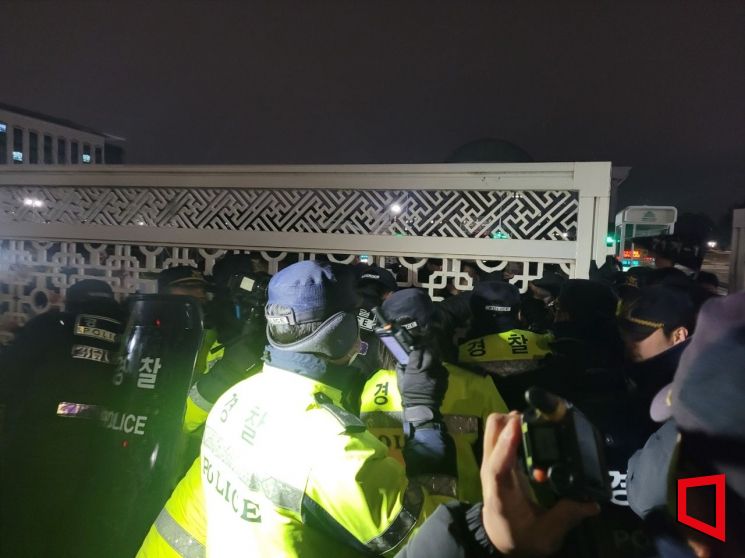
In the past, obstructing the exercise of rights by state agencies was recognized as rebellion. In the 1997 verdict on Jeon Du-hwan and Roh Tae-woo, the court ruled, "If the National Assembly was blockaded by military force, barring lawmakers from entry, and the National Assembly could not convene for a considerable period, it effectively made the National Assembly's authority impossible," and convicted them.
Experts foresee that crimes such as rebellion and abuse of authority to obstruct the exercise of rights could be established. Professor Lee Chang-hyun of Hankuk University of Foreign Studies Law School said, "If lawmakers were blocked from gathering to lift martial law, it violates the constitution and may constitute rebellion," adding, "It is important to know why the full lockdown occurred and who gave the orders. The Police Chief and Seoul Police Chief should have made an accurate situational judgment."
Professor Kim Jae-yoon of Konkuk University Law School pointed out, "Obstructing the National Assembly's lifting of martial law is a disruption of the national order and a significant act of participation. Those who gave command orders cannot escape responsibility," and said, "The National Assembly, which upholds the constitution, cannot be blocked by a martial law proclamation. That is unconstitutional. If judged independently, it would be abuse of authority to obstruct the exercise of rights."
Going forward, the police leadership will be investigated for rebellion. Currently, due to the adjustment of investigative authority between prosecutors and police, only the police can investigate rebellion, but criticism arises that a fair investigation cannot be conducted. Consequently, there are calls for a separate investigative body. Woo Jong-su, head of the National Police Agency's Criminal Investigation Headquarters, rebutted, "How can cases be assigned if there is no will to investigate?" The Public Administration and Security Committee resolved a motion demanding the swift arrest of suspects accused of rebellion, stating, "A prompt and fair investigation by investigative agencies is necessary."
© The Asia Business Daily(www.asiae.co.kr). All rights reserved.
![Clutching a Stolen Dior Bag, Saying "I Hate Being Poor but Real"... The Grotesque Con of a "Human Knockoff" [Slate]](https://cwcontent.asiae.co.kr/asiaresize/183/2026021902243444107_1771435474.jpg)

















