Hyundai Motor, Geumyang, Sungwoo Hitech, Kobat, Panstar, and Other Companies
Participation of Dongseo University, Dong-A University, Pusan National University, Pukyong National University, and Gyeongnam Information University
Dongseo University (President Jang Je-guk) held a ‘Industry-Academia-Research Cooperation Seminar for Innovation and Growth in the Secondary Battery Industry’ at Paradise Hotel Busan on the 4th.
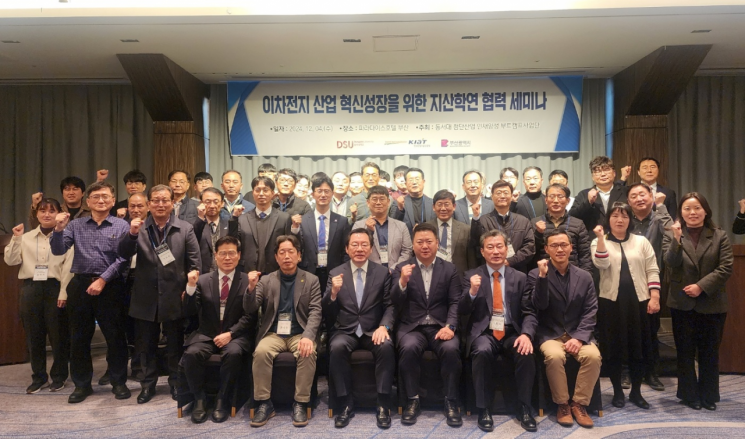 On the 4th, Dongseo University held the "Industry-Academia-Research Cooperation Seminar for Innovative Growth in the Secondary Battery Industry." Photo by Dongseo University
This seminar was organized as part of the ‘Advanced Industry Talent Training Bootcamp Project’ conducted by Dongseo University with support from the Ministry of Education, Korea Institute for Advancement of Technology, and Busan City. About 70 participants from companies including Hyundai Motor Company, Kumyang, Sungwoo Hitech, KOBAT, Fanstar, and universities such as Dongseo University, Dong-A University, Pusan National University, Pukyong National University, and Gyeongnam Information College gathered to explore ways to foster the secondary battery industry in Busan.
In the first keynote presentation, Park Yong-sung, a senior expert at the Carbon Neutral Green Growth Committee, emphasized the necessity of secondary batteries and electric vehicles in the 2050 carbon neutrality roadmap. According to the ‘Global EV Outlook 2024’ published by the International Energy Agency (IEA), global vehicle sales are expected to increase more than threefold from 15 million units in 2023 to 45 million units.
In the second presentation, Jung Chang-ho, head of Hyundai Motor Company’s Battery Performance Development Team, discussed global trends in eco-friendly vehicles, Hyundai Motor’s electrification and battery development strategies, and battery safety strategies, demonstrating Hyundai Motor’s leadership in future mobility.
In the third presentation, Jang Seok-young, Vice Chairman of Kumyang, presented on “Kumyang’s Cylindrical Battery World Leader Strategy,” highlighting Kumyang’s history with Busan, its future towards globalization, battery innovation business strategies, regional coexistence, and expansion of global cooperation, emphasizing Kumyang’s significant role in the Busan regional economy.
In the fourth presentation, Son Sung-man, head of the Research Center at Sungwoo Hitech, introduced critical information on electric vehicle crash safety, fire safety, and global vehicle development trends aimed at increasing energy density, which are very important for electric vehicle development.
In the fifth presentation, Baek Jong-hyun, CEO of KOBAT, introduced Japan’s energy policies and response strategies and KOBAT’s ESS technology solutions under the theme ‘KOBAT & Fanstar Enterprise Cooperation for Entry into the Japanese ESS Market.’ He explained that through the cooperation system between KOBAT, which has excellent ESS technology, and Fanstar Enterprise, which has extensive infrastructure and distribution know-how, the company will continue to grow.
In the sixth presentation, Nam Ho-soo, Dean of the Smart Mobility Department at Dongseo University, introduced strategies for innovative growth in the secondary battery industry and the ‘Secondary Battery Talent Training Bootcamp Project’ and ‘Bootcamp Operation System’ currently being conducted at Dongseo University. He stated that through training future secondary battery personnel at Dongseo University, sustainable growth of the secondary battery industry in the Busan region can be promoted.
During the final discussion on cooperation plans, participants from Hyundai Motor Company, Kumyang, Sungwoo Hitech, KOBAT, related organizations, companies, and academia discussed cooperation methods through close networking. They agreed to create a good example of industry-academia-research cooperation by linking secondary battery-related companies with active field training for students, leading to practical employment.
President Jang Je-guk of Dongseo University said, “Dongseo University is proactively preparing to nurture talent needed for the clean energy-based mobility industry to respond to innovative changes in advanced industries,” adding, “We will contribute to the development of regional and national advanced industries through the Bootcamp Project, Glocal University 30, and Busan-type RISE projects.”
Dongseo University’s Advanced Industry Talent Training Bootcamp Project focuses on intensive education in secondary battery materials, cells, packs, and recycling for students from various interdisciplinary majors, nurturing specialized talent required by advanced industry companies such as secondary batteries and mobility, and supports their employment.
© The Asia Business Daily(www.asiae.co.kr). All rights reserved.
![Clutching a Stolen Dior Bag, Saying "I Hate Being Poor but Real"... The Grotesque Con of a "Human Knockoff" [Slate]](https://cwcontent.asiae.co.kr/asiaresize/183/2026021902243444107_1771435474.jpg)















