Cabinet Resignation Announced Amid Martial Law Declaration
Concerns Over Government Leadership Vacuum Grow
Industry Impact Monitored as 'MinGwanWon Team' Emphasized
The declaration of martial law is shaking the industrial sector. With next year's economic growth rate projected to be in the 1% range, the added tariff pressure from the second Trump administration in the U.S. has further increased uncertainty in the domestic political situation. In particular, concerns are rising that the administrative leadership vacuum may become a reality for the time being due to the push for the president's impeachment and the resignation of all government ministers. Amid the chaos, companies that had been relying solely on government support are left stunned, fearing that ‘Bokjibu-dong’?a passive attitude toward work?may spread among frontline public officials.
On the 5th, the industrial sector is closely monitoring the situation, worried that the government's policy vacuum could delay or derail industrial support measures. Especially, they fear that the resignation of the heads of economic ministries will cause a loss of momentum in addressing economic issues. An industry official said, "The current confusion is too great to communicate closely with the government, but the biggest concern is not knowing when the cabinet will be normalized."
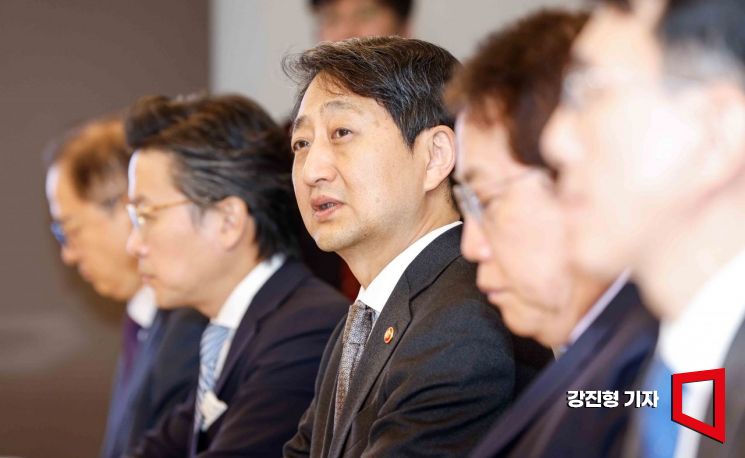 Minister Andeok Geun of the Ministry of Trade, Industry and Energy is delivering opening remarks at the "Automobile Industry Meeting in Preparation for the New U.S. Administration" held on the 13th of last month at the Korea Automobile Mobility Industry Association in Seocho-gu, Seoul. Photo by Kang Jin-hyung
Industries such as semiconductors, petrochemicals, steel, and secondary batteries, which had been demanding strong government support, now face the prospect of having to completely revise their management plans. The shock is significant, as they had emphasized a ‘public-private one team’ approach with the government. Minister An Deok-geun of the Ministry of Trade, Industry and Energy has canceled all schedules, including meetings with the semiconductor equipment industry. Companies that need to strengthen their trade negotiation power ahead of the Trump administration's inauguration are worried about missing the ‘golden time’ for negotiations with the U.S.
In particular, the petrochemical industry, which had high expectations for restructuring support measures, is unable to hide its frustration as the announcement of plans is delayed. Initially, Choi Sang-mok, Deputy Prime Minister and Minister of Strategy and Finance, planned to hold a meeting of ministers related to industrial competitiveness enhancement this month to announce measures to boost the competitiveness of the petrochemical industry. Key elements such as low-interest policy financing support and tax benefits fall under the Ministry of Strategy and Finance’s jurisdiction, but it has become impossible to predict whether the plans will proceed as scheduled due to the ministers’ resignation declarations.
A petrochemical industry official said, "We expected measures to be announced by January or February next year at the latest, but this incident has made that uncertain," adding, "There is also concern that the measures might be completely scrapped." Another industry official said, "The petrochemical issue is related not only to companies but also to the regional economy," and added, "It is an urgent situation for the industrial complex regions where petrochemicals have a high proportion of the economy."
The steel industry is also on high alert, concerned about whether the anti-dumping investigation into low-priced Chinese thick plates will be affected. Hyundai Steel has filed a sole anti-dumping petition against Chinese thick plates after domestic companies lost competitiveness due to Chinese products. A steel industry official said, "It does not seem to have affected operations or workplaces yet, but we need to keep an eye on the anti-dumping investigation situation."
In this situation, the inauguration of the Trump administration in the U.S. is expected to further increase external risks. With the possibility of strong tariffs on imports from China and other countries looming, export companies are also facing negative prospects. The martial law situation has occurred at a time when urgent policy responses are needed to find appropriate trade strategies, and it is expected to disrupt the establishment of next year's economic policy direction. An industry official said, "If the presidential impeachment process proceeds, a leadership vacuum of at least three months is inevitable," adding, "The government's role is especially important in trade issues, so the current situation is worrisome."
© The Asia Business Daily(www.asiae.co.kr). All rights reserved.
![Clutching a Stolen Dior Bag, Saying "I Hate Being Poor but Real"... The Grotesque Con of a "Human Knockoff" [Slate]](https://cwcontent.asiae.co.kr/asiaresize/183/2026021902243444107_1771435474.jpg)
















