French National Assembly Passes No-Confidence Vote Against Barnier Government
Prime Minister Barnier Must Submit Government Resignation
Possibility of Passing Next Year's Austerity Budget Diminishes
President Macron's Leadership Put to the Test
French Political Scene Likely to Be Swept by Turmoil
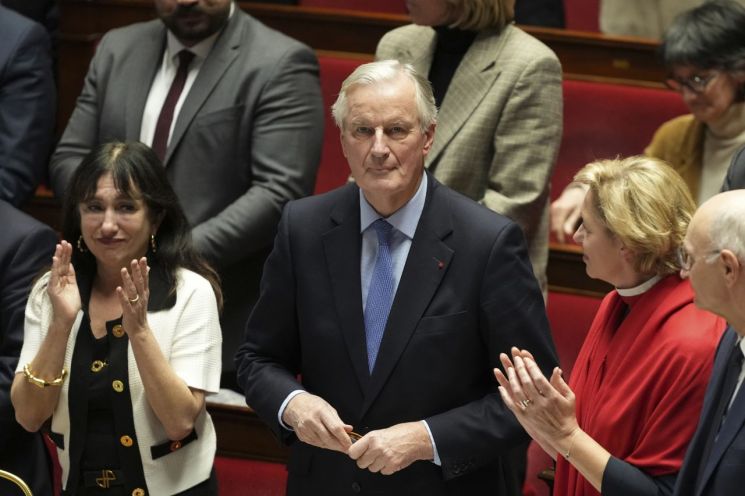
On the 4th (local time), the French National Assembly passed a vote of no confidence against the Michel Barnier government. This was due to the government choosing the 'parliament passing' card to handle next year's austerity budget. As a result, the Barnier government, which was launched last September, is now facing dissolution after about two and a half months. It will be recorded as the shortest-lived government in the history of the French Fifth Republic, and the first case since the Georges Pompidou government in 1962 where a French government collapsed due to a no-confidence vote passed by the National Assembly, it is expected.
According to major foreign media, the French National Assembly voted on the no-confidence motion against the Barnier government, proposed by the left-wing coalition, that evening and passed the motion with 331 votes in favor and 243 against. The total number of members in the National Assembly was 574 (3 seats vacant), and the quorum for passing the no-confidence motion was 288 seats. The left-wing coalition New Popular Front (NFP), which proposed the no-confidence motion, along with the far-right National Rally (RN) and its allied forces, who also proposed their own no-confidence motion, all voted in favor.
Accordingly, Prime Minister Barnier must submit the government's resignation to President Emmanuel Macron. Receiving a no-confidence vote from the National Assembly just 90 days after taking office, Barnier has earned the dishonor of being the shortest-serving prime minister in the history of the French Fifth Republic. Matilde Panot, the parliamentary leader of the far-left party La France Insoumise (LFI), which led the collapse of the Barnier government, emphasized, "Finally, the Barnier government has fallen along with its violent budget," calling today "a historic day."
The Barnier government and the opposition have been in conflict over the 2025 budget. The Barnier government submitted next year's austerity budget to the National Assembly, focusing on reducing government spending and raising taxes to cut the national fiscal deficit. The opposition has opposed the government budget, citing reasons such as cuts to social welfare, weakening consumer sentiment, and increased burdens on businesses. Unable to narrow the differences, Prime Minister Barnier announced on the 2nd that he would invoke Article 49.3 of the Constitution, which allows the government to pass the social security finance bill without a vote in the National Assembly under government responsibility. This was the direct cause of the no-confidence motion being proposed and voted on that day.
With the collapse of the Barnier government, the passage of next year's budget has become uncertain. If the 2025 budget is not passed by the end of the year, in the worst case, a 'shutdown' could occur, paralyzing public administration for the first time in the history of the French Fifth Republic. Currently, extending this year's budget into next year seems likely, but the problem is that no fiscal tightening measures can be implemented in that case. France, where this year's fiscal deficit is expected to be 6.1% of GDP, is under pressure from the European Union (EU) to reduce fiscal spending.
The historic government collapse has brought President Macron into another political crisis. The far-left party is demanding not only the fall of the Barnier government but also the resignation of President Macron. However, during a visit to Saudi Arabia the day before, Macron blocked the possibility of resignation in response to media questions, saying, "I will carry out the presidency until the last moment.
President Macron is expected to quickly appoint a new successor prime minister. It is reported that Macron hopes to appoint the new prime minister before the reopening ceremony of Notre-Dame Cathedral scheduled for the 7th. Local French media see it as likely that Macron will select the prime minister from the centrist coalition.
However, intense party rivalry is expected over the prime minister appointment, and the French political scene is anticipated to plunge into a stormy whirlpool. French media Le Monde described Macron's task of forming a new government amid parliamentary paralysis as "like looking for a five-legged sheep."
Moreover, even if a new cabinet is formed with difficulty, there is a dominant analysis that major reforms will be hard to expect. This is because no party secured a majority of seats in the parliament after the early general election. Accordingly, calls for dissolving the National Assembly are gaining strength. However, since President Macron dissolved the parliament in June, according to the constitutional rule that allows dissolution only once a year, it seems that the National Assembly can only be dissolved after June 2025.
© The Asia Business Daily(www.asiae.co.kr). All rights reserved.
![Clutching a Stolen Dior Bag, Saying "I Hate Being Poor but Real"... The Grotesque Con of a "Human Knockoff" [Slate]](https://cwcontent.asiae.co.kr/asiaresize/183/2026021902243444107_1771435474.jpg)
















