Surge in Political Theme Stocks During Former President Park Geun-hye's Impeachment Period
Stock Market Volatility Inevitable Amid Martial Law Aftermath and 'Impeachment Political Turmoil'
The aftermath of President Yoon Suk-yeol's sudden declaration of martial law is intensifying. As the possibility of an impeachment political crisis grows, warnings about increased volatility in the domestic stock market are also rising. In particular, political theme stocks are wildly fluctuating amid the sluggish market trend. This is interpreted as an effect of the learning experience from the impeachment crisis during former President Park Geun-hye's era. At that time, political theme stocks repeatedly surged and plunged, disrupting the market.
According to the financial investment industry on the 5th, 23 listed companies in the domestic stock market surged to their price limit the previous day. Among the companies that hit the upper limit, most were political theme stocks such as ATEC, Kona I, and Orient Precision. Despite the flood of stocks hitting the upper limit that day, the main indices retreated. The KOSPI fell 1.44% compared to the previous day, and the KOSDAQ index dropped 1.98%. Foreign investors recorded a net sale of 407.8 billion KRW in the securities market and also net sold 14.8 billion KRW worth in the KOSDAQ market. As political uncertainty increased, avoidance sentiment seems to have grown as investors tried to avoid the storm for the time being.
Kim Dae-jun, a researcher at Korea Investment & Securities, explained, "Concerns that political uncertainty will spread throughout the economy adversely affected investor sentiment," adding, "With the possibility of credit rating changes and the rapid depreciation of the won, foreign investors may continue to avoid the domestic stock market."
Market experts judged that bearish pressure would intensify for the time being, considering past cases. Political and economic uncertainties negatively affect the country's credit rating in the mid to long term. Consequently, the possibility of a change in Korea's outlook by credit rating agencies has increased. Korea currently maintains an 'Aa2' rating, the third highest according to international credit rating agency Moody's. If the rating changes, the perspective of overseas investors toward domestic stocks could also shift.
The won's depreciation trend is also a negative factor for the stock market. If the won continues to weaken in a situation where the won-dollar exchange rate is above 1,400 KRW, foreign investors are likely to sell won-denominated assets. Han Ji-young, a researcher at Kiwoom Securities, analyzed, "The increase in Korea's unique political uncertainty itself can instill a negative view among foreign investors."
The weakening of policy implementation momentum also fuels stock market anxiety. Kim Yoon-jung, a researcher at LS Securities, explained, "The corporate value-up program is a key policy task actively promoted by the government this year to revitalize the capital market," adding, "With a red light on the current administration's leadership and regime maintenance, there is a risk of losing the driving force and the entity responsible for policy implementation."
The growing calls for impeachment against President Yoon in the political sphere following the declaration of emergency martial law also exacerbate stock market sluggishness. Currently, the presidential office's senior aides and all cabinet members have tendered their resignations, effectively paralyzing state administration. Seven years ago, during the impeachment crisis, political uncertainty increased, leading to continued stock market weakness.
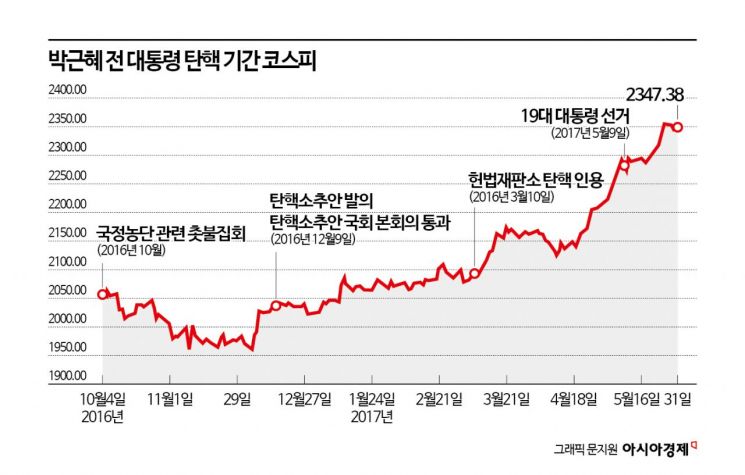
From December 3, 2016, when the impeachment motion against former President Park Geun-hye was proposed, until March 10, 2017, when the Constitutional Court decided on dismissal, the domestic stock market was generally sluggish, and political theme stocks were rampant. During this period, KD rose 195%, and Sewoo Global increased 145%. At that time, theme stocks related to prominent politicians emerged rapidly and repeatedly surged and plunged.
Despite the stock-specific market conditions, overall investor sentiment was subdued. Various variables suppressed the market from the impeachment motion proposal to the Constitutional Court's acceptance of the impeachment. Additionally, external factors such as changes in major countries' monetary policies and the potential expansion of protectionism and populism contributed to the domestic stock market's bleak period. The market was also sensitive to exchange rates at that time. The won-dollar exchange rate is a barometer for foreign investors' view of the domestic stock market.
Meanwhile, based on past learning effects, there is also an analysis that large-cap stocks will show relatively stronger performance than mid- and small-cap stocks after the impeachment political crisis. According to a report analyzed by Korea Investment & Securities, the expected early presidential election after the impeachment crisis acted as a factor diminishing the attractiveness of mid- and small-cap stocks. In past presidential election periods, the KOSDAQ index, reflecting individual investors' sentiment, showed a clear weakness compared to large-cap stocks.
© The Asia Business Daily(www.asiae.co.kr). All rights reserved.

















