POSCO Holdings, POSCO Steelion, POSCO DX, POSCO International Record 52-Week Intraday Lows on the 4th
Group Market Cap Halved This Year
Steel and Secondary Battery Slumps, Consecutive Fire Accidents, First Strike Crisis Since Founding
Aftermath of Emergency Martial Law and Impact of Giant Whale Plunge
POSCO Group stocks, hit simultaneously by various adverse factors, are showing sluggish performance, with a series of record lows. The downturn in the steel and secondary battery industries, consecutive fires, union strikes, and a sharp drop in stocks related to the great whale theme due to the emergency martial law situation have all combined to pull down stock prices. The market capitalization of POSCO Group stocks has halved since the beginning of this year.
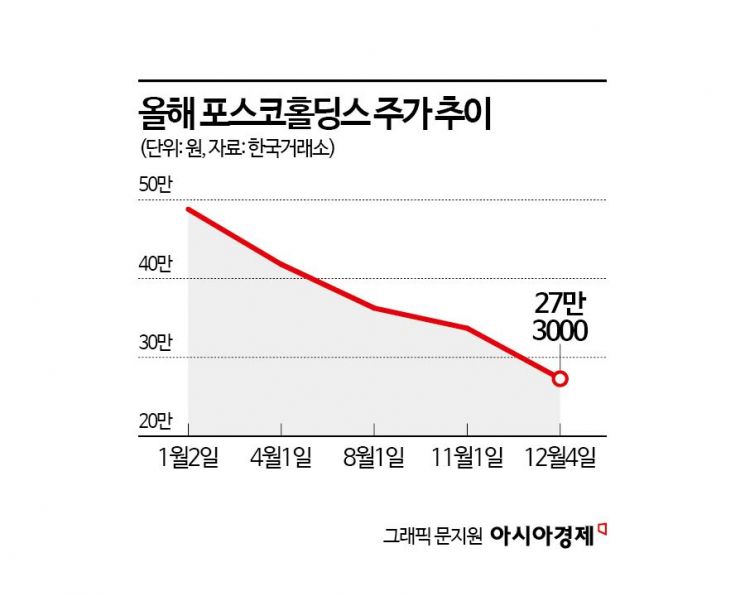
According to the Korea Exchange on the 5th, POSCO Holdings, along with POSCO DX, POSCO Steelion, and POSCO International, all recorded intraday 52-week lows. POSCO Holdings fell to an intraday low of 267,000 KRW, breaking its 52-week low. It has continued a six-day losing streak. POSCO DX closed down 1.42% at 28,000 KRW the previous day, hitting an intraday 52-week low of 20,150 KRW. POSCO Steelion also dropped to an intraday low of 29,200 KRW, setting a new 52-week low. POSCO International plunged more than 12%, hitting an intraday 52-week low of 40,050 KRW. Additionally, POSCO Future M and POSCO M-Tech fell by 1.80% and 2.62%, respectively.
The combined market capitalization of POSCO Group stocks shrank from 93.8751 trillion KRW at the end of last year to 46.6335 trillion KRW.
The poor performance of POSCO Group stocks is due to multiple overlapping adverse factors. Amid ongoing recessions in the steel and secondary battery sectors, a series of explosions and fires occurred, and the company faced its first strike threat in its 56-year history. Furthermore, the sharp decline in great whale-themed stocks due to the emergency martial law situation also had an impact. In the stock market the previous day, concerns about the loss of momentum in the development project of the East Sea deep-sea gas field, known as the great whale, arose due to the declaration and lifting of emergency martial law, causing related stocks to plummet. As a result, POSCO International, grouped as a theme stock, fell sharply by 12.62%.
Moreover, POSCO faced its first-ever strike threat since its founding. The POSCO labor union held a strike rally on the 2nd and 3rd. POSCO management and the union have held 12 rounds of negotiations so far but have not reached an agreement.
The steel industry and secondary battery sectors have suffered recessions throughout this year, worsening performance. Due to the global economic downturn and aggressive low-price dumping of Chinese steel, POSCO closed its Pohang No. 1 Steel Mill and No. 1 Wire Rod Mill. Accidents also occurred consecutively. At POSCO's Pohang Steelworks 3 Finex Plant, explosions and fires occurred on the 10th and 24th of last month.
Researcher Baek Jae-seung of Samsung Securities said, "POSCO Holdings, which experienced a valuation expansion to a price-to-book ratio (PBR) of 1.0 for the first time in a long while last year due to the secondary battery industry boom and the company's active investment in the secondary battery value chain, has experienced a stock price decline this year as both steel and secondary battery markets have entered a slowdown phase." He added, "Due to the strengthening of global protectionism following the election of President Donald Trump and increased uncertainty over the Inflation Reduction Act (IRA), it is still difficult to predict a short-term recovery in both steel and secondary battery markets."
Poor performance is expected to continue into the fourth quarter. Researcher Kim Yoon-sang of iM Securities said, "POSCO Holdings' fourth-quarter results are expected to fall short of market expectations," adding, "While the headquarters segment's performance will improve due to increased sales volume, the performance of POSCO International and subsidiaries related to secondary batteries is inevitably slowing down."
The performance momentum for next year is also expected to be limited. Researcher Kim said, "It is difficult to expect a meaningful rebound in the steel and secondary battery business sectors next year," forecasting, "The steel business segment will see only slight improvement compared to the previous year due to an unfavorable macroeconomic environment and continued slowdown in China, while the secondary battery materials business segment will continue to operate at a loss due to weak material prices and low operating rates caused by a slowdown in downstream industries."
© The Asia Business Daily(www.asiae.co.kr). All rights reserved.


















