Park Jumin "If the military had entered quickly, martial law might have continued"
Possibility that the situation would have changed if the police had responded actively
Although history has no room for hypotheticals, if certain circumstances had been different during the 'long night' of martial law from yesterday to today, history could have changed significantly. Those who witnessed the unprecedented attempt by martial law troops to enter the National Assembly point to the troops' late arrival, passive actions, and inconsistent responses from the police surrounding the Assembly as factors that led to the collapse of martial law.
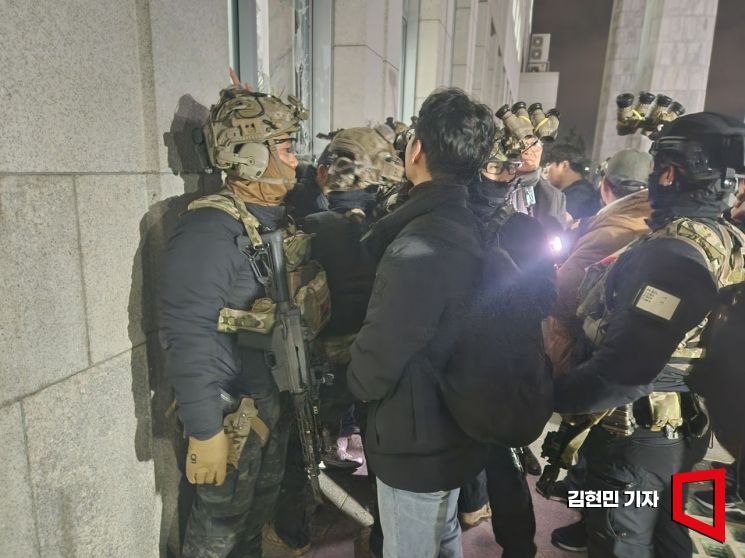 On the 4th, about 20 martial law troops attempted to enter the main building of the National Assembly, clashing with citizens.
On the 4th, Park Jumin, a member of the Democratic Party of Korea, said on CBS Radio, "(President Yoon Seok-yeol and the Martial Law Command) seemed to intend to quickly suppress the National Assembly with military forces to prevent attempts to dissolve it and then gradually expand the measures." He analyzed, "If the military had acted faster, the National Assembly could have been seized, and instead of ending in 1 hour and 55 minutes, martial law could have continued for a prolonged period."
According to Kim Minki, Secretary General of the National Assembly, and others, after martial law was declared, the police blocked the outer gates of the National Assembly at 10:50 p.m., restricting access for lawmakers and aides. Then, from 11:48 p.m. the previous night, about 230 martial law troops entered the Assembly grounds and attempted to enter the main building. Considering that President Yoon's martial law declaration was at 10:27 p.m., there was a considerable time gap.
Besides the delay, another notable point is that the martial law troops were few in number and, despite being an elite unit, were stopped by unarmed aides' resistance.
According to information compiled and disclosed by Park Seonwon, a Democratic Party lawmaker, the 707th Special Mission Brigade that entered the National Assembly had been ordered to be on standby since the day before and appeared to be heavily armed at the time of deployment. Park said, "It is presumed that live ammunition was also issued immediately after the martial law announcement," adding, "The 707th Special Mission Unit was equipped with shotguns, rifles, submachine guns, night vision goggles, and passage-clearing equipment, and snipers were also deployed." This indicates significant prior preparation. However, the fact that such a well-prepared elite unit failed to achieve its objective suggests that the military may have followed orders passively. Kim Yonghyun, the Minister of National Defense, who is known to have planned this martial law, said at a parliamentary confirmation hearing last September, "In the current situation of the Republic of Korea, who among the people would accept martial law, and would our military really follow it? Even I might not follow."
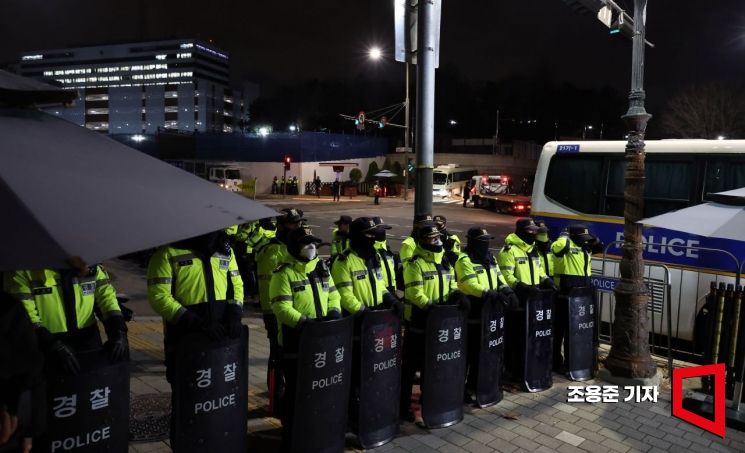 On the night of the 3rd, President Yoon Suk-yeol declared martial law through an emergency statement. In the early morning of the 4th, after the National Assembly passed a resolution demanding the lifting of martial law, barricades and police forces were controlling access in front of the entrance to the Yongsan Presidential Office and the Ministry of National Defense building.
Additionally, there was evidence that a large number of police had already been deployed around the National Assembly since the 2nd. The police response was also a turning point. Initially, the police completely blocked the National Assembly but later allowed partial entry, showing inconsistent responses. Some speculate that if the police had actively prevented the martial law troops from entering or had actively intervened to stop the plenary session itself, the situation might have been different. The fact that 190 lawmakers gathered in the plenary hall suggests that the police may not have responded actively.
Meanwhile, online, a video of a soldier near the National Assembly bowing his head and apologizing became a topic of interest. The operator of the YouTube channel ‘TV Heo Jaehyun’ said, "There was an unnamed martial law soldier who bowed and said 'I'm sorry' to the citizens who had gathered in front of the National Assembly to protest today," adding, "In that brief moment when he said 'I'm sorry,' I felt his sincerity."
© The Asia Business Daily(www.asiae.co.kr). All rights reserved.
![Clutching a Stolen Dior Bag, Saying "I Hate Being Poor but Real"... The Grotesque Con of a "Human Knockoff" [Slate]](https://cwcontent.asiae.co.kr/asiaresize/183/2026021902243444107_1771435474.jpg)
















