'Sosyeonseu' Real-Time Trend No.1 for 'Gyeomyeongryeong'
Portal Sites Like Naver and Daum Temporarily Paralyzed
Criticism Over Failure to Send Emergency Disaster Alerts
When the president declared and then lifted martial law over a period of 3 to 4 days, portal sites and social networking services (SNS) buzzed with a surge in traffic as users flocked to check related news. Amid this, fake news, including composite photos of armored vehicles and breaking news about nighttime curfews, also spread, causing confusion.
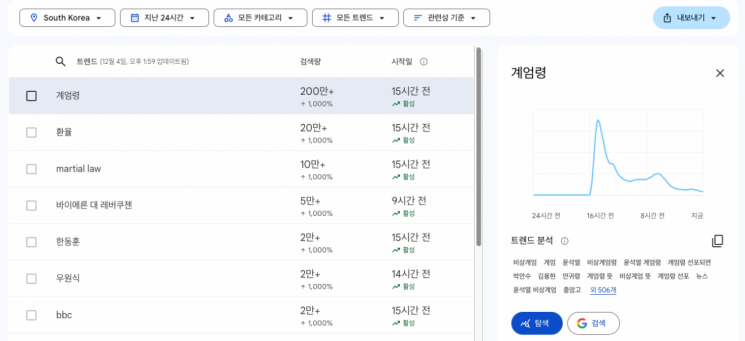
According to Google's real-time trends on the 4th, as of 2 p.m. that day, searches related to 'martial law' exceeded 2 million, ranking first. Other keywords related to martial law such as 'exchange rate' with 200,000 searches, 'matrial law', 'Han Dong-hoon', and 'Woo Won-shik' also appeared in the real-time search trend rankings.
Shortly after the declaration of martial law, images of armored vehicles running on roads and breaking news screen captures stating that random inspections would be conducted after 11 p.m. circulated online, heightening public anxiety. While many citizens were unsettled, some netizens posted that the convenience store in the armored vehicle photo had already withdrawn from Korea earlier this year, or that the trees with green leaves in the photo did not match the current season, showing a cautious attitude toward fake news. On X, some users posted fact-checking summaries regarding fake news, reflecting an increased awareness of misinformation compared to the past.
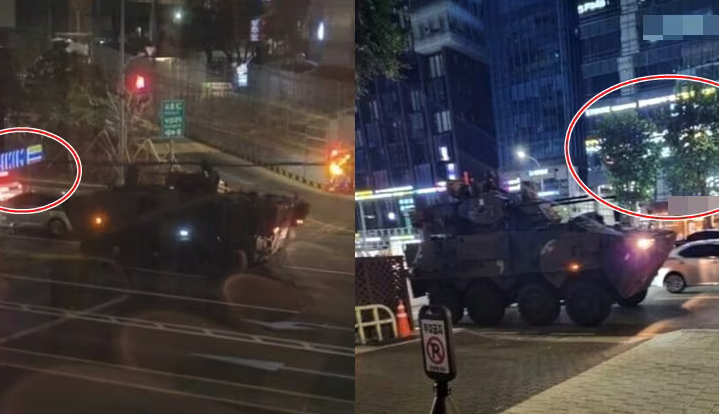 Immediately after the declaration of martial law, a photo showing an armored vehicle driving on the streets of Seoul was released online. Netizens pointed out that this photo was fake news, citing the Ministop convenience store sign and the tree with green leaves, which do not match the winter season. Online community
On some internet communities, posts claimed that martial law-related terms did not appear in the Daum Cafe trends, which track the latest issues, or that certain keywords like 'impeachment' and 'Yoon Seok-yeol' were being regulated by post administrators. Regarding this, Kakao explained, "(Daum Cafe trend rankings) are selected solely based on traffic within cafe posts," adding, "This service is only provided in the Daum Cafe application and does not offer political keywords nor is it linked with other services such as Daum search."
Late at night, as users flocked to check confusing news, difficulties in smoothly using services provided by Naver and Kakao, such as cafes, also occurred. From around 11 p.m. the previous day, Naver Cafe experienced connection delays and other errors, increasing public anxiety. Subsequently, Naver Cafe underwent temporary maintenance, and functions were gradually restored on both web and mobile cafes. Daum Cafe also experienced temporary connection delays. This was analyzed as an effect of increased traffic as netizens rushed to internet services to check news related to martial law. Both companies are closely monitoring the situation and responding to ensure stable service provision.
Why Were No Emergency Disaster Alerts Sent Despite the 'Martial Law Declaration'? What Are the Sending Criteria?
During the night of the 3rd, President Yoon Seok-yeol declared martial law but lifted it within six hours due to parliamentary intervention. During this period, no emergency disaster alert messages related to the situation were sent, which has drawn criticism for exacerbating confusion. In contrast, on the morning of the 4th, immediately after martial law was lifted, emergency disaster alerts warning of 'road icing' were sent to most regions nationwide, raising questions about the criteria. According to the National Disaster Portal operated by the Ministry of the Interior and Safety, among the five disaster alert messages sent since 10:23 p.m. on the 3rd when President Yoon declared martial law, none were related to martial law.
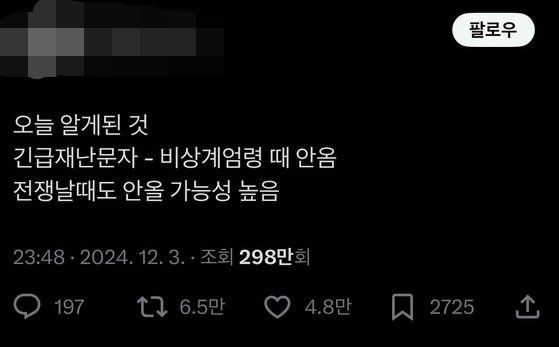 President Yoon Suk-yeol declared martial law on the night of the 3rd but lifted it after six hours due to parliamentary intervention. During this period, no emergency disaster alert messages related to the situation were sent, leading to criticism that the lack of communication increased confusion. X (X)
After the National Assembly passed a resolution to lift martial law in the plenary session, no emergency disaster alerts related to the lifting were sent. The Ministry of the Interior and Safety's criteria for sending disaster alerts include: ▲ disaster response information based on weather warnings ▲ information on natural or social disasters ▲ disaster information from authorized agencies pre-coordinated with the ministry ▲ other information deemed necessary by the disaster alert broadcasting officer. The ministry stated that the martial law situation did not meet these criteria, so no emergency disaster alerts were sent.
However, there are criticisms that the disaster alert service, which is transmitted to prevent or reduce damage to life or property, was not activated at the crucial moment, resulting in inadequate dissemination of response guidelines and situation updates, thereby fueling public confusion. A ministry official explained, "Martial law does not meet the criteria for sending disaster alerts, so no messages were sent," adding, "Among the sending criteria, 'occurrence of social disasters' applies only to civil defense matters such as localized warfare or North Korean attacks."
© The Asia Business Daily(www.asiae.co.kr). All rights reserved.
![Clutching a Stolen Dior Bag, Saying "I Hate Being Poor but Real"... The Grotesque Con of a "Human Knockoff" [Slate]](https://cwcontent.asiae.co.kr/asiaresize/183/2026021902243444107_1771435474.jpg)

















