Negative Movement in Won Assets Overseas
Acceleration of Foreign Investor Withdrawal Due to Martial Law Situation
Supply-Demand Gap Replaced by Government Funds
Global Investors' Watchful Stance to Continue Until Early Next Year
"Is it possible that I won't be able to board the flight to Korea?"
An official from a foreign asset management firm, who was scheduled to attend a domestic financial investment industry event on the 5th, reportedly called a local institution representative in the early hours of the 4th as the domestic political situation rapidly deteriorated due to the martial law crisis. From the perspective of foreign investors who are not deeply familiar with the domestic political situation, the very circumstance of the "president declaring martial law" became a factor causing hesitation to visit Korea. Fortunately, concerns about the market eased after the National Assembly passed a resolution demanding the lifting of martial law, but aftershocks remain.
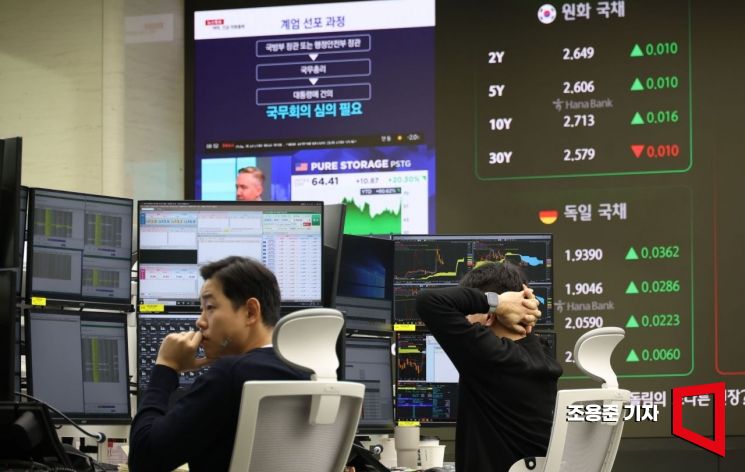 President Yoon Suk-yeol declared martial law. On the morning of the 4th, when martial law was lifted by the National Assembly's resolution, news related to martial law appeared on the monitors in the Hana Bank dealing room in Jung-gu, Seoul. Due to the impact of martial law, the KOSPI opened down 1.97%, and the exchange rate started at 1,418 won that day. Photo by Jo Yong-jun
As of 1:25 PM that day, the KOSPI index stood at 2,456.54, down 1.75% from the previous trading day. During the session, the KOSPI briefly dropped more than 2%, fluctuating around the 2,440 level. Although the KOSPI seemed to stabilize due to government intervention, foreign investors sold over 500 billion KRW, widening the decline again.
Domestic and foreign financial investment industry officials who interact with overseas investors expect foreign investors to adopt a wait-and-see stance rather than buying at the bottom, given the unpredictable developments regarding the president’s position and the domestic political situation.
A domestic financial investment industry official said, "Among foreign investors, the prevailing view is that the martial law crisis has not been fully resolved but only temporarily contained, so for the time being, foreign investors will not buy at the bottom even if domestic stock prices fall," adding, "Because it is difficult to predict the political risks stemming from the martial law crisis, foreign investors are likely to remain cautious."
Namwoo Lee, Chairman of the Korea Corporate Governance Forum, said, "When the exchange rate soars, export companies like Samsung Electronics and Hyundai Motor make considerable profits. Foreign investors usually buy stocks based on corporate profit forecasts. In the past, these export companies would have attracted buying interest, but this time, most export companies’ stock prices are weak," adding, "This means foreigners are not actively buying, and they likely judge that the risks triggered by the martial law crisis are high, leading them to lower their valuations."
The government is forced to fill the supply gap caused by global investors’ cautious stance. To stabilize the market, the government announced it would mobilize all available resources, including the Stock Market Stabilization Fund and the Bond Market Stabilization Fund. On the same day, Financial Services Commission Chairman Byunghwan Kim held a "Financial Situation Review Meeting" with the Financial Supervisory Service head, heads of financial public institutions, and financial association leaders, stating, "We will prepare to immediately activate the 10 trillion KRW Stock Market Stabilization Fund (Stock Stabilization Fund) at any time." He also added, "We will operate the 40 trillion KRW Bond Market Stabilization Fund (Bond Stabilization Fund) and the corporate bond and commercial paper (CP) purchase program to maintain stability in the bond and money markets."
Value-Up, Commercial Act Amendments, Financial Investment Tax... Capital Market Policies Returning to Square One
An official from a foreign asset management firm lamented, "I newly realized how uneasy it is to hold won-denominated assets." Indeed, after President Yoon Seok-yeol declared martial law on the 3rd, the won-dollar exchange rate surged to as high as 1,430 KRW. Domestic stock futures and virtual asset prices also experienced rollercoaster fluctuations. The exchange rate has just entered its third week after surpassing the psychological support level of 1,400 KRW, and it has now broken through that level.
Concerns are also rising that negative perceptions of won-denominated assets may worsen. Changhan Sagong, head of Schroder Investment Management, said, "Since the election of President Donald Trump, pressure on the Korean economy has increased due to tariff hikes and other factors, and with political factors added, the negative views of foreign investors toward the Korean capital market are likely to deepen," adding, "Additional outflows from stocks, bonds, and government bonds may occur, and credit default swap (CDS) spreads may widen, which could increase costs in attracting foreign investors or raising overseas funds."
CDS is an indicator of credit risk for countries or companies; a higher figure means a higher risk level of national creditworthiness. The CDS premium is a measure of Korea’s external creditworthiness in the international financial market. If this indicator rises, it lowers Korea’s external credit rating, increasing the government’s foreign currency funding costs and acting as a factor that causes capital outflows and increases volatility in the domestic financial market.
After checking comments from global investment banks (IBs) following the martial law crisis, Sagong said, "It is expected to take some time to resolve the deepened Korea discount caused by the martial law crisis," adding, "If the unstable political atmosphere continues without resolution, foreign capital inflows may not return until the first quarter of next year." The ongoing foreign selling spree has exacerbated the deterioration of foreign capital inflows due to the martial law crisis.
Policies that had been actively promoted to boost the Korean stock market have also lost momentum. Lee Jae-myung, leader of the Democratic Party of Korea, was scheduled to chair a "Commercial Act Amendment Forum" hosted by the party but the forum was abruptly canceled due to the martial law crisis. An official who was to present at the forum said, "We received the cancellation notice at 3 AM," adding, "Since political stabilization is the priority, the Commercial Act amendment will likely be pushed down the opposition party’s priority list." Uncertainty over the abolition of the financial investment income tax (Financial Investment Tax) has also increased. Although it was widely expected that the ruling and opposition parties would move to abolish the tax by the regular National Assembly session ending on the 10th, this has become uncertain due to the martial law crisis. Earlier this year, President Yoon attended the Korea Exchange’s market opening ceremony, declaring efforts to resolve the "Korea discount" (undervaluation of the Korean stock market) and boost the market, but now he is criticized as the very cause of the market’s retreat.
Researcher Yoonjung Kim of LS Securities said, "The corporate value-up program is a key government policy this year aimed at revitalizing the capital market," adding, "With the necessary legislative amendments for policy momentum stalled and pending, this crisis has turned on a red light for the current administration’s leadership and its continuity."
© The Asia Business Daily(www.asiae.co.kr). All rights reserved.
![Clutching a Stolen Dior Bag, Saying "I Hate Being Poor but Real"... The Grotesque Con of a "Human Knockoff" [Slate]](https://cwcontent.asiae.co.kr/asiaresize/183/2026021902243444107_1771435474.jpg)















