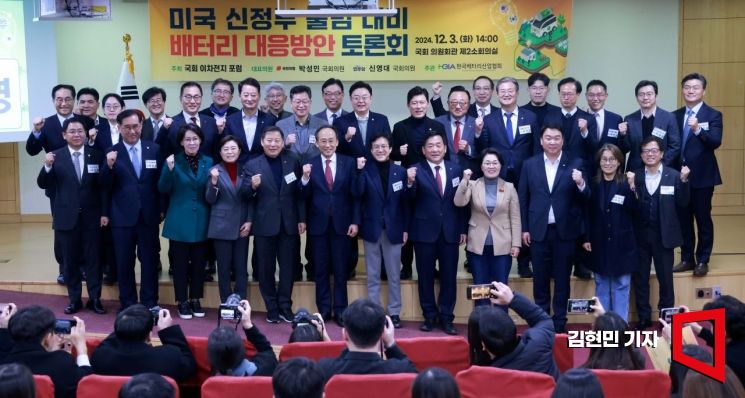
 Participants including Choo Kyung-ho, floor leader of the People Power Party, are taking a commemorative photo at the "Battery Response Measures Discussion Forum in Preparation for the New U.S. Administration," hosted by the Secondary Battery Forum, held on the 3rd at the National Assembly Members' Office Building. Photo by Kim Hyun-min
Since the inauguration of U.S. President Donald Trump, there have been growing concerns that the Inflation Reduction Act (IRA) might be repealed or its functions curtailed, leading to forecasts of significant impacts on the domestic battery industry. On the 3rd, Junmo Park, a lawyer from the law firm Yulchon who attended the 'Battery Response Measures Discussion for the Launch of the New U.S. Government' hosted by the National Assembly Secondary Battery Forum, presented three possible scenarios for the direction of the IRA under the second Trump administration based on the U.S. legal system.
Lawyer Park outlined three possibilities: full repeal of the Inflation Reduction Act, partial amendment or selective repeal of the IRA, and reduction in the scope or scale of subsidies or additional requirements.
The possibility of repealing the IRA has been raised because President-elect Trump was consistently critical of the Biden administration's 'Green New Deal' policies during his campaign. In a July 2024 media interview, he stated, "I will abolish the electric vehicle subsidy of up to $7,500," adding, "Tax credits and tax incentives are generally not good." In a September speech at the New York Economic Club, he said, "I will reclaim all unused subsidies under the Inflation Reduction Act."
The critical view of the IRA is not limited to Trump alone but reflects the stance of the entire Republican Party. The Republican Party platform includes a pledge to "cancel Biden's electric vehicle and other mandates."
In the recent U.S. general election held alongside the presidential election, the Republican Party secured 53 seats in the Senate and 220 seats in the House, gaining control of both chambers. Consequently, some have raised the possibility of a full repeal of the IRA.
However, Lawyer Park believes that a full repeal of the IRA is unlikely. This is because most of the regions benefiting from the IRA are concentrated in Republican-held areas, which could lead to defections in Congress. Park explained, "In early 2017, during the initial Trump administration, there was an attempt in the federal Congress to repeal Obamacare, but some Republican senators voted against it, resulting in the final rejection of the alternative bill. Given this precedent, a full repeal of the IRA would not be easy."
In fact, even within the U.S. Republican Party, there are negative views regarding the full repeal of the IRA. In August, 18 Republican House members opposed the full repeal, stating to House Speaker Mike Johnson that "a full repeal of the IRA would be the worst-case scenario, pouring tens of billions of taxpayer dollars down the drain without any return." Among them, 15 were re-elected in the recent election.
Among the electoral districts where Korean battery companies have production facilities, Indiana, Ohio, Kentucky, and Tennessee each have two Republican senators. Michigan and Georgia both have two Democratic senators, while Arizona has one Democratic and one independent senator.
There is also speculation about the possibility of selectively repealing only some subsidy provisions of the IRA.
The IRA includes three main types of subsidies: production tax credits (PTC) and investment tax credits (ITC) for renewable energy, advanced manufacturing production tax credits (AMPC, 45X), and electric vehicle tax credits (subsidies, 30D). The scenario suggests that only some of these could be selectively repealed.
However, Lawyer Park believes that, for the same reasons mentioned earlier, selectively repealing only some provisions would also be difficult to pass in the Senate.
The U.S. Senate places great importance on individual senators' legislative rights and allows unlimited legislative delays (filibusters). However, if two-thirds (60 seats) of senators agree, a filibuster can be ended. Although the Republicans hold the majority in the Senate with 53 seats, they have not reached the 60 seats needed to end a filibuster. If the Democrats use filibusters in the Senate, amending the IRA will be difficult.
There are ways to prevent filibusters. Using the budget reconciliation procedure, a bill can pass the Senate with a simple majority (51 seats). However, the budget reconciliation procedure can only be used once per fiscal year. The Republicans are expected to use this procedure only for key legislation. Regarding this, Lawyer Park said, "In the first year of the Trump administration, Republicans are more likely to use the budget reconciliation procedure to pass the Tax Cuts and Jobs Act (TCJA) rather than the IRA."
The Tax Cuts and Jobs Act, enacted early in the Trump administration in 2017, lowered the corporate tax rate from 35% to 21% and is set to expire in 2025, requiring extension by Congress next year.
However, some speculate that the Republicans might package the Tax Cuts and Jobs Act with some provisions of the IRA and use the budget reconciliation procedure. On the 15th of last month, a major foreign news outlet reported that "Trump's transition team plans to eliminate the $7,500 electric vehicle tax credit as part of broader tax-reform legislation." It also predicted that the Republicans could use the reconciliation procedure as Biden did when passing the IRA.
The reason the Republicans are likely to target the electric vehicle tax credit first among the three subsidies is that it has relatively less impact on corporate investment decisions compared to renewable energy production and investment tax credits and advanced manufacturing production tax credits.
The most likely scenario is to reduce or limit the subsidy amount through a presidential executive order without touching the IRA itself. An executive order is a system that allows the president to order federal administrative agencies to withdraw or review existing rules' benefits or regulations. It can also order a work stoppage for rules that have not yet been finalized.
Lawyer Park said, "President-elect Trump could strictly apply the electric vehicle tax credit subsidy requirements through an executive order, reducing the number of vehicles eligible for subsidies." He also mentioned the possibility of strengthening the Foreign Entity Ownership Control (FEOC) requirements or imposing additional demands such as expanding employment of Americans.
© The Asia Business Daily(www.asiae.co.kr). All rights reserved.
![Clutching a Stolen Dior Bag, Saying "I Hate Being Poor but Real"... The Grotesque Con of a "Human Knockoff" [Slate]](https://cwcontent.asiae.co.kr/asiaresize/183/2026021902243444107_1771435474.jpg)
















