"President Joe Biden called South Korea, which declared martial law, a model democratic country, but the South Korea-U.S. alliance now faces its biggest test in decades." (The New York Times (NYT))
Major U.S. media outlets urgently reported on June 3 (local time) that President Yoon Suk-yeol declared martial law in an emergency address but lifted it six hours later after accepting the National Assembly's request. They particularly focused on the background of the martial law declaration and its future political repercussions, pointing to this incident as a "setback for South Korean democracy" and highlighting its potential impact on U.S. Indo-Pacific diplomatic and security policies.
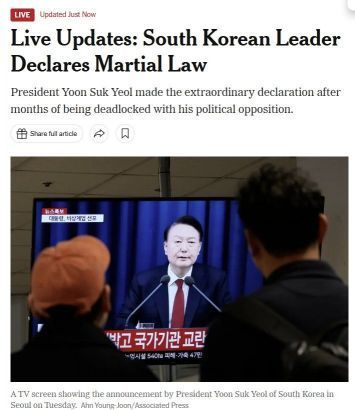 The US daily newspaper The New York Times (NYT) is urgently reporting on June 3 (local time) the news of President Yoon Seok-yeol's declaration of martial law.
The Associated Press (AP) reported that "President Yoon lifted the martial law he declared during a tense political drama night when the military surrounded the National Assembly and lawmakers were voting against military rule," adding, "His astonishing move recalls a return to an era of authoritarian leaders not seen since the 1980s."
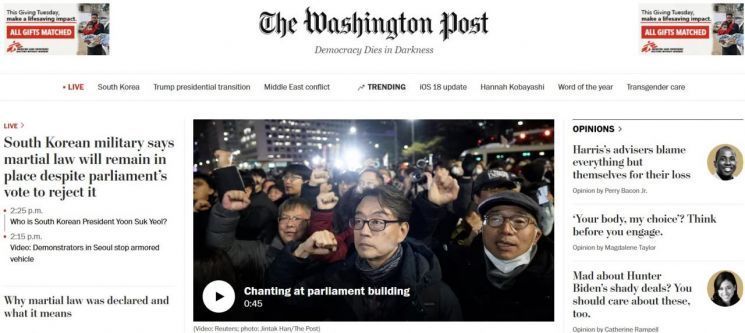
The Washington Post (WP) said the background of the martial law declaration was that President Yoon, struggling with declining approval ratings, aimed "to suppress the opposition party," predicting significant repercussions.
The newspaper reported, "President Yoon blamed the opposition for unprecedented impeachment attempts against government officials and next year's budget cuts," adding, "Since taking office in 2022, Yoon has struggled with low approval ratings, and political backlash related to his wife and senior officials of the ruling People Power Party is growing." It further noted, "Yoon's declaration angered many South Koreans and evoked painful memories of military rule before South Korea's democratic transition in the late 1980s," and predicted, "Although the order lasted only six hours, it will have widespread repercussions in South Korea, known for its vibrant democracy."
U.S. media paid attention to the impact on Washington's future diplomatic and security policies, considering South Korea as a key U.S. ally in the Indo-Pacific region.
The NYT stated, "South Korea, hosting about 30,000 U.S. troops, is a symbol of democracy and the United States' most important ally in Asia, where authoritarian and democratic countries compete," noting, "President Yoon's move appears to have surprised the Biden administration." It added, "President Biden, who has used democracy versus dictatorship as a diplomatic framework, has strengthened the military alliance with South Korea as a bulwark against North Korea, China, and Russia," and analyzed, "Biden will face a difficult choice on how to handle this crisis."
Bloomberg News expressed concern, saying, "South Korea, one of the most like-minded and strongest allies of the U.S. in this (Asia) region, has revealed undemocratic principles," and warned, "China could exploit this fact to showcase the advantages of its own system over the West." The news agency evaluated, "Can Washington continue to rely on Seoul, a firm and reliable U.S. ally? President Yoon's subversion and destruction of democracy present a difficult dilemma for Washington."
Within the U.S. political circles, there are forecasts that President Yoon's political life is uncertain and could lead to his downfall. The Center for Strategic and International Studies (CSIS), a think tank in Washington D.C., released an urgent report on the same day about Yoon's martial law declaration, diagnosing, "Although martial law was lifted early on June 4 (Korean time), President Yoon's domestic survival prospects are currently uncertain." The report was prepared with the participation of Victor Cha, a leading U.S. Korea expert and Korea Chair.
CSIS predicted, "The National Assembly acted swiftly to overturn the martial law declaration, and street protests against a president with approval ratings in the 10% range could spread," adding, "This could lead to President Yoon's (political) downfall."
It also suggested that North Korea might exploit South Korea's political and social turmoil to provoke provocations. CSIS stated, "Although no North Korean statement has been issued yet, it is highly likely that North Korea will use this turmoil for propaganda purposes against the Yoon administration."
CSIS emphasized, "The Biden administration is taking a cautious stance in mentioning the situation on the Korean Peninsula," but added, "More information will be disclosed, and all political conflicts must be resolved peacefully."
© The Asia Business Daily(www.asiae.co.kr). All rights reserved.
![Clutching a Stolen Dior Bag, Saying "I Hate Being Poor but Real"... The Grotesque Con of a "Human Knockoff" [Slate]](https://cwcontent.asiae.co.kr/asiaresize/183/2026021902243444107_1771435474.jpg)

















