Emergency Macroeconomic and Financial Issues Meeting Held on the Night of the 3rd and Morning of the 4th
Resolution to Implement Measures Including Liquidity Supply and Joint Real-Time Monitoring System
Decision to Ensure Normal Operation of Financial and Foreign Exchange Markets
On the previous day (the 3rd), immediately after President Yoon Seok-yeol declared martial law, the heads of the economic and financial control towers prepared for the shock that the financial market might face by holding an emergency macroeconomic and financial issue meeting (F4 meeting) on the night of the 3rd and again on the morning of the 4th. Although the martial law was lifted six hours after its declaration, the financial authorities decided to mobilize all possible means to stabilize the market amid increased uncertainty.
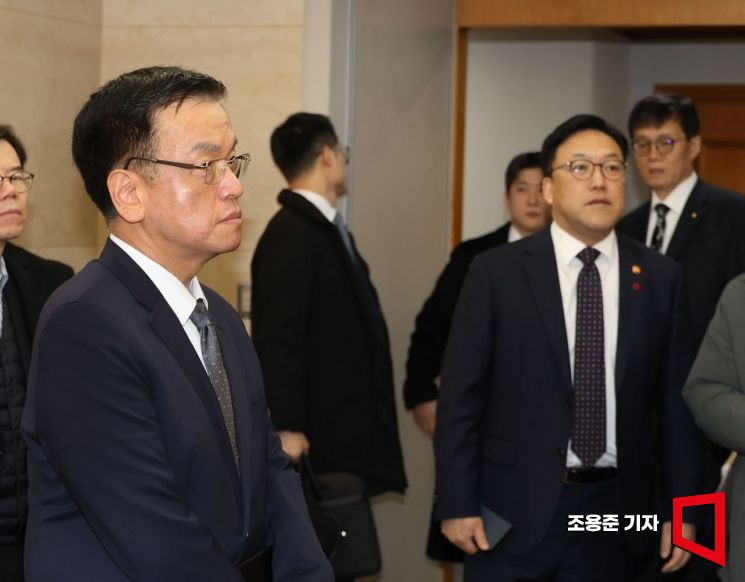 Choi Sang-mok, Deputy Prime Minister and Minister of Economy and Finance (left), Lee Chang-yong, Governor of the Bank of Korea (right), and Kim Byung-hwan, Chairman of the Financial Services Commission (center), are leaving the meeting room with serious expressions after concluding a closed-door emergency macroeconomic and financial issues meeting held on the 4th at the Korea Federation of Banks in Jung-gu, Seoul.
According to the Ministry of Economy and Finance and financial authorities on the 4th, Deputy Prime Minister and Minister of Economy and Finance Choi Sang-mok held the second F4 meeting related to the martial law declaration at 7 a.m. that day, attended by Bank of Korea Governor Lee Chang-yong, Financial Services Commission Chairman Kim Byung-hwan, and Financial Supervisory Service Governor Lee Bok-hyun. They agreed to take measures such as unlimited liquidity supply and operating a joint real-time monitoring system.
The participants in the meeting decided to operate all financial and foreign exchange markets normally, including the stock market, as the foreign exchange market and overseas Korean stock markets, which had shown instability due to the martial law measures the previous day, gradually stabilized following the lifting of martial law. The won-dollar exchange rate (NDF) surged to 1,444 won after the martial law declaration but closed at 1,415.8 won. The authorities judged that foreign currency procurement by domestic banks was also proceeding smoothly with successful refinancing.
However, they decided to supply unlimited liquidity until the stock, bond, short-term money, and foreign currency markets are fully normalized. Additionally, a government-wide joint real-time monitoring system will be operated to closely watch the financial market situation.
After the meeting, Governor Lee met with reporters and said regarding the impact on the financial market, "We are conducting daily F4 meetings to continuously monitor the situation," adding, "The Bank of Korea’s Monetary Policy Committee will also hold a meeting, and under the leadership of the Financial Services Commission Chairman, plans to discuss measures related to private financial companies are underway." Regarding the assessment that the market has stabilized, he added, "The foreign currency funding market is moving stably," and "We will closely monitor the situation going forward."
Earlier, these leaders held an emergency meeting at 11:40 p.m. on the previous night, about 1 hour and 10 minutes after President Yoon declared martial law, chaired by Deputy Prime Minister and Minister of Economy and Finance Choi Sang-mok.
Immediately after the F4 meeting, Governor Lee Bok-hyun also held an emergency financial situation review meeting at 1:30 a.m., attended by deputy governors and heads of major operational departments. Governor Lee checked the foreign currency funding conditions by financial sector and the volatility of the virtual asset market, promptly sharing and cooperating with related agencies. He also activated an emergency response system to hold financial situation review meetings as needed, ensuring thorough crisis response.
© The Asia Business Daily(www.asiae.co.kr). All rights reserved.
![Clutching a Stolen Dior Bag, Saying "I Hate Being Poor but Real"... The Grotesque Con of a "Human Knockoff" [Slate]](https://cwcontent.asiae.co.kr/asiaresize/183/2026021902243444107_1771435474.jpg)















