36 Improvement Orders and 47 Fines Issued This Year Following Wastewater Treatment Facility Inspections
Approximately 1,800 Unregistered Private Sewage Treatment Facilities Registered Through Legalization Project
Enhancing Facility Management Capabilities to Improve River Water Quality... Requesting Active Interest and Cooperation
In Goyang Special City, Gyeonggi Province (Mayor Lee Dong-hwan), there are over 24,000 registered private sewage treatment facilities, including approximately 10,400 wastewater treatment facilities and about 13,500 septic tanks. The city is making efforts to guide and inspect private sewage treatment facilities to improve the water quality of public water bodies and ensure systematic management.
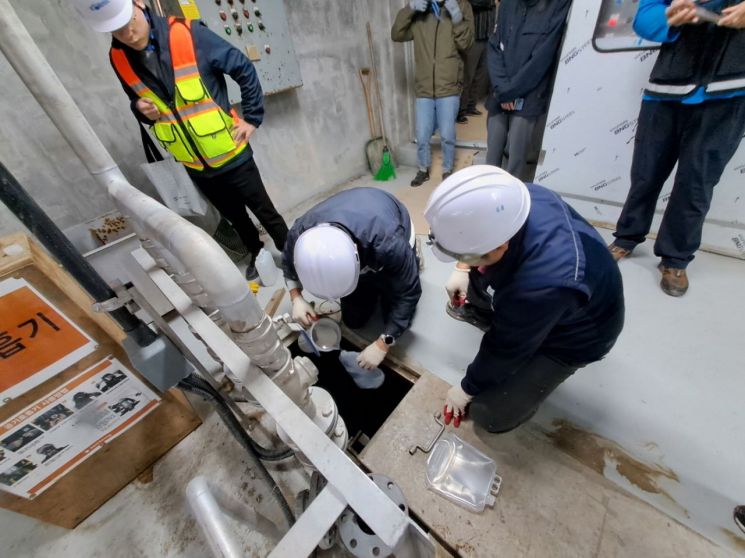 Sampling and inspection of treated wastewater from the wastewater treatment facility. Provided by Goyang Special City.
Sewage that does not pass through public sewage treatment facilities is treated and discharged through private sewage treatment facilities. Private sewage treatment facilities collectively refer to wastewater treatment facilities and septic tanks, which treat wastewater generated from buildings or facilities by sedimentation and decomposition. Wastewater treatment facilities primarily use biological treatment with microorganisms, while septic tank facilities use a putrefaction tank method.
In particular, proper management is essential to maintain the quality of discharged water from wastewater treatment facilities. The city conducts regular comprehensive inspections and encourages appropriate management by owners and managers of wastewater treatment facilities.
Inspection targets are divided into small-scale and large-capacity facilities, focusing mainly on facilities with high load such as general restaurants, nursing homes, and campsites, as well as areas where complaints frequently occur. Minor violations identified during inspections are immediately corrected on-site through administrative guidance, while administrative actions such as fines are imposed if facilities are operated without justifiable reasons or if the discharged water exceeds quality standards.
 Pre-inspection before completion of private sewage treatment facility. Provided by Goyang Special City
This year, as a result of inspections on wastewater treatment facilities, the city issued 36 improvement orders and imposed 47 fines totaling 48.5 million KRW by November for violations including exceeding discharge water quality standards, unauthorized use without completion, and failure to appoint technical managers.
Meanwhile, for septic tank facilities that treat human waste generated from flush toilets in buildings, the city sends internal cleaning notices twice a year to encourage cleaning. Inadequate cleaning can reduce the facility’s treatment capacity, cause odors, and lead to water pollution.
The notice includes information on ▲septic tank cleaning procedures ▲status of human waste collection and transportation companies ▲sewage-related laws regarding septic tank internal cleaning, and advises building owners or managers to verify cleaning volume and fee schedules in their presence to prevent disputes.
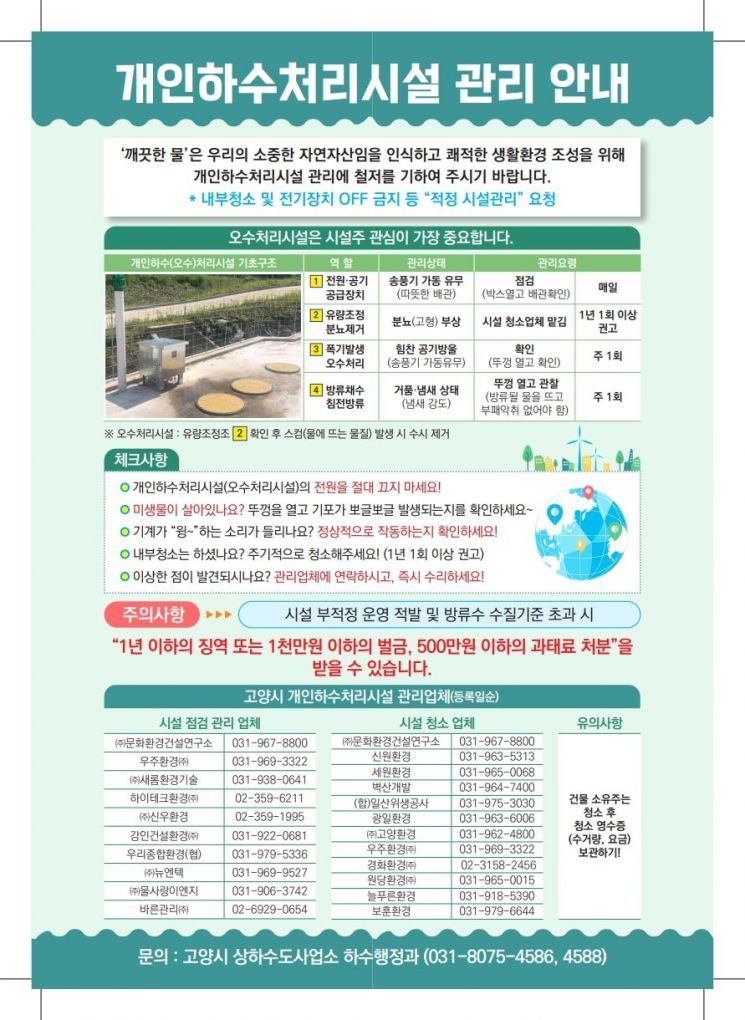
To manage private sewage treatment facilities more systematically, Goyang City conducted a full-scale survey in 2020 and completed the “Unregistered Private Sewage Treatment Facility Regularization Project,” which converts unregistered facilities identified through the survey into legally registered ones.
From 2021 to 2022, the project actively guided unregistered facilities into the regulatory system, converting about 1,800 facilities to registered status and repairing damaged facilities. The city’s proactive administration focused on improving the water quality of public water bodies and systematic facility management rather than on administrative penalties for illegal facilities.
Currently, there are 33 companies registered and operating in the city related to private sewage treatment facilities, including 10 design and construction companies, 11 management companies, and 12 human waste collection and transportation companies. Key inspection items for these companies include ▲compliance with business operator obligations related to private sewage treatment facilities ▲adherence to registration standards for facilities, equipment, and technical personnel ▲completion of technical personnel training. Annual inspections are conducted to prevent the distribution of substandard products and poor construction.
Meanwhile, the city plans to continuously promote and expand the installation of separate sewage pipelines according to the basic sewage maintenance plan to preserve the water quality of public water bodies and improve residents’ health and hygiene. It also plans to focus on disaster prevention and water quality improvement through safety inspections of sewage treatment facilities.
Mayor Lee Dong-hwan of Goyang Special City stated, “We will strive to ensure stable water quality management so that inadequately treated domestic sewage does not flow into rivers, and we will do our best to always operate optimal sewage treatment facilities.”
© The Asia Business Daily(www.asiae.co.kr). All rights reserved.
![Clutching a Stolen Dior Bag, Saying "I Hate Being Poor but Real"... The Grotesque Con of a "Human Knockoff" [Slate]](https://cwcontent.asiae.co.kr/asiaresize/183/2026021902243444107_1771435474.jpg)


















