Court Administration Officials Discuss Measures
Report to Chief Justice Cho Hee-dae
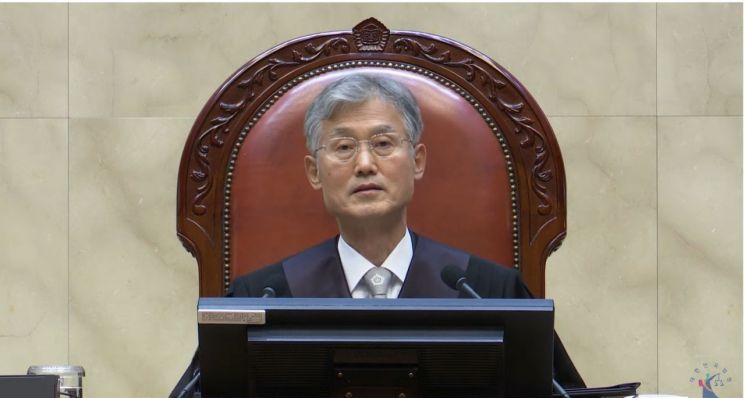
On the evening of the 3rd, when President Yoon Seok-yeol declared martial law, an emergency executive meeting of the judiciary was convened under the direction of Chief Justice Cho Hee-dae.
The emergency executive meeting reportedly gathered Cheon Dae-yeop, Director of the Court Administration Office, Bae Hyung-won, Deputy Director, executives at the director level, and related deliberators to discuss the situation concerning martial law.
At the meeting, they are expected to assess the current situation, review relevant regulations, and establish future response measures.
Article 77, Paragraph 1 of the Constitution states, "The President may declare martial law in accordance with the law when it is necessary to respond to military needs or maintain public peace and order with armed forces during wartime, armed conflict, or a national emergency equivalent thereto."
Additionally, Article 2, Paragraph 2 of the Martial Law Act stipulates, "Martial law is declared by the President during wartime, armed conflict, or a national emergency equivalent thereto when in a state of armed conflict with the enemy or when social order is extremely disturbed, making the performance of administrative and judicial functions significantly difficult, in order to meet military needs or maintain public peace and order."
Under martial law, all administrative affairs and judicial administrative tasks, except for judicial proceedings, fall under military jurisdiction. Regarding the military court's jurisdiction under martial law, Article 10, Paragraph 1 of the Martial Law Act specifies that military courts shall try persons who have committed any of 13 types of crimes, including crimes of rebellion, crimes of foreign invasion, crimes related to diplomatic relations, crimes endangering public security, crimes involving explosives, obstruction of official duties, arson, currency-related crimes, murder, robbery, crimes stipulated in the National Security Act, crimes regulated under the Act on the Safety Control of Firearms, Knives, and Explosives, and crimes prescribed by laws enacted for military necessity. However, the martial law commander may allow trials to be conducted by the competent court if necessary.
Paragraph 2 of the same article states, "If there is no court in the martial law area or if communication with the competent court is cut off, all criminal cases shall be tried by military courts notwithstanding Paragraph 1."
Accordingly, ongoing trials related to the specified crimes are expected to be transferred to military courts. However, ordinary trials outside of these cases will proceed according to the usual court procedures.
Chief Justice Cho is currently receiving reports on related matters at his official residence and is expected to come to the courthouse early on the morning of the 4th.
© The Asia Business Daily(www.asiae.co.kr). All rights reserved.
![Clutching a Stolen Dior Bag, Saying "I Hate Being Poor but Real"... The Grotesque Con of a "Human Knockoff" [Slate]](https://cwcontent.asiae.co.kr/asiaresize/183/2026021902243444107_1771435474.jpg)















