Year-End Calendar Production Boom Is a Thing of the Past
Gift Demand Declines Amid Consumer Slump
Q4 Earnings Rebound Difficult to Expect
The domestic paper industry is distressed by the missing year-end demand. Typically, the fourth quarter is a period when production volumes for calendars, diaries, and other items surge, but this has sharply declined. Additionally, overall consumption contraction has reduced gift demand, triggering alarm bells for the paper industry's performance.
According to the paper and printing industry on the 4th, the production volume of so-called 'seasonal items' such as calendars and diaries this year is reported to have decreased by more than 10% compared to the previous year. This is due to the increasing number of people substituting calendar and diary functions with their mobile phones, leading to an overall decline in demand.
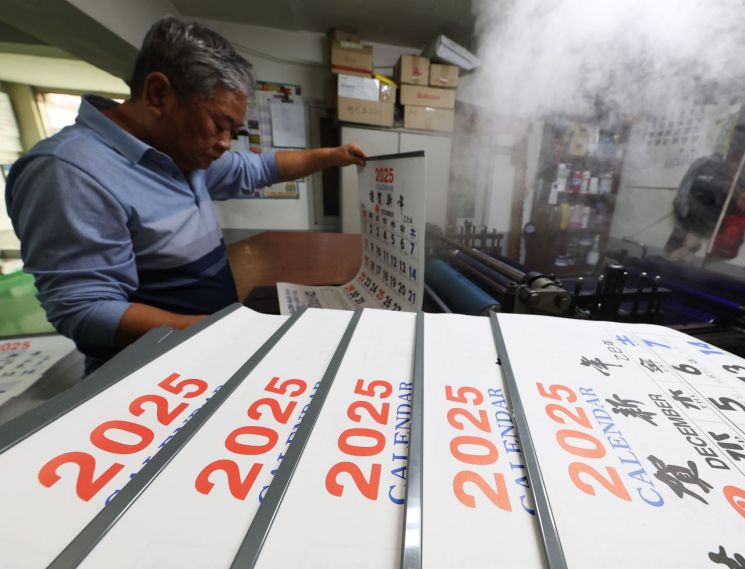 On the 4th, an official at a printing shop in Jangan-gu, Suwon-si, Gyeonggi-do is producing the 2025 Eulsa year calendar. Photo by Yonhap News.
Statistics from the Korea Paper Association show that the production volume of printing paper, which includes paper used for seasonal items, has been decreasing every fourth quarter. It dropped from 618,938 tons in 2021 to 589,219 tons in 2022, and further to 587,312 tons last year. Commercial banks, which have driven year-end demand, have also been reducing the number of calendars they produce annually. Last year, the five major commercial banks produced about 6.3 million calendars, approximately 20% less than in 2019.
The failure of consumption to recover is also a problem. A paper industry official said, "Even if year-end seasonal item demand decreases, when the domestic economy is good, gift demand increases, leading to a high volume of white cardboard used for packaging," adding, "However, in recent years, due to the recession, gift demand has also declined, making it impossible to expect any year-end demand boost."
To overcome this situation, the paper industry raised printing paper prices. Hansol Paper increased printing paper prices by 7% last September. Murim (Murim Paper, Murim P&P, Murim SP) and Korea Paper also raised printing paper prices by 7% from late August and September. All achieved the price increase effect by reducing the discount rate applied to the wholesale reference price (official price).
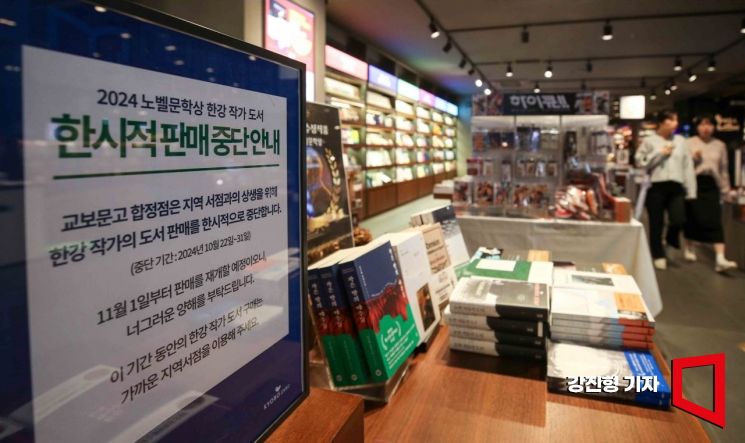 On the 22nd, a temporary suspension notice for books by Han Kang, the 2024 Nobel Literature Prize winner, was posted at Kyobo Bookstore Hapjeong Branch in Mapo-gu, Seoul. Kyobo Bookstore announced that it will suspend the sale of Han Kang's books at some stores until the end of this month to promote coexistence with local bookstores. Photo by Kang Jin-hyung
However, despite the price hikes, consumption has not recovered easily, making a fourth-quarter performance rebound unlikely. Although the selection of author Han Kang as the Nobel Literature Prize winner seemed to bring a favorable wind to the paper and printing-related industries, the industry evaluates this as only a brief effect.
Earlier, paper companies recorded poor results in the third quarter. Hansol Paper posted an operating loss of 17.9 billion KRW in the third quarter this year, turning to a deficit. Korea Paper's third-quarter operating profit fell by 80% year-on-year to 500 million KRW. Murim managed to hold its ground with a 28% year-on-year increase in third-quarter operating profit to 8.7 billion KRW.
A paper industry official said, "Maritime logistics costs have more than doubled compared to last year, making profitability improvement difficult," adding, "With the inauguration of the Donald Trump administration in the U.S., exports may shrink, raising concerns that poor performance could continue next year."
© The Asia Business Daily(www.asiae.co.kr). All rights reserved.
![Clutching a Stolen Dior Bag, Saying "I Hate Being Poor but Real"... The Grotesque Con of a "Human Knockoff" [Slate]](https://cwcontent.asiae.co.kr/asiaresize/183/2026021902243444107_1771435474.jpg)

















