'Effect of Reducing Average Travel Speed and Queue Length'
The Seoul Metropolitan Police Agency announced on the 4th that it has formed a task force (TF) for 'Improvement of Habitual Traffic Congestion Points' in collaboration with Seoul City, the Autonomous Police Committee, and the Korea Road Traffic Authority, and has promoted improvements to the signal system that enable rapid response at congestion points.
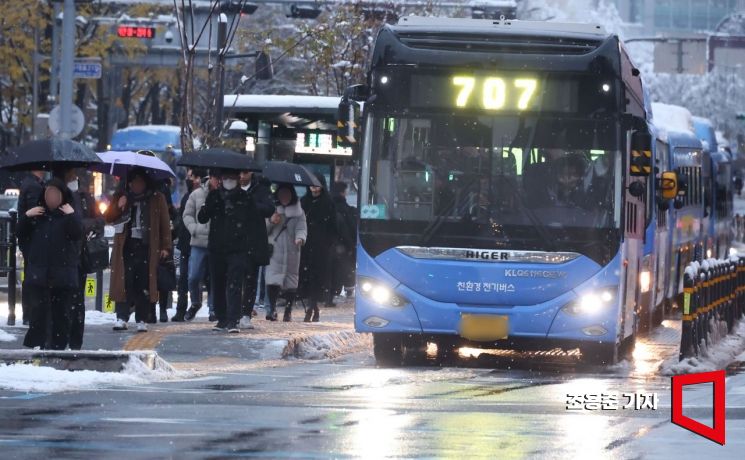 On the 28th, when heavy snow fell for two consecutive days in Seoul and the metropolitan area, citizens hurried to work using buses and other public transportation on Sejong-daero near Gwanghwamun in Seoul. Photo by Jo Yong-jun
The improvement targets were selected based on an analysis of traffic speed data (TOPIS) and congestion-related complaints received by each organization, identifying a total of 130 locations, including 35 points with low vehicle speeds and congestion, and 95 points with many complaints.
By adjusting the signal system, signal timing, and coordination values, as well as improving facilities at these points until October, the average travel speed increased by 7.9%, and the length of waiting queues decreased by 10.2%.
At the Sangam Intersection in Mapo-gu, Seoul, the average signal waiting length from the World Cup Tunnel toward Sangam Intersection sharply decreased by 48.7%, from 780 meters to 400 meters.
A Seoul Metropolitan Police official stated, "To alleviate traffic congestion that citizens can feel, we plan to continuously collaborate with Seoul City, the Autonomous Police Committee, and others to actively promote improvements to the traffic signal operation system that are low-cost and high-efficiency, as well as improvements to unreasonable traffic safety facilities."
© The Asia Business Daily(www.asiae.co.kr). All rights reserved.
![Clutching a Stolen Dior Bag, Saying "I Hate Being Poor but Real"... The Grotesque Con of a "Human Knockoff" [Slate]](https://cwcontent.asiae.co.kr/asiaresize/183/2026021902243444107_1771435474.jpg)















