Regulations Apply from the 31st
Samsung Electronics' HBM Exports to China Account for About 20%
SK Hynix Exports Most HBM to the US
Ministry of Industry: "Limited Impact on Korea"
The U.S. government has effectively blocked the export of high-bandwidth memory (HBM), a key component necessary for artificial intelligence (AI) development, to China by adding it to the list of controlled export items. SK Hynix and Samsung Electronics, which hold the first and second largest shares of the global HBM market, are within the scope of this regulation. However, the related industry and the Ministry of Trade, Industry and Energy, the main government agency in charge, assessed that "the impact will be limited."
The U.S. Department of Commerce's Bureau of Industry and Security (BIS) announced on the 2nd (local time) through the Federal Register that HBM products will be added to the list of export-controlled items. The restriction on HBM exports to China, which had been discussed since the draft stage, was included in the final regulation. Since HBM is considered an essential element in AI chipset manufacturing and the regulation aims to limit China's AI capabilities, the export restriction on HBM was deemed inevitable.
The Department of Commerce decided to control products with a "memory bandwidth density," the performance unit of HBM, exceeding 2 gigabytes (GB) per second per square millimeter. The Department stated that all currently produced HBM stacks exceed this standard. This regulation will take effect from the 31st.
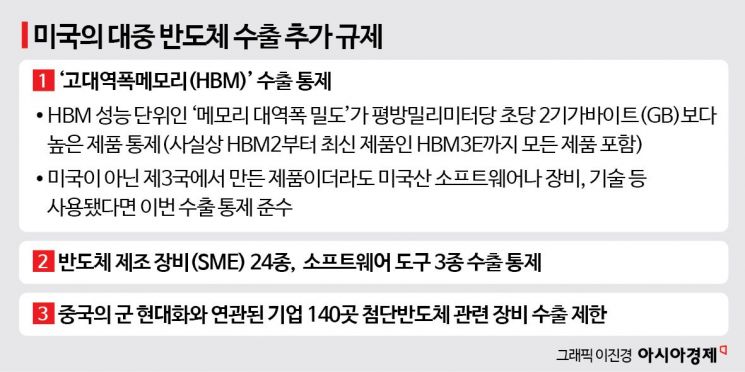
The U.S. government cited the Foreign Direct Product Rules (FDPR) as the basis for this HBM export control. This means that even if a product is made in a country other than the U.S., if it uses U.S.-origin software, equipment, or technology, it must comply with export controls. It is considered a weapon that only the U.S., which has leveraged superior technological capabilities to shape the international patent system to its advantage, can use. Notably, 33 countries, including Japan and the Netherlands, which have already implemented semiconductor equipment export controls at a level equivalent to the U.S. or have low relevance to semiconductor equipment, were designated as FDPR-exempt countries, but South Korea was not included.
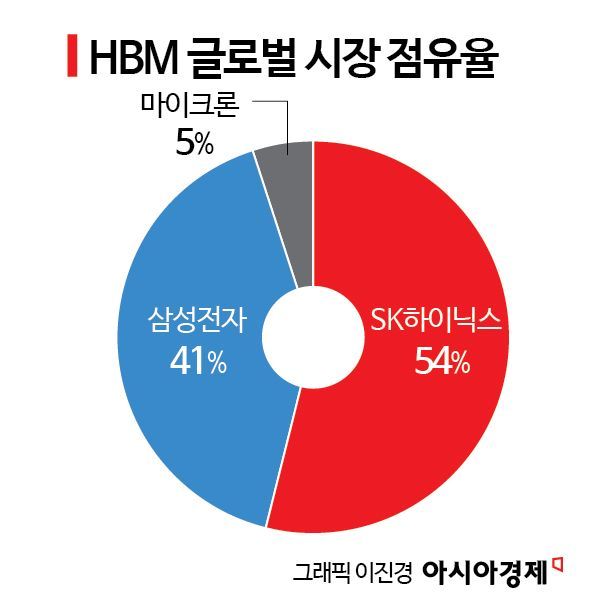
Accordingly, exports to China by Samsung Electronics and SK Hynix, which use U.S. company technology and equipment in semiconductor design and manufacturing, are also expected to be affected. Currently, the global HBM market is dominated by SK Hynix, Samsung Electronics, and U.S.-based Micron, forming the big three. Since the semiconductor industry heavily depends on U.S. source technology, SK Hynix and Samsung Electronics will be subject to this export control.
Within the industry, it is analyzed that the impact on Samsung Electronics will be greater than on SK Hynix. This is because Samsung supplies HBM used in Nvidia's AI accelerator H20 for export to China. Foreign media reported that Samsung's HBM exports to China account for about 20%. A company official stated regarding the impact, "We are carefully reviewing the situation and will cooperate closely with relevant agencies," expressing a general stance.
On the other hand, SK Hynix mainly produces the latest generations after HBM3, most of which are supplied to the U.S. It is known that since production volume cannot meet demand within the U.S., there is currently no significant impact expected.
Go Young-min, a researcher at Daol Investment & Securities, said, "Looking at the supply of domestic HBM to the Chinese region, Nvidia's sales proportion in China has already decreased to around 10% since the fourth quarter of last year, and Nvidia's China-targeted product H20 is equipped with HBM3," adding, "For SK Hynix, which is aiming to expand the proportion of HBM3E, the practical impact is expected to be limited."
The South Korean government also expects the impact on the domestic industry from this measure to be minimal. The Ministry of Trade, Industry and Energy released reference materials on the day, stating, "SK Hynix supplies most of its HBM to the U.S. company Nvidia, and Samsung Electronics exports some lower-spec HBM to China, but the proportion relative to sales is small," and added, "Overall, the impact on Korean companies is understood to be minor."
The ministry also explained that the U.S. export control on HBM to China applies only to direct exports of HBM to China and does not include HBM packaged together with logic chips, stating, "It is expected that the impact can be minimized by switching to export methods permitted under future U.S. regulations."
This measure is expected to be the last semiconductor sanction against China issued by the Biden administration. The industry points out that, although the semiconductor regulation stance toward China is expected to continue even after the inauguration of the Trump administration, domestic companies also need strategic responses.
In addition to 29 types of advanced semiconductor equipment, the U.S. administration newly added 24 types of semiconductor equipment, including heat treatment and measurement equipment, and three related software items to the list of export-controlled items.
An industry insider said, "While the Trump administration, an icon of uncertainty, is worrisome, the Biden administration also seems to be under pressure to show results, so the risks are high," adding, "It seems difficult for the U.S. and China to create an atmosphere of extreme reconciliation, which could affect demand sentiment for large-scale cloud services involving HBM, considering future potential demand, so we are watching closely with concern."
© The Asia Business Daily(www.asiae.co.kr). All rights reserved.
![Clutching a Stolen Dior Bag, Saying "I Hate Being Poor but Real"... The Grotesque Con of a "Human Knockoff" [Slate]](https://cwcontent.asiae.co.kr/asiaresize/183/2026021902243444107_1771435474.jpg)

















