Last Month's Consumer Price Inflation Rate at 1.5%
Core Inflation Rate Also Maintains 1% Range Trend
Last month, the consumer price inflation rate recorded 1.5%. This marks the third consecutive month with inflation in the 1% range. Core inflation and living costs also continued their slowing trend. The government forecasted that prices would remain stable for the time being unless any significant external factors arise.
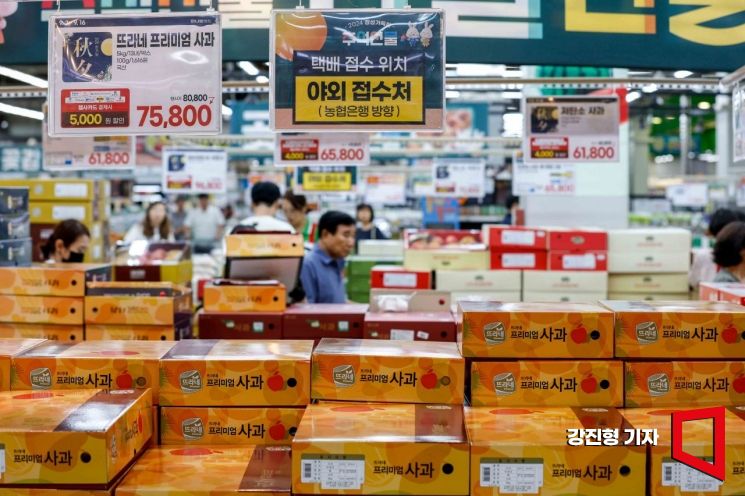
According to the 'November Consumer Price Trends' released by Statistics Korea on the 3rd, the consumer price index last month rose 1.5% compared to the same period last year. The consumer price inflation rate showed a slowing trend, recording the 2% range for five consecutive months after falling below 3% in April this year (2.9%). It then dropped to the 1% range in September (1.6%) and maintained a 1% range inflation rate for three consecutive months.
The biggest factor pulling down overall prices was the decline in petroleum product prices. Last month, petroleum prices fell 5.3% year-on-year, supported by stable international oil prices, which lowered the overall inflation rate by 0.22 percentage points. However, the decline was smaller compared to October (-10.9%) due to adjustments in the fuel tax reduction measures.
Core inflation, which shows the underlying trend of prices, also remained stable. Last month, the index excluding agricultural products and petroleum rose 1.8% compared to the same month last year. Since entering the 1% range in August for the first time in 36 months, it has remained in the 1% range for four consecutive months. The OECD method core inflation index, which excludes food and energy, recorded 1.9% following 1.8% in the previous month.
The living cost index, which consumers are sensitive to due to frequent purchases and high expenditure share, rose 1.6% compared to a year ago. The living cost index peaked at 4.6% in October last year, fluctuated in the 3% range this year, and then saw a significant slowdown in the rate of increase from September (1.5%). Among these, food prices rose 2.2% year-on-year with a slowing increase, while non-food items increased by only 1.2%. The living cost index including rent and deposits rose 1.4%.
The fresh food index rose 0.4% compared to the same month last year, marking the lowest increase in 32 months since March 2022. Fresh fruit prices fell sharply by 8.6%, while fresh vegetables and fresh fish increased by 10.4% and 0.4%, respectively. Prices of agricultural, livestock, and fishery products rose 1.0%, but vegetables surged 10.4%, pushing overall prices up by 0.15%. Among items, radish rose 62.5%, showing the largest increase following the previous month. Pumpkin (42.9%), gim (seaweed) (35%), tangerines (23.2%), and tomatoes (15.3%) showed significant increases, whereas green onions (-20.7%), potatoes (-11.8%), apples (-8.9%), onions (-7.9%), chicken (-6.4%), and rice (-6.1%) declined.
The government expects no rapid price increases for the time being. Kim Beom-seok, the 1st Vice Minister of the Ministry of Economy and Finance, held a price-related vice ministerial meeting at the Government Complex Seoul on the same day and said, “There are uncertainties such as abnormal weather and international oil prices,” but added, “If there are no special shocks, the inflation rate is expected to remain within 2%.” The Bank of Korea also presented a core inflation forecast of 1.9% for next year in a report released the day before.
The government announced plans to resolve the gap between consumer prices and the inflation rate actually felt by the public. Hwang Kyung-im, head of the Price Policy Division at the Ministry of Economy and Finance, explained, “We have experienced high inflation rates, with inflation rising up to 6%, which has accumulated,” and added, “(The public) will still feel that the perceived inflation level is high.”
© The Asia Business Daily(www.asiae.co.kr). All rights reserved.
![Clutching a Stolen Dior Bag, Saying "I Hate Being Poor but Real"... The Grotesque Con of a "Human Knockoff" [Slate]](https://cwcontent.asiae.co.kr/asiaresize/183/2026021902243444107_1771435474.jpg)















