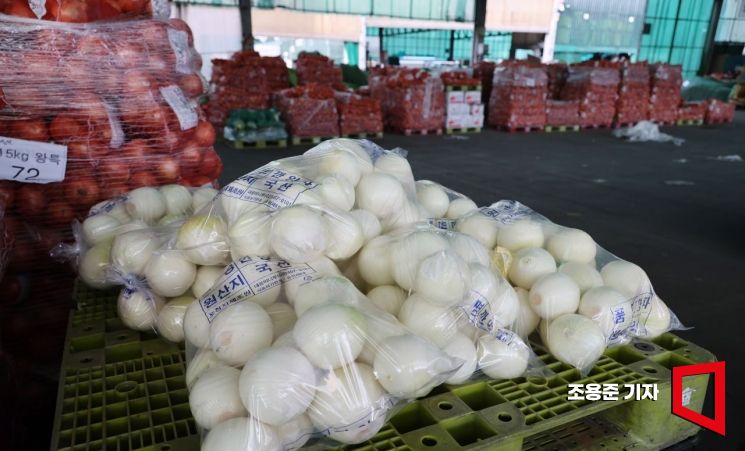
 Onions from the production area are piled up at the vegetable collection center in Garak Wholesale Market, Songpa-gu, Seoul. Photo by Jo Yongjun
The Bank of Korea stated that although the current consumer price inflation rate remains in the mid-1% range, it is expected to approach 2% for the time being due to base effects and exchange rate increases.
On the morning of the 3rd, the Bank of Korea held a price situation review meeting at its Seoul headquarters, chaired by Deputy Governor Kim Woong.
The consumer price inflation rate for November recorded 1.5%, higher than the previous month (1.3%), as the slowdown in petroleum product prices significantly narrowed. The core inflation rate also slightly increased, mainly due to durable goods such as passenger cars, acting as an upward factor. Accordingly, the living cost inflation rate also expanded from 1.2% in October to 1.6% in November.
Deputy Governor Kim said, "The November consumer price inflation rate rose to the mid-1% range due to base effects from last year's year-end oil price decline and the reduction in the fuel tax cut rate. Although the exchange rate has recently risen, considering the time lag in its impact, the effect of the exchange rate increase on prices is still limited and is expected to appear after December."
He added, "Going forward, the consumer price inflation rate is expected to approach 2% for the time being due to the influence of base effects and exchange rate increases, and the core inflation rate will continue a stable trend at the current level."
© The Asia Business Daily(www.asiae.co.kr). All rights reserved.
![Clutching a Stolen Dior Bag, Saying "I Hate Being Poor but Real"... The Grotesque Con of a "Human Knockoff" [Slate]](https://cwcontent.asiae.co.kr/asiaresize/183/2026021902243444107_1771435474.jpg)















