Kimjang Costs Are Lower Than Average This Year
In November, the consumer price index for agricultural and livestock products rose by 0.8% compared to the same month last year. The Ministry of Agriculture, Food and Rural Affairs (MAFRA) evaluated that the prices remain stable.
On the 3rd, MAFRA announced that the November consumer price survey results showed that the consumer price index for agricultural and livestock products fell by 5.8% compared to the previous month but increased by 0.8% compared to the same month last year. Additionally, processed foods and dining out rose by 0.2% and 0.3% month-on-month, and by 1.3% and 2.9% year-on-year, respectively.
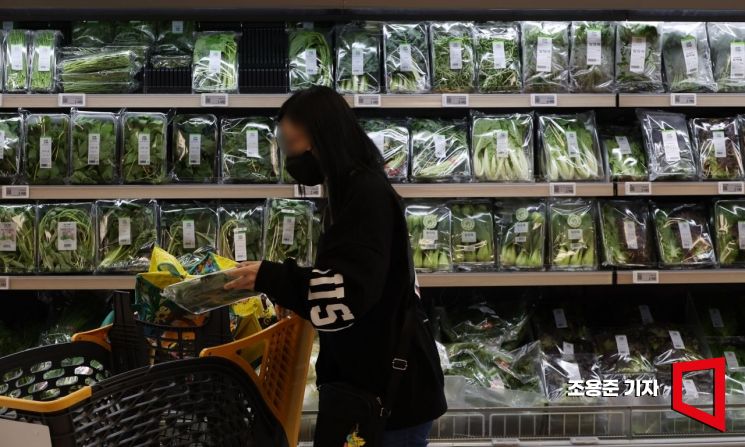 Customers visiting a large supermarket in Seoul are purchasing agricultural and marine products such as radishes, green onions, napa cabbage, and salted seafood to prepare for kimchi-making.
A MAFRA official explained, "Agricultural products had maintained high prices due to unprecedented heatwaves in summer, but since October, temperatures have dropped and farmers’ active efforts to restore crop growth have contributed to price declines, especially for leafy vegetables such as cabbage and lettuce, resulting in an 8.4% decrease compared to the previous month." The official added, "In particular, prices of three key kimchi ingredients?cabbage, red pepper powder, and garlic?which account for about 65% of kimchi costs, are lower than average, keeping overall kimchi-making expenses below the usual level."
The Ministry expects that the price of radishes, which are currently somewhat high, will gradually stabilize after January when winter radishes are fully harvested and supply conditions improve.
Regarding tangerines, whose prices have recently risen somewhat, the increase was due to reduced production and delayed shipments caused by frequent rainfall during the harvest season. However, with the revision of the Jeju Island Tangerine Ordinance to expand shipments and increased production of alternative fruits such as apples, persimmons, and grapes, prices are expected to stabilize at levels similar to or below last year’s from December onward.
Livestock products saw smooth supply across all categories, resulting in a 1.8% decrease compared to the previous month and only a 1.7% increase compared to the same month last year. However, considering that it is the season when highly pathogenic avian influenza (AI) and African swine fever (ASF) outbreaks become frequent, the Ministry plans to strengthen quarantine management and minimize supply impacts through early detection and measures at affected farms.
Prices of processed foods rose for some products due to increased prices of cocoa, coffee, and palm oil, which saw production declines caused by abnormal weather and reduced cultivation areas. MAFRA plans to minimize consumer burden by promoting price reductions and discount events for products mainly made from wheat, corn, and soybeans, whose international prices have fallen, through continuous communication with the industry.
Park Soon-yeon, Director of Distribution and Consumption Policy at MAFRA, said, "Despite difficult weather conditions this year, such as heatwaves and reduced sunlight, farmers’ active efforts helped overcome these challenges." She added, "To respond to increasingly frequent abnormal weather, we will establish and implement a climate change response plan for stable supply and demand of horticultural agricultural products within this year without delay."
© The Asia Business Daily(www.asiae.co.kr). All rights reserved.
![Clutching a Stolen Dior Bag, Saying "I Hate Being Poor but Real"... The Grotesque Con of a "Human Knockoff" [Slate]](https://cwcontent.asiae.co.kr/asiaresize/183/2026021902243444107_1771435474.jpg)















