Five Companies Evaluated Through Place Naming Design Competition, 'Geonwon Architecture' Selected as Winner
Accelerating Station Area Development Project with Construction Starting in 2025 and Completion Targeted for 2028
Work, Living, Leisure, and Public Services All Enjoyed in One Place... Future Opening of Gyeongchun Line Forest Trail Extension Also Anticipated
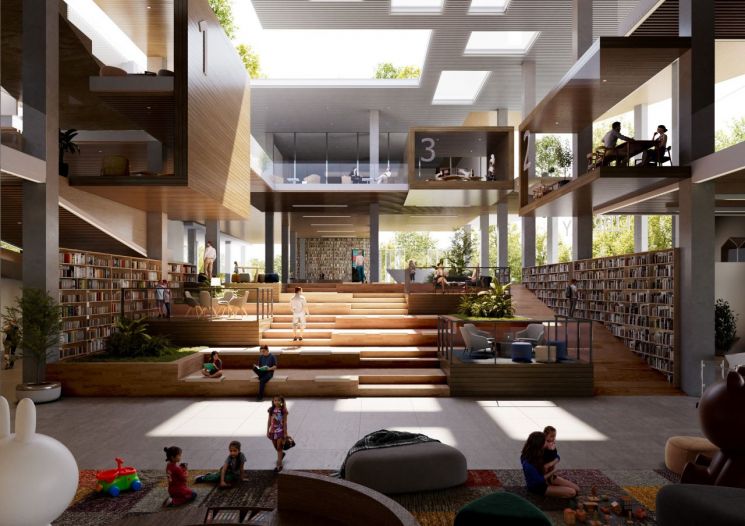
Nowon-gu, Seoul (District Mayor Oh Seung-rok) announced the winning design for the public land in the Gwangwoon University Station area development project, raising expectations for the project's swift progress.
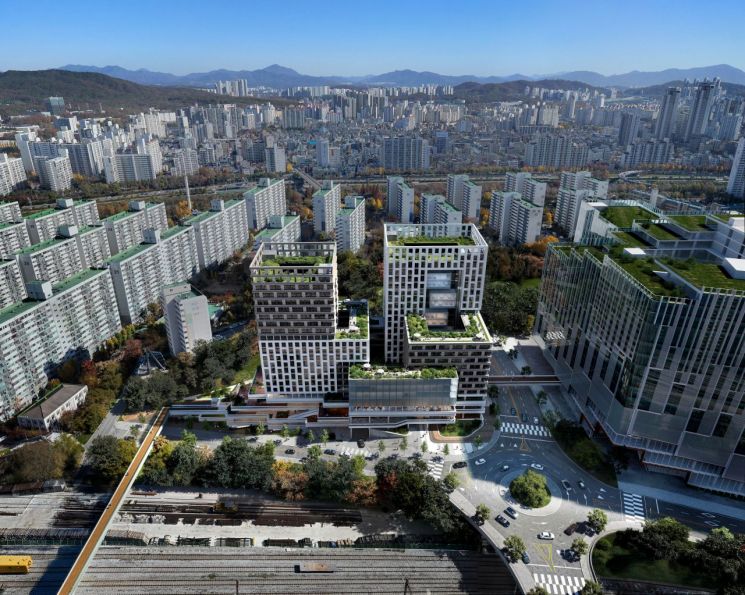
Following the groundbreaking ceremony for the Gwangwoon University Station area development project held last October, the residential land (Seoul One I-Park), which began construction first, will be followed by the public land, scheduled to start construction after obtaining building permits in the second half of next year. Completion is expected in 2028, progressing rapidly in tandem with the residential land occupancy.
The public land will be developed on a site of approximately 10,000㎡ with a floor area ratio of 400%, featuring buildings ranging from three basement levels to up to 20 floors above ground, becoming another landmark and a living base for residents of Wolgye-dong.
Key facilities include ▲ Seoul-style dormitory ▲ sports center ▲ library ▲ youth career center ▲ Wolgye 3-dong community center, fulfilling the residents' long-standing desire to expand cultural complex hubs that were previously lacking in the area.
The design selection was conducted through a commissioned design competition jointly organized by the district office, Seoul Metropolitan Government, and Hyundai Development Company. The aim was to select an innovative design that properly embodies the overall philosophy of the Gwangwoon University Station area development project. After evaluation on November 27, the winning design was finalized on the 29th, awarded to ‘Comprehensive Architecture Office Geonwon’.
The judges praised the winning design, stating it “presented the most practical ideas for activating public pedestrian pathways,” and highlighted that “the successful integration of programs in the podium section and the appropriate adjustment of level differences were relatively superior,” explaining the reasons for its selection.
Beyond the construction of cultural complex facilities on the public land, a particularly notable aspect is the opening of the extended section of the Gyeongchun Line Forest Trail. The Gyeongchun Line Forest Trail is a project that transformed the abandoned Gyeongchun Line railway into a park. After the trail's creation, the Gyeongchun Line Gongneung Forest Trail, nicknamed ‘Gongnidan-gil,’ has become a hot spot for young people in the northeastern area, while Hwarangdae Railroad Park has become a beloved local attraction across generations.
The district has worked to include the last disconnected section of the Gyeongchun Line Forest Trail (from Nokcheon Middle School in Wolgye-dong to Gwangwoon University Station) as a public contribution within the Gwangwoon University Station area development project. As a result, residents will be able to enjoy a complete forest trail stretching from Gwangwoon University Station through the Gyeongchun Railway Bridge and Hwarangdae Railroad Park to the boundary of Guri City. At the same time, the development site of the Gwangwoon University Station area is expected to enhance connectivity with neighboring areas, contributing to the transformation of the entire city.
A district official stated, “We have consistently strived since the pre-negotiation phase in 2019 to ensure that the public land is utilized with functions perfectly suited to the area and that development profits are shared with residents.” In fact, in 2020, a feasibility study was conducted to establish plans for utilizing cultural complex facilities aimed at creating healing and cultural hubs within the public land, with ongoing consultations with the Seoul Metropolitan Government.
Based on the winning design, the district plans to incorporate an expanded plaza and cultural facilities, aiming for project completion in 2028.
District Mayor Oh Seung-rok said, “We will devote great effort to developing the public land to complete a compact city where all life necessities are met within an N-minute living zone,” adding, “With the successful completion of the Gwangwoon University Station area development project, we will present a model first case of a self-sufficient living zone.”
© The Asia Business Daily(www.asiae.co.kr). All rights reserved.
![Clutching a Stolen Dior Bag, Saying "I Hate Being Poor but Real"... The Grotesque Con of a "Human Knockoff" [Slate]](https://cwcontent.asiae.co.kr/asiaresize/183/2026021902243444107_1771435474.jpg)
















