Limited to Listed Companies Subject to Legal Amendments
Only Four Types of Capital Transactions Applied
Director Exemption Possible
Business Community Relieved by Revised Self-Regulation Law
Investors Criticize as "Reversed Legal Amendment"
The reason the government significantly retreated from amending the Commercial Act to expand the 'duty of loyalty of directors' to include 'shareholders' and instead opted to amend the Capital Markets Act (CMA) is due to concerns that such changes would impose restrictions on corporate activities, leading to a 'contraction of management.' In the severe economic situation, the government could not overcome the backlash from the business community, which warned that amending the Commercial Act could increase lawsuits (frivolous litigation) and restrict management activities.
Limited to Listed Companies... Directors May Be Exempted from Liability
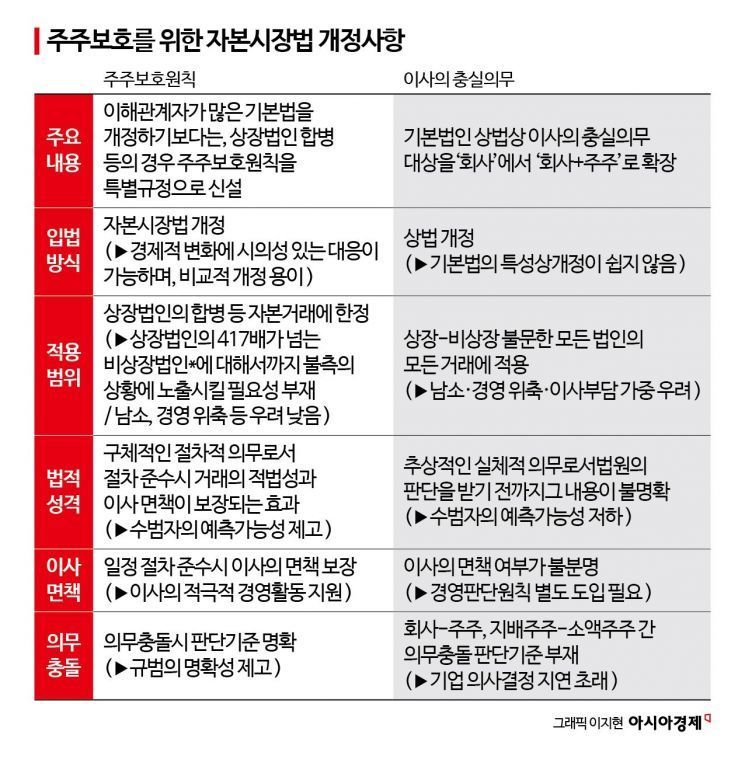
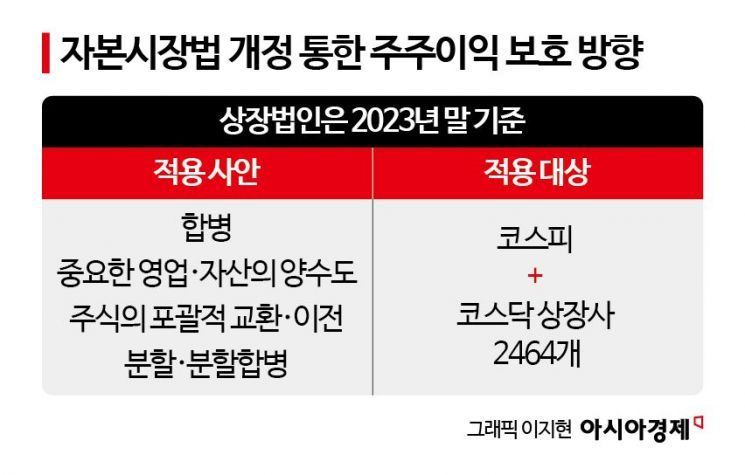
The direction of the CMA amendment is to codify shareholder protection principles for four types of transactions where conflicts between listed companies and corporations have frequently occurred in the market: ▲mergers ▲transfer of business or assets ▲comprehensive stock exchanges or comprehensive transfers ▲corporate splits (including split mergers).
Kim Byung-hwan, Chairman of the Financial Services Commission, stated, "By establishing procedural regulations that require the board of directors to strive to protect the legitimate interests of shareholders, we expect that compliance with procedures will guarantee the legality of transactions and exempt the board from liability." He emphasized, "This is expected to increase predictability compared to the substantive duty regulation method in the Commercial Act, which lists both the company and shareholders as subjects of the board's duty of loyalty."
Specifically, when a listed company conducts a merger, etc., the law will be amended to exclude the application of the current standard price and instead require that the value be fairly determined by comprehensively considering stock prices, asset values, income values, and so forth. The Financial Services Commission recently deleted the standard price clause for mergers between non-affiliated companies through an enforcement decree amendment. Through this legal amendment, they intend to completely abolish the valuation criteria for mergers between affiliated companies as well.
Additionally, when a subsidiary is listed after a physical split, a basis will be established to allow the parent company's general shareholders, excluding major shareholders, to be preferentially allocated up to 20% of the public offering new shares. The government also plans to remove the five-year review period during which the stock exchange assesses efforts to protect general shareholders in cases of subsidiary listings after physical splits.
Regarding the government's CMA amendment, the prevailing evaluation is that the meaning of 'shareholder protection' has been significantly diminished. President Yoon visited the Korea Exchange in Seoul on January 2 this year and expressed his intention to amend the Commercial Act, saying, "We will promote legal amendments so that the board of directors responsibly reflects the interests of minority shareholders."
Lee Bok-hyun, Governor of the Financial Supervisory Service, also repeatedly stated in public that the Commercial Act amendment should be pursued throughout the first half of this year. However, due to strong opposition from the business community, the government ultimately shifted to amending the CMA instead of the Commercial Act after 10 months.
Professor Lee Sang-hoon of Kyungpook National University School of Law pointed out, "The approach of amending the Capital Markets Act, which is rule-based, inevitably has limitations. The moment you regulate corporate behavior by text, companies can circumvent it with similar transactions by seeking help from law firms."
He added, "If shareholder protection principles are not established even within the Capital Markets Act, it is like having no compass when interpreting regulations, which can cause interpretative problems in numerous corporate activities."
Investors Oppose... Business Community Welcomes
The reactions of investors and the business community sharply diverged. Institutional investors and minority shareholders expressed deep regret over the government's shift to amending the Capital Markets Act. Lee Nam-woo, Chairman of the Korea Corporate Governance Forum, said, "It is like saying that only highways must obey traffic laws while general city roads or other areas outside highways do not have to follow traffic rules," adding, "Foreign investors may become more pessimistic about the Korean market."
Jung Eui-jung, President of the Korea Federation of Stock Investors, said, "For decades, companies have received special privileges while minority shareholders have suffered," and added, "After the Commercial Act is amended, it seems necessary to add caveats for security reasons."
The business community, which waged an all-out battle against the Commercial Act amendment, expressed relief. The Korea Economic Association and 16 major domestic groups including Samsung, SK, Hyundai Motor, and LG issued an emergency statement last month for the first time in nine years, requesting the opposition party to halt legislative discussions on the Commercial Act amendment.
Seven economic organizations, excluding the Korea Economic Association, also met with the Democratic Party's Stock Market Revitalization Task Force to express their concerns. The main worries are that companies could be exposed to attacks from foreign hedge funds or that lawsuits could be rampant using the amended Commercial Act as a weapon.
Lee Jae-hyuk, Executive Director of the Korea Listed Companies Association, said, "Although there are some concerns, it is fortunate that the direction was found through amending the Capital Markets Act rather than the general Commercial Act," and added, "I hope a reasonable alternative can be found."
Professor Kwon Jae-yeol of Kyung Hee University School of Law said, "If the Commercial Act, which specifies the duty of loyalty of directors, is tampered with, it will lead to disregard for corporations and could have adverse effects on the legal system for 10 or 20 years," adding, "The Democratic Party's plan is like draining the Han River because polluted water entered it, so a targeted approach through amending the Capital Markets Act is appropriate."
However, regarding the detailed regulations of the CMA amendment prepared as an alternative, some in the business community expressed the need for careful review. A business community official expressed concerns, saying, "The part that requires preferential allocation of up to 20% of public offering new shares to the parent company's general shareholders after a physical split may infringe on property rights," and added, "Also, inducing listed companies to fulfill protection efforts for parent company shareholders without any time limit when a subsidiary is listed after a physical split is tantamount to telling them not to list in Korea at all but to list overseas."
© The Asia Business Daily(www.asiae.co.kr). All rights reserved.


















