Hankyung Association Commissions Research Project to Professor Kim Hyun-seok of Pusan National University
An analysis has revealed that extending the retirement age from the current 60 to 65 would result in an annual cost of approximately 30.2 trillion won for employing workers aged 60 to 64.
The Korea Economic Association announced these findings on the 2nd through a research report titled "Cost Estimation and Implications of Retirement Age Extension," commissioned to Professor Kim Hyun-seok of Pusan National University.
The report estimated the additional number of regular workers aged 60 to 64 resulting from extending the retirement age to 65 by utilizing data from the Statistics Korea's Economically Active Population Survey supplementary survey by employment type. This calculation was made by subtracting the number of workers already employed as regular employees even without the retirement age extension.
The estimation showed that in the first year of the retirement age extension, approximately 58,000 additional regular workers aged 60 would be employed. By the fifth year of implementation, all regular workers aged 60 to 64 would be included in the retirement age extension, with about 590,000 additional workers expected.
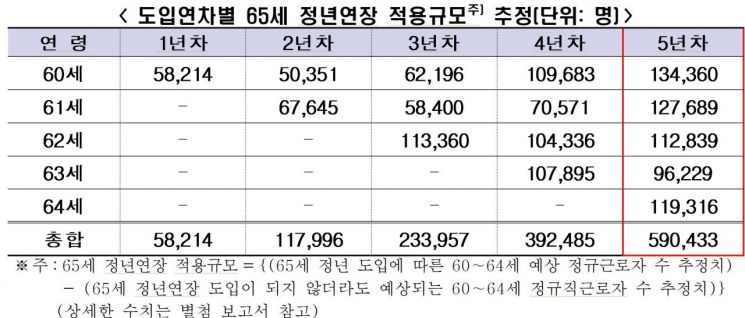 Estimated Scale of Applying the Retirement Age Extension to 65 by Introduction Year. Provided by Hankyung Association
The costs associated with additional employment are also expected to increase significantly. In the first year of the retirement age extension, the cost of extending employment for 60-year-old regular workers is estimated at about 3.1 trillion won, and by the fifth year, the cost of maintaining employment for all age groups from 60 to 64 is projected to reach approximately 30.2 trillion won.
The Korea Economic Association stated, "The employment cost of 30.2 trillion won for workers aged 60 to 64 due to the retirement age extension is equivalent to employing about 902,000 young workers aged 25 to 29, based on the average monthly wage of 2,791,000 won last year." They added, "The impact of the retirement age extension on investment and new hiring contractions should also be carefully considered."
The report emphasized corporate autonomy and noted that the necessity of employing older workers may vary by industry and company. According to the Ministry of Employment and Labor's "2023 Employment Status of Older Workers," the gap in the proportion of workers aged 55 and older between industries reaches up to 62.5 percentage points. Accordingly, the report suggested that retirement age extension policies should be decided autonomously according to each company's circumstances rather than being uniformly implemented.
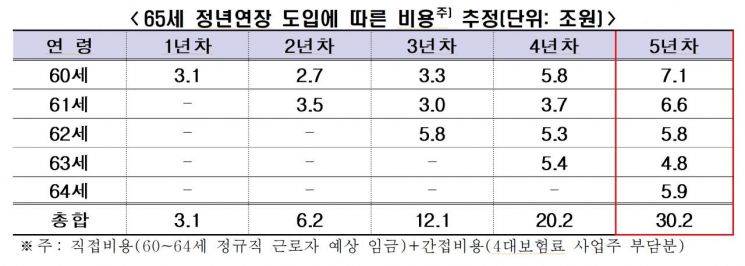 Cost Estimation for Introducing Retirement Age Extension to 65. Provided by Hankyung Business Association
Professor Kim stated, "While the need to expand employment for older workers is recognized amid social changes such as low birth rates and aging, a uniform extension of the retirement age could impose a significant burden on companies," and added, "It should be carefully reviewed."
Lee Sang-ho, Director of the Economic and Industrial Headquarters at the Korea Economic Association, said, "The current labor market is rigid, and the seniority-based wage system does not reflect productivity, making it difficult for companies to utilize older workers." He continued, "Before introducing the retirement age extension, it is necessary to increase labor market flexibility and reform the wage system to reflect job value and productivity, creating an environment where companies can actively utilize older workers."
© The Asia Business Daily(www.asiae.co.kr). All rights reserved.
![Clutching a Stolen Dior Bag, Saying "I Hate Being Poor but Real"... The Grotesque Con of a "Human Knockoff" [Slate]](https://cwcontent.asiae.co.kr/asiaresize/183/2026021902243444107_1771435474.jpg)

















