Introduction to Social and Science Subjects from 2027
Excluding Special Education Life English and Information Communication
"Comprehensive Consideration of Expert Opinions in Educational Field"
The Ministry of Education has partially adjusted the AI digital textbook roadmap. The Korean language and technology/home economics (practical arts) subjects, which were scheduled for introduction in 2026, have been excluded from application, and the introduction in social studies and science subjects for elementary and secondary levels has been postponed by one year. Regarding the passage of a bill in the National Assembly's Education Committee that defines AI digital textbooks as 'educational materials,' the ministry expressed confidence that it will persuade the National Assembly before the final passage.
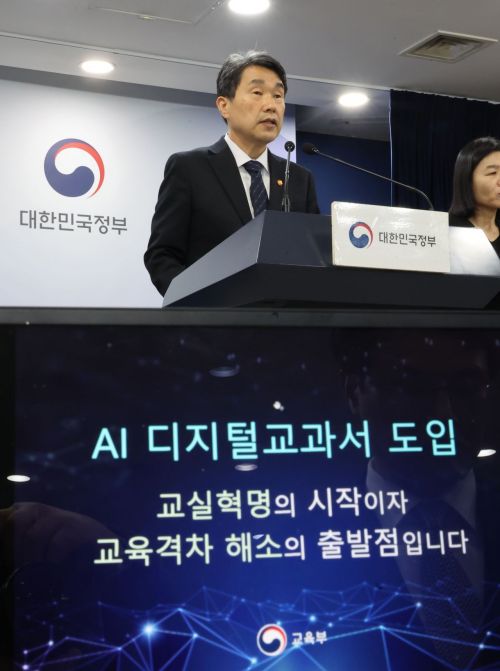
On the afternoon of the 29th, Lee Ju-ho, Deputy Prime Minister for Social Affairs and Minister of Education, held a briefing at the Government Seoul Office and announced the 'AI Digital Textbook Certification Review Results and Introduction Roadmap Adjustment Plan' containing these details. The Deputy Prime Minister said, "Since the introduction of AI digital textbooks is an uncharted path for us, there may be concerns and worries," but added, "I believe that when digital technology is used wisely, it can realize teachers' instructional innovation and personalized education for students."
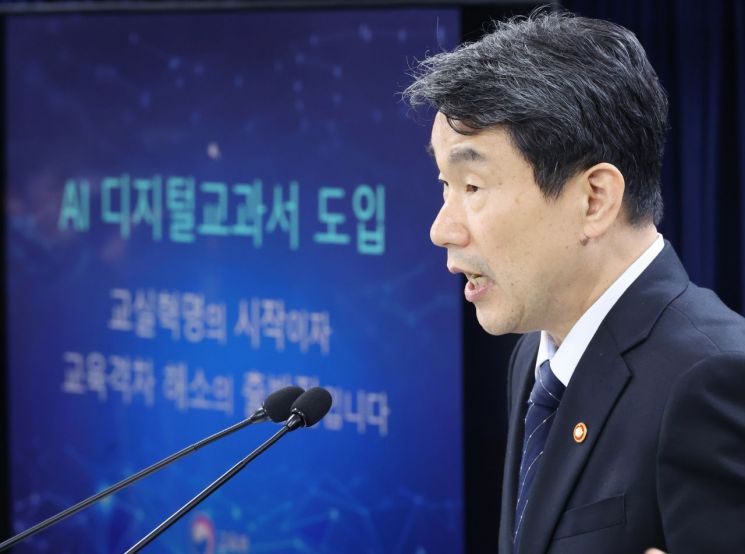
On the same day at midnight, the Ministry of Education published the final results of the AI digital textbook certification review in the official gazette. A total of 76 AI digital textbooks produced by 12 applicants passed. Oh Seung-geol, President of the Korea Institute for Curriculum and Evaluation, said at the briefing, "The certification review was conducted mainly based on common standards, content review standards, and technical review standards," and added, "The certification and introduction of AI digital textbooks have laid the foundation for continuous development toward making AI digital textbooks more user-friendly and advanced for students and teachers."
The AI digital textbooks that passed the certification review are scheduled to be distributed to schools starting next month. Schools will decide which textbooks to adopt and use them in the field from the first semester of next year.
Adjusting the 'Pace' of Introduction... Korean Language Excluded, Social Studies and Science Postponed
The AI digital textbook introduction roadmap has been adjusted, with some subjects excluded from the application target. The focus will be on demonstrating classroom changes by applying AI digital textbooks in English, mathematics, and information subjects in 2025. The Ministry of Education explained that this decision was made after comprehensively considering opinions from the educational field, experts, and the policy conditions of metropolitan and provincial offices of education.
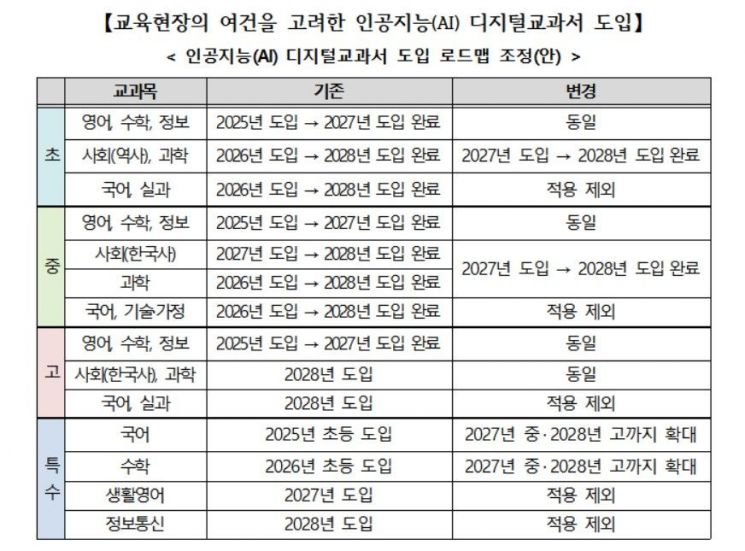
Although AI digital textbooks were scheduled to be introduced in Korean language and technology/home economics (practical arts) subjects in elementary, middle, and high schools in 2026, it was ultimately decided not to introduce them. Earlier, the National Council of Superintendents of Metropolitan and Provincial Offices of Education proposed in October that while AI digital textbooks should be introduced as planned in 2025, adjustments are necessary for subjects applied after 2026, reflecting voices from the school field. The Deputy Prime Minister also mentioned at the National Assembly audit on October 24, "For AI digital textbook subjects introduced after 2026, we will prepare adjustment plans through expert review and consultation with metropolitan and provincial offices of education."
Similarly, the introduction of AI digital textbooks in social studies and science subjects, originally planned for elementary and middle schools in 2026, has been postponed to 2027, with completion of introduction by 2028. For high schools, the original plan to introduce them in 2028 remains unchanged. In special education, the life English and information communication subjects, scheduled for introduction in 2027 and 2028 respectively, have been excluded from the application target.
The Deputy Prime Minister explained, "English, mathematics, and coding are subjects where the effectiveness of AI digital textbooks has been most proven globally, whereas social studies and science require more inspection and consideration in various aspects," adding, "English and mathematics are subjects where students struggle the most and gaps occur, as evidenced by terms like 'Mathphobia' and 'Englishphobia,' and private education accounts for a very high proportion. Therefore, there were many opinions to focus on English and mathematics first."
The Ministry of Education also stated that it is steadily supporting the creation of an environment for utilizing AI digital textbooks, including infrastructure and teacher capacity building. In the first half of this year, 10,000 leading teachers for classroom revolution were trained, and in cooperation with metropolitan and provincial offices of education, teacher training for 150,000 teachers is underway in the second half of the year.
Starting next month, training will be provided to support schools in selecting which certified textbooks are educationally suitable. After schools select textbooks, practical training on student-centered lesson design using the selected textbooks will be conducted to support focused research and design on how teachers can effectively utilize AI digital textbooks.
AI Digital Textbooks Expected to Play a Role in 'Closing Gaps'... Classroom Revolution
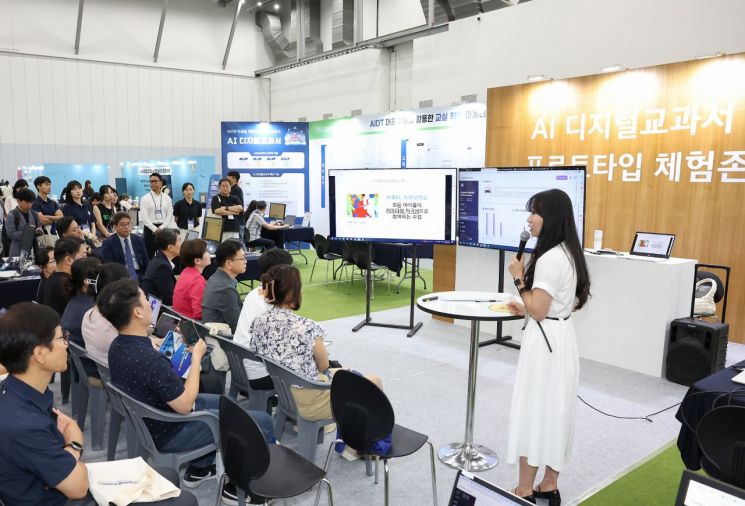
The Ministry of Education expects AI digital textbooks to play the greatest role in closing learning gaps among students. The Deputy Prime Minister said, "There are various benefits and goals, but we are focusing first on closing educational gaps," and added, "We are preparing to announce policies for closing educational gaps using AI digital textbooks soon."
He also emphasized that AI digital textbooks can stimulate students' learning interest and provide content tailored to their levels. An interim analysis of the effectiveness of AI courseware classes was conducted on 1,049 students from schools designated as digital leading and research schools from September last year to this year. The average score in the 'use of learning strategies' area increased from 3.55 to 3.86, and the average in the 'self-regulation' area improved from 3.59 to 3.71.
Additionally, the Deputy Prime Minister said, "I believe AI digital textbooks will open new opportunities in soft areas such as reducing private education, fostering students' creativity and character, the so-called 'high-touch' aspects," and added, "the time will soon come when we can present educational improvement goals through AI digital textbooks based on data from various perspectives."
AI Digital Textbooks Reduced to 'Educational Materials'?..."Will Persuade the National Assembly"
Recently, concerns have arisen that the expansion of AI digital textbooks may face setbacks after a bill amending the Elementary and Secondary Education Act to define AI digital textbooks as 'educational materials' passed the National Assembly's Education Committee. Unlike 'textbooks,' which are mandated for use in all schools, educational materials can be autonomously selected by school principals. The opposition party, which passed the bill alone, argues that social discussion on AI digital textbooks is insufficient and that cautious introduction is necessary.
The Ministry of Education points out that if AI digital textbooks become educational materials, costs may be passed on to schools, potentially causing educational disparities. The Deputy Prime Minister said, "If the amendment to the Elementary and Secondary Education Act is finally passed by the National Assembly, AI digital textbooks will lose their status as textbooks, depriving students of equal educational opportunities, preventing classroom revolution, and likely expanding educational gaps," adding, "The amendment contradicts the intent to expand the range of curricular books to allow various learning materials in school education, may impose financial burdens on students and parents, and since it does not go through certification procedures, it cannot guarantee quality control in content or technology."
He continued, "Applying the bill retroactively to AI digital textbooks that passed certification today will cause great confusion in schools that have been preparing for their introduction," and said, "I think this law passed because the National Assembly did not fully review this part. If we continue to persuade and explain, this law will not be passed."
Subscription Fee Issue, Price Negotiations Underway... "Will Be Under 1 Trillion Won"
Regarding the fact that the subscription fee for AI digital textbooks has not yet been determined, it was explained that "price negotiations are underway." Like traditional printed textbooks, price negotiations must be conducted between AI digital textbook publishers and the government, but since negotiations are upcoming, nothing can be said definitively. Currently, metropolitan and provincial offices of education and the Ministry of Education have formed a negotiation team and are conducting price negotiations, with the Ministry predicting that the price will be set by the end of next month.
However, it is expected to be lower than the scale estimated by the education sector and others. Previously, the National Assembly Legislative Research Office's report titled 'Prospects and Tasks for Local Education Finance Burden Due to AI Digital Textbook Introduction' forecasted that the subscription fee scale for AI digital textbooks over the next four years would be up to 6.6156 trillion won. The Deputy Prime Minister said, "The cost we currently anticipate, including various additional expenses, is much lower than the market prediction of 'several trillion won,'" adding, "There is a very high possibility it will be under 1 trillion won."
Regarding complaints about price burdens from frontline education offices that must bear the subscription fee, the Deputy Prime Minister said, "Considering the conditions of local education finances, if necessary, we will set a direction to partially cover costs through special grants. We need to discuss how much the central government will share," and added, "One thing is clear: there will be absolutely no burden on parents."
© The Asia Business Daily(www.asiae.co.kr). All rights reserved.
![Clutching a Stolen Dior Bag, Saying "I Hate Being Poor but Real"... The Grotesque Con of a "Human Knockoff" [Slate]](https://cwcontent.asiae.co.kr/asiaresize/183/2026021902243444107_1771435474.jpg)

















